
How Much Does Whole-Home Generator Installation Cost in Rock Hill, SC?
Table of Contents
When the power goes out, everything suddenly becomes more complicated. The Wi-Fi disappears, the refrigerator stops humming, the air conditioner shuts down, and everyone starts looking for flashlights that somehow never seem to be where they belong.
For homeowners in Rock Hill, SC, a whole-home generator can turn that stressful situation into something much less dramatic. Instead of dragging out extension cords or wondering how long the food in the freezer will last, a standby generator can automatically restore power to important systems in your home.
Naturally, one of the first questions homeowners ask is: How much does a whole-home generator actually cost to install?
The short answer is that there isn’t one universal price. Your final generator installation cost Rock Hill SC homeowners can expect depends on the generator’s capacity, electrical requirements, fuel source, transfer switch, placement, trenching, permits, and several other details.
As a general planning range, many professionally installed standby generator systems fall somewhere between roughly $8,000 and $16,000, including equipment and installation. Generac currently cites that range for complete home standby generator installations, while noting that location and installation complexity can significantly affect the final number.
Let’s break down where that money actually goes and what Rock Hill homeowners should consider before choosing a generator.
How Much Does A Whole-home Generator Cost To Install In Rock Hill, SC?
For a typical Rock Hill homeowner, it is reasonable to begin budgeting somewhere around $8,000 to $16,000 or more for a professionally installed whole-home standby generator.
That does not mean every project will land neatly inside that range.
A smaller generator protecting essential circuits may cost less. A large generator designed to power nearly everything in a bigger home may cost substantially more, especially if the property needs extensive gas piping, trenching, electrical upgrades, or site preparation.
Generac reports that complete home standby generator systems commonly fall between $8,000 and $16,000, including the generator, system equipment, materials, and installation.
The actual project normally includes more than simply buying a generator and placing it beside the house.
Your total price may include:
- The standby generator itself
- Automatic transfer switch
- Electrical wiring and connections
- Generator pad or prepared mounting area
- Natural gas or propane connections
- Trenching when required
- Electrical panel modifications
- Load-management equipment
- Permits and inspections
- Startup and system testing
This is why comparing generator prices online can sometimes be misleading.
You might see a generator listed for several thousand dollars and assume that is approximately what the entire project will cost. Unfortunately, the generator is only one piece of the puzzle.
Think of it like buying a swimming pool. The pool itself may have a price tag, but digging, plumbing, electrical work, permits, equipment, and installation determine what you’ll actually spend.
How Much Is A Generator For A 2,000 Sq. Ft. House Installed?
A 2,000-square-foot home does not automatically require one specific generator size.
Square footage is helpful, but your home’s actual electrical demand matters much more.
Two houses that are both exactly 2,000 square feet might have completely different backup-power requirements.
One may have:
- A gas furnace
- Gas water heater
- Gas stove
- One modest air conditioner
Another might have:
- Two HVAC systems
- Electric water heating
- Electric cooking
- Well equipment
- Multiple refrigerators
- A large freezer
- Home office equipment
- An EV charger
Those homes could require very different generator capacities.
Home Depot notes that 20-24 kW systems are among its most popular choices and can provide significant capacity for homes in the roughly 3,000-square-foot-or-larger category, but generator sizing still needs to account for the appliances and loads homeowners want to operate during an outage.
For many 2,000-square-foot homes, homeowners may explore systems somewhere around the mid-teen to low-20-kW range, but a professional load calculation should determine the actual size.
Installed costs can easily fall within the $8,000-$16,000 range, depending on the generator selected and the complexity of the installation. More complicated projects can move higher.
One mistake we encourage homeowners to avoid is saying, “My neighbor has a 20 kW generator, so I’ll just get the same one.”
Your neighbor may have completely different electrical loads.
A generator should be sized for your house, not the house next door.
How Much Does Labor Cost To Install A Whole-house Generator?
Labor is a significant part of the overall generator installation cost because whole-home generator projects involve several specialized tasks.
This isn’t simply an electrician arriving with a wrench, connecting two wires, and calling it a day.
Generator installation may involve:
- Evaluating your electrical service
- Installing an automatic transfer switch
- Running electrical conductors
- Preparing the installation location
- Connecting the fuel supply
- Performing gas or propane-related work
- Installing load-management equipment
- Coordinating permits and inspections
- Testing generator operation
- Simulating an outage
- Confirming that the system transfers power correctly
Generac states that installation alone, not including the generator, can average approximately $5,000-$10,000, depending on factors such as generator placement, required materials, fuel source, electrical or gas upgrades, landscaping and trenching, and permitting.
That number helps explain why extremely low generator installation quotes deserve a second look.
A bargain quote may leave out important pieces of the installation.
Before accepting an estimate, ask exactly what it covers.
Does it include the transfer switch?
Permitting?
Site preparation?
Fuel connections?
Electrical work?
Startup?
Testing?
The goal should not necessarily be finding the cheapest number written on a piece of paper. It should be understanding what you’re getting for that number.
A properly installed generator is supposed to make an emergency less stressful, not create another emergency of its own.
How Much Does Home Depot Charge To Install A Whole-home Generator?
Home Depot publishes its own generator installation cost information, which provides homeowners with another useful comparison point.
According to Home Depot, its average air-cooled generator installation and materials cost is approximately $6,897. It also states that generator installation costs can range from approximately $5,000 to $12,500 depending on unit size.
There is an important catch, though.
Those numbers do not necessarily represent the exact price you would pay for a specific Rock Hill home.
Home Depot also notes that propane tank installation may add approximately $5,000-$8,000 in some situations.
Your quote can vary depending on:
- Generator capacity
- Home electrical configuration
- Natural gas availability
- Propane requirements
- Generator location
- Distance to utilities
- Site accessibility
- Local labor costs
- Required upgrades
Home Depot itself recommends an in-home consultation because every property is different.
That principle applies whether you’re comparing a national retailer or a local electrical contractor.
Online prices are useful for budgeting.
An on-site assessment is useful for figuring out what the project will actually cost.
Is It Worth Getting A Whole-house Generator In Rock Hill, SC?
For many homeowners, yes.
But the value isn’t simply about how many times the electricity goes out every year.
It’s about what happens when it does.
Imagine losing power on a hot summer afternoon. Your refrigerator and freezer are slowly warming up. The HVAC system isn’t running. Your internet disappears. Phones need charging. If you work remotely, your office becomes surprisingly useless.
Now imagine the same outage with a standby generator.
Utility power stops.
The generator detects the interruption.
The automatic transfer switch changes the home’s power source.
The generator starts supplying electricity to the circuits it was designed to support.
Suddenly, the outage becomes more of an inconvenience than a household crisis.
A whole-house generator can be especially valuable for households that rely heavily on:
- Air conditioning
- Refrigerators and freezers
- Medical equipment
- Home offices
- Security systems
- Sump or well pumps
- Internet equipment
- Electric cooking
- Garage-door systems
There’s also the convenience factor.
Portable generators can be useful, but they generally require more involvement. During terrible weather, the last thing most people want to do is head outside and start setting up equipment.
A permanently installed standby generator is designed to operate automatically.
That convenience may be one of the biggest reasons homeowners decide the investment is worthwhile.
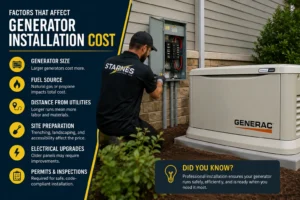
What Factors Affect The Cost Of Whole-home Generator Installation In Rock Hill, SC?
If you’re comparing the generator installation cost Rock Hill SC homeowners may encounter, you’ll quickly notice that quotes can vary significantly.
There are good reasons for that.
Generator Size
Larger generators usually cost more.
But don’t assume bigger automatically means better.
An oversized generator may cost more than necessary, while an undersized generator could struggle to support the electrical loads you expect it to handle.
Professional sizing is important.
What You Want To Power
Do you want backup power for just the essentials?
Or do you want to keep almost everything operating normally?
Essential-circuit systems may prioritize:
- Refrigerator
- Freezer
- Selected lights
- Internet
- HVAC equipment
- Important outlets
Whole-home coverage may include many more circuits and appliances.
The greater your expected demand, the larger the generator and supporting equipment may need to be.
Fuel Source
Standby generators commonly operate on natural gas or propane.
Natural gas can be convenient when a suitable utility supply is already available.
Propane may make sense for properties without natural gas, but installing or upgrading propane storage can add substantially to project costs.
Distance From Utilities
Generator location matters more than most homeowners realize.
Generac notes that installing the unit closer to the natural gas connection and electrical meter can reduce installation costs.
Longer distances can mean:
- More wire
- More conduit
- More gas piping
- More trenching
- More labor
That beautiful hidden location behind the far corner of the yard might look great, but the installation bill may not love it quite as much.
Electrical Panel Condition
Older homes can introduce additional challenges.
If the home’s electrical panel or service equipment needs modification before the generator can be safely connected, those improvements can increase the project price.
This is why the existing electrical system should be evaluated before installation begins.
Automatic Transfer Switch
The automatic transfer switch is one of the most important components of a standby generator system.
When utility power fails, the transfer switch safely disconnects the home from the grid and allows the generator to provide power to designated circuits.
When utility power returns, the system switches back.
Without getting too technical, it’s basically the referee making sure utility electricity and generator electricity don’t try to play on the field at the same time.
Trenching And Site Preparation
Sometimes the ideal generator location requires underground electrical or fuel connections.
That means trenching.
Hard ground, landscaping, patios, retaining walls, fences, slopes, or difficult access can make installation more complicated.
Generac specifically identifies landscaping, trenching, generator placement, materials, permits, electrical upgrades, and gas upgrades as factors that can heavily influence installation costs.
Permits And Inspections
Generator projects may require applicable permits and inspections.
These requirements help ensure the system meets electrical, fuel, placement, and safety standards.
Permitting may not be the most exciting part of buying a generator, but neither is explaining to your insurance company why your backyard electrical project was based on a 14-minute internet tutorial.
Professional installation matters.
Should You Choose The Cheapest Generator Installation Quote?
Not automatically.
Price matters, of course. Nobody wants to overpay.
But a generator is connected to your home’s electrical system and potentially its natural gas or propane supply. Installation quality matters just as much as equipment quality.
When comparing quotes, look beyond the bottom-line number.
Ask:
- What generator size is included?
- Why was that size recommended?
- Is the automatic transfer switch included?
- Are permits included?
- Is site preparation included?
- Are electrical upgrades included?
- What fuel work is included?
- Will the system be fully tested?
- What happens if additional work is discovered?
- Who handles future generator service?
A detailed estimate makes comparing contractors much easier.
If one quote is dramatically cheaper, find out why before celebrating.
Sometimes you discovered a great deal.
Sometimes half the project simply isn’t included.
Know What Your Generator Will Cost Before The Next Outage Knows Your Name
A whole-home generator isn’t something most homeowners buy every few years. It is a long-term addition to your home’s electrical system, and getting the size and installation right matters.
At Starnes Electric LLC, we can help Rock Hill homeowners evaluate their backup-power needs, understand their electrical system, and determine what type of generator setup makes sense for their home.
Instead of guessing based on square footage or choosing a generator simply because it has the biggest number on the box, we can help you look at the loads that actually matter during an outage.
If you’re researching generator installation cost Rock Hill SC, contact Starnes Electric LLC to discuss your home, backup-power priorities, and installation options.
The next power outage may be unpredictable.
Your plan for dealing with it doesn’t have to be.
About the Author: Dalton Starnes