
How Much Does It Cost to Upgrade an Electrical Panel? (100 vs. 200 Amp)
Table of Contents
Your electrical panel probably isn’t something you think about while making coffee in the morning. It sits quietly in the garage, basement, utility room, or another out-of-the-way spot, directing electricity throughout your home without asking for much attention.
That is, until breakers start tripping every time you run the microwave and hair dryer at the same time.
As homes become increasingly dependent on electricity, older electrical systems sometimes struggle to keep up. Modern households may have multiple televisions, computers, large HVAC systems, electric ranges, dryers, hot tubs, workshops, EV chargers, and countless devices plugged in at once. A panel that was perfectly adequate decades ago might feel a little overwhelmed today.
That’s where an electrical panel upgrade comes in.
For many homeowners, the big decision is whether to stick with 100-amp service or upgrade to a 200-amp electrical panel. And, naturally, price is a major consideration.
The average electrical panel upgrade cost varies considerably. Current national estimates commonly put standard panel upgrades in roughly the $1,200 to $2,000 range, although a complete service upgrade can cost considerably more when additional wiring, meter equipment, grounding, utility coordination, or other improvements are necessary.
Let’s take a closer look at what you’re actually paying for and whether 100 or 200 amps makes the most sense for your home.
Can You Upgrade A 100-amp Panel To 200-amp?
Yes. Upgrading a 100-amp electrical panel to a 200-amp panel is a common residential electrical project.
However, it usually involves more than taking the old breaker box off the wall and hanging a bigger one in its place.
Here’s an important distinction:
The electrical panel and the electrical service are related, but they are not the same thing.
You could technically install a panel rated for 200 amps, but if the wires and equipment feeding your home are still designed for 100 amps, you haven’t magically created 200-amp electrical service.
A true upgrade can require several components to be evaluated or replaced, including:
- The main electrical panel
- Main breaker
- Service entrance conductors
- Meter socket or meter base
- Grounding and bonding components
- Service mast or conduit
- Utility connection
- Breakers
- Related wiring
That is one reason the electrical panel upgrade cost can vary so much from one home to another.
Imagine two houses next door to each other.
House A already has relatively modern service equipment, accessible wiring, and a meter setup that makes the upgrade straightforward.
House B has decades-old equipment, outdated grounding, difficult access, and service components that need replacement.
Both homeowners may say, “I just need a 200-amp panel.”
Their electricians may see two completely different projects.
Upgrading from 100 amps to 200 amps should therefore begin with an evaluation of the home’s existing electrical service and expected electrical demand.
How Much Does It Cost To Upgrade To A 200-amp Electrical Panel?
A basic 100-to-200-amp electrical panel upgrade may cost approximately $1,200 to $3,000, depending on the project and what is included. Current national estimates vary, with HomeAdvisor reporting approximately $750 to $2,000 for upgrading from 100 to 200 amps before additional wiring for new circuits, while Angi places many electrical panel upgrade projects around $1,200 to $2,000.
Here’s the important part: a full 200-amp service upgrade can cost more than a simple panel replacement.
If additional service equipment has to be replaced, the total could move into several thousand dollars.
For example, your project might require:
- A new 200-amp panel
- New main breaker
- New breakers
- New service entrance cable
- Meter base replacement
- Grounding upgrades
- Surge protection
- Utility coordination
- Permit and inspection fees
- Repairs around the panel location
The electrical panel itself is only part of the total investment.
This is why homeowners should be careful when comparing prices online. One estimate may be referring to changing the breaker panel. Another may include a complete service upgrade.
Those are not necessarily apples-to-apples prices.
If someone tells you they can quote the exact cost of your 200-amp upgrade without knowing anything about your home’s electrical system, take that number with a generous grain of salt.
How Much Does It Cost To Upgrade To A 100-amp Electrical Panel?
If your home already has 100-amp electrical service and you simply need to replace an old or damaged panel with another 100-amp panel, the job may be less expensive than increasing the home’s service capacity.
You might see costs around $1,000 to $2,000 or more for many standard panel replacement projects, depending on the equipment, number of circuits, labor requirements, permits, and condition of the existing system. National cost data currently places many overall electrical panel upgrades around $1,200 to $2,000.
But should you install another 100-amp panel?
That’s the more interesting question.
For a smaller home with modest electrical demands, gas appliances, no EV charger, and no major plans for electrification, 100 amps may continue to meet the home’s needs.
However, if you’re already spending money to replace an outdated electrical panel, it may be worth discussing whether increasing the service size makes sense.
Suppose you’re planning to add:
- An electric vehicle charger
- Electric water heater
- Heat pump
- Hot tub
- Workshop equipment
- Additional HVAC equipment
- Electric range
- Home addition
- Pool equipment
Suddenly, that 100-amp service doesn’t have quite as much breathing room.
This doesn’t mean every homeowner needs 200 amps. Electrical capacity should be determined through a proper load calculation rather than simply choosing the biggest available panel.
Still, future plans should absolutely be part of the conversation.
Replacing a 100-amp panel today only to discover you need a 200-amp service upgrade two years from now isn’t anyone’s favorite way to spend money.
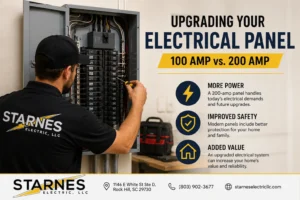
Is It Worth Upgrading To A 200-amp Panel?
For many modern homes, upgrading to 200-amp electrical service can be worthwhile.
The biggest benefit is increased capacity.
Think of your electrical service like a highway.
A 100-amp service may function perfectly well when traffic is light. But start adding more appliances, larger HVAC systems, an EV charger, and additional electrical equipment, and rush hour gets interesting.
A 200-amp service gives your electrical system considerably more capacity to accommodate current and future electrical loads.
It can be particularly attractive if you’re renovating or planning upgrades that depend heavily on electricity.
A 200-Amp Upgrade May Make Sense If You Are:
- Remodeling or adding square footage
- Installing an EV charging station
- Converting gas appliances to electric
- Adding a hot tub or swimming pool
- Installing a large workshop
- Adding central HVAC equipment
- Planning major kitchen upgrades
- Frequently experiencing electrical capacity issues
- Preparing an older home for modern electrical demands
There’s also something to be said for planning ahead.
Maybe you don’t own an electric vehicle today.
But what about several years from now?
Maybe your gas water heater works perfectly.
But if you eventually switch to an electric model, you’ll be glad someone thought about the additional electrical load.
That doesn’t mean homeowners should upgrade solely because 200 sounds more impressive than 100. A licensed electrician can perform a load calculation to determine whether your existing service is adequate.
If 100 amps comfortably supports your home and your future plans, there may be no reason to replace perfectly functional equipment just for bragging rights.
Nobody has ever impressed their dinner guests by saying, “Want to see my 200-amp panel?”
Well, almost nobody.
What Factors Affect The Cost Of An Electrical Panel Upgrade?
There are several reasons your neighbor might pay one amount while your electrical panel project costs something completely different.
Understanding these variables helps make estimates much less confusing.
1. Existing Electrical Service
Upgrading an existing 200-amp panel with another 200-amp panel can be much simpler than converting an older 60- or 100-amp system to 200 amps.
The more equipment that needs to change, the more labor and material the project requires.
2. Panel Size And Capacity
A larger electrical panel generally costs more than a smaller unit, but capacity isn’t the only consideration.
The number of breaker spaces matters too.
A home with numerous circuits may require a larger panel configuration even if the overall service amperage doesn’t change.
3. Number And Type Of Breakers
Breakers add to the total electrical panel upgrade cost, especially when specialized breaker protection is required.
Modern electrical standards may require certain circuits to use AFCI or GFCI protection.
Older homes sometimes need numerous breaker updates when the panel is replaced.
4. Meter And Service Equipment
Sometimes the existing meter base, service entrance conductors, mast, or other equipment cannot accommodate the new service capacity.
Angi notes that installing a 200-amp-rated panel does not by itself create 200-amp service if exterior wiring and meter equipment remain rated for lower amperage.
Those components may have to be upgraded as well.
5. Existing Wiring
Opening an older electrical panel occasionally reveals surprises.
And by “surprises,” we don’t mean a forgotten twenty-dollar bill.
We’re talking about:
- Damaged wiring
- Improper connections
- Corrosion
- Overcrowded circuits
- Double-tapped breakers
- Outdated components
- Grounding problems
Additional repairs can increase the project’s cost.
6. Panel Location And Accessibility
A panel located in an easy-to-access utility area may be simpler to replace than one squeezed into a difficult location.
If relocation is required, costs can increase considerably because circuits may need to be extended or rerouted.
7. Permits And Inspections
Electrical panel replacements and service upgrades commonly involve local permitting and inspection requirements.
A professional electrical contractor can determine what is required for the project.
Permits aren’t exactly the glamorous side of home improvement, but electrical work is one area where “we’ll just wing it” is a particularly bad strategy.
8. Utility Company Requirements
A service upgrade may require coordination with the electric utility.
Power may need to be disconnected before work begins and reconnected after approved work is completed.
In some situations, utility-side equipment may also require attention.
9. Additional Electrical Improvements
Homeowners sometimes combine panel replacement with other upgrades.
For example:
- Whole-home surge protection
- EV charging circuits
- Generator connections
- Subpanels
- New dedicated circuits
- Electrical grounding improvements
- Outdoor electrical equipment
Bundling this work can increase the total project price, although it may make sense to complete related upgrades while the main electrical system is already being worked on.
How Do I Know If I Need A 100-amp Or 200-amp Electrical Panel?
Choosing between 100 amps and 200 amps is less about the physical size of your house and more about how much electricity the home uses.
A 1,500-square-foot home packed with electrical equipment might need more capacity than a 2,500-square-foot house where most major appliances run on gas.
That’s why electricians use load calculations.
100-Amp Service May Be Adequate For:
- Smaller homes
- Homes with gas heating
- Homes with gas water heating
- Homes with gas cooking
- Properties with relatively few large electrical loads
- Houses without EV chargers, pools, hot tubs, or major workshop equipment
200-Amp Service May Be Better For:
- Larger modern homes
- Homes with all-electric appliances
- Electric HVAC systems
- EV charging
- Hot tubs and pools
- Workshops
- Major additions
- Multiple large appliances
- Future electrification plans
You should also pay attention to how your current electrical system behaves.
An electrical panel may deserve professional evaluation if you notice:
- Breakers tripping frequently
- Lights flickering when appliances start
- Burning smells near electrical equipment
- Buzzing or crackling sounds
- Rust or corrosion inside the panel
- Heat around the electrical panel
- Lack of available breaker spaces
- Reliance on multiple subpanels because the main panel is full
Some of these symptoms can indicate safety issues rather than simple capacity limitations, so they shouldn’t be ignored.
Never remove the panel cover and investigate internal wiring yourself. Electrical panels contain energized components that can remain dangerous even when individual breakers are switched off.
Don’t Let Your Electrical Panel Become The Hardest-Working Thing In The House
Your electrical system should support the way you actually live.
If your home’s panel was designed during an era when a television, refrigerator, and a few lamps were considered a busy evening, today’s electrical demands may be asking quite a bit more from it.
At Starnes Electric LLC, we help homeowners understand whether their current electrical service is still doing its job or whether moving from 100 amps to 200 amps makes more sense.
We can evaluate your existing panel, electrical loads, future plans, and service equipment so you’re not choosing an upgrade based on guesswork.
If you’re researching electrical panel upgrade cost because your breakers keep tripping, you’re remodeling, adding an EV charger, or simply wondering whether your older panel is ready for another decade of electrical demands, contact Starnes Electric LLC.
We’ll help you figure out what your home actually needs, because when it comes to electricity, having enough capacity is much better than discovering you don’t at the exact moment the oven, dryer, air conditioner, and car charger all decide to get busy.
About the Author: Dalton Starnes