Commercial Electrical Code Compliance Checklist for Rock Hill, SC
Table of Contents
Commercial electrical code compliance is about more than passing an inspection. It is about keeping employees, customers, equipment, and the building itself safer while avoiding the expensive headache of discovering electrical problems after walls are closed or a business is ready to open.
For businesses in Rock Hill, SC, electrical requirements involve state-adopted codes, local permitting procedures, approved plans, and inspections. In my opinion, the best approach is simple: treat code compliance as part of the project from day one rather than something to worry about the afternoon before the inspector arrives.
Need Help Meeting Electrical Code?
Keep your Rock Hill business safe and compliant. Call Starnes Electric LLC for professional commercial electrical service.
What Should Be Included In A Commercial Electrical Inspection Checklist?
A commercial electrical inspection checklist should cover the entire electrical system, not just whether the lights turn on.
That sounds obvious, yet it is surprisingly easy for electrical work to become a series of little isolated projects. Someone adds a receptacle. Someone else installs equipment. A tenant builds a new office. Another contractor replaces lighting. Ten years later, the electrical panel looks like a scrapbook of every renovation the building has ever experienced.
A useful inspection checklist brings everything back into focus.
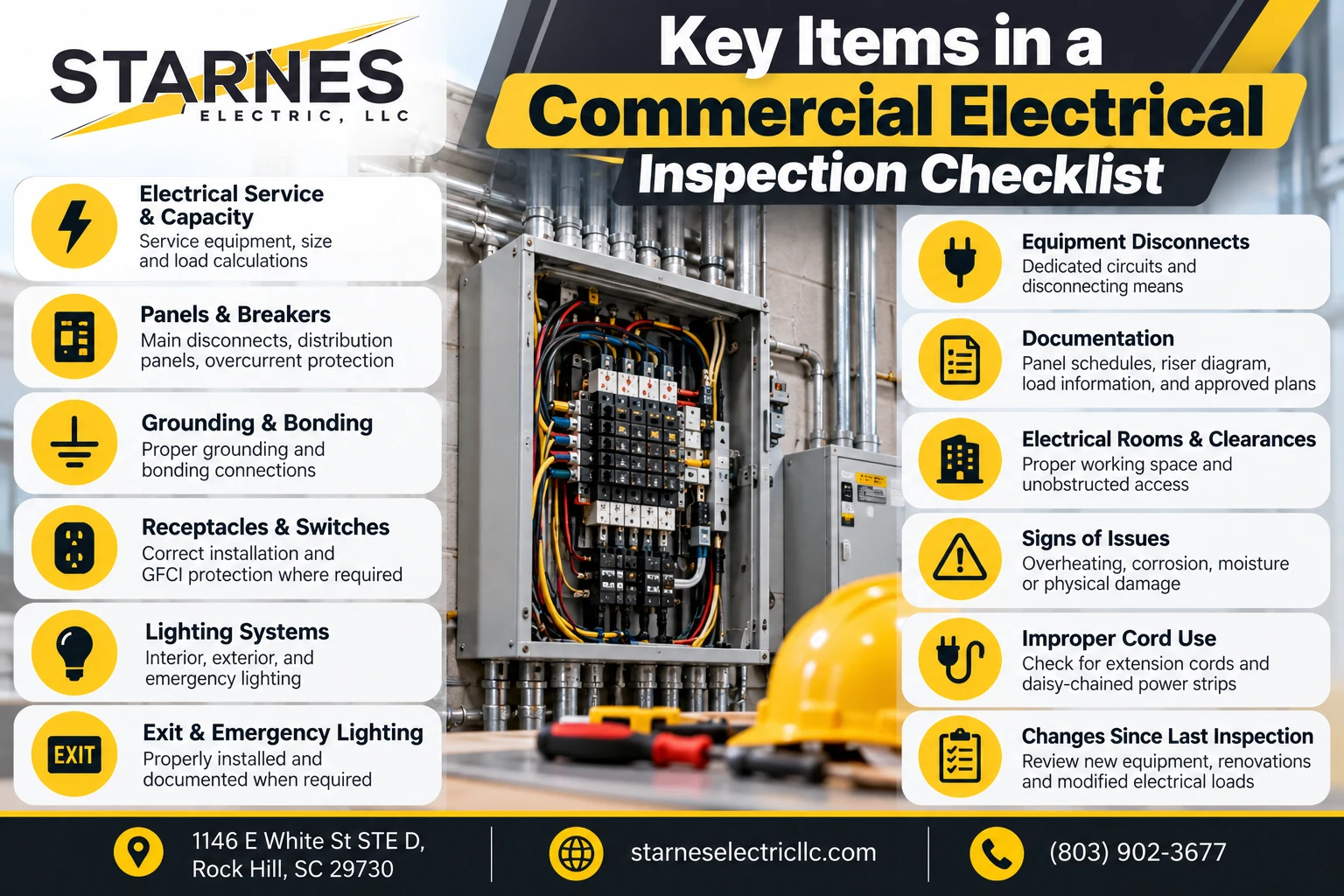
For commercial properties, areas worth reviewing typically include:
- Electrical service equipment and service capacity
- Main disconnects
- Distribution panels and subpanels
- Circuit breakers and overcurrent protection
- Panel directories and circuit identification
- Grounding and bonding
- Conductors and wiring methods
- Junction boxes and electrical enclosures
- Receptacles and switches
- GFCI protection where required
- Lighting systems
- Emergency and exit lighting
- Equipment disconnects
- Dedicated circuits for applicable equipment
- Exterior electrical equipment
- Electrical rooms and required working clearances
- Signs of overheating, corrosion, moisture, or physical damage
- Improper extension cord or power-strip use
- Modifications made since the building’s original electrical installation
For new commercial buildings in Rock Hill, the City’s published plan checklist specifically calls for items such as a power riser diagram and panel schedules, the location and size of the electrical service, meter, disconnects, panels and transformers, plus fixture layouts and schedules showing manufacturer and load information. Exit lights, emergency lighting and smoke detectors must also be shown when required.
That tells you something important about inspections: documentation matters almost as much as workmanship.
An electrical system can look tidy from the floor while still having problems hidden behind panel covers or above ceilings. Inspectors are not simply admiring whether conduits are straight. They are comparing the installation against approved plans, applicable code requirements, equipment listings, and safe installation practices.
I would also add one item to every commercial checklist that technically sounds less exciting than wiring: changes since the last inspection.
Businesses evolve. Equipment gets replaced. Offices get rearranged. Restaurants add appliances. Warehouses add machinery. Retailers install new displays. Those changes may alter electrical loads or require circuits, disconnects, protection, or permits that were never part of the original design.
That is often where yesterday’s compliant electrical system becomes today’s question mark.
What Are The Electrical Code Requirements For Commercial Buildings In South Carolina?
This is the section where it is worth being precise because “the electrical code” is not just a mysterious rulebook sitting in an inspector’s truck.
As of September 2026, South Carolina’s currently effective statewide building-code cycle is based on the 2021 South Carolina Building Codes, with the 2020 National Electrical Code, or NEC, as modified by South Carolina. The current code cycle took effect January 1, 2023.
There is also a change approaching. South Carolina has adopted the 2024 building-code cycle and the 2023 NEC, with an implementation date of January 1, 2027.
Why does that matter?
Because a commercial project beginning near a code transition should not rely on an old checklist someone downloaded three years ago. The applicable requirements can depend on timing, project scope, permitting, adopted amendments, and the authority having jurisdiction.
Some of the broad electrical issues commercial projects commonly need to address include:
Proper electrical service sizing
The electrical service must be appropriate for the calculated demand of the building. Adding substantial HVAC equipment, commercial kitchen appliances, machinery, EV charging, or other major loads without considering available service capacity is asking for trouble.
Overcurrent protection
Circuits and equipment need properly sized overcurrent protection. A bigger breaker is not a clever cure for a circuit that keeps tripping.
If a breaker repeatedly trips, something needs to be evaluated. Upsizing protection without verifying the conductors and connected load can turn a nuisance into a serious hazard.
Grounding and bonding
Grounding and bonding are fundamental parts of electrical safety. They help create an effective path for fault current and reduce dangerous voltage differences between conductive components.
They also happen to be areas where incorrect DIY or renovation work can get confusing quickly.
GFCI and other required protection
Depending on the location and use, particular receptacles, outlets, circuits, or equipment may require ground-fault protection or other protective measures.
Commercial requirements are not identical to residential requirements, so copying whatever was done in someone’s kitchen is not an electrical design strategy.
Safe equipment installation
Electrical equipment should be installed according to applicable code provisions and its listing and labeling instructions. Panels, disconnects, transformers, equipment and enclosures also need appropriate access and working space.
That last point deserves more respect than it gets.
The electrical room should not become the company’s unofficial broom closet.
Stacking inventory, filing boxes, mop buckets, shelving, Christmas decorations, and six years of mysterious office furniture directly in front of electrical equipment can create access problems when somebody actually needs to work there.
Rock Hill also requires commercial project documents such as an Electric Load Data Form in applicable permit processes, and its commercial building guidance requires electrical plans showing service and distribution information.
The larger point is this: commercial electrical compliance is a system. Load calculations, equipment, circuits, wiring methods, protection, installation, documentation, and inspection all need to make sense together.
What Is An Electrical Safety Checklist For A Commercial Property?
A code inspection and a routine electrical safety review overlap, but they are not exactly the same thing.
A code inspection generally looks at compliance with applicable requirements for the work being inspected. A property owner or facility manager should also be thinking about what has happened to the building since that inspection.
Buildings are not museums. People use them.
Things get bumped, overloaded, modified, unplugged, moved, repaired, taped together, and occasionally “temporarily fixed” for so long that nobody remembers the temporary part.
A practical ongoing electrical safety checklist could include checking for:
- Damaged receptacles, switches, covers, cords, and plugs
- Discoloration or heat marks around outlets
- Buzzing or crackling sounds
- Burning or unusual electrical odors
- Frequently tripped breakers
- Receptacles that feel unusually warm
- Loose plugs that fall out of receptacles
- Missing panel blanks or damaged electrical enclosures
- Blocked access to panels and disconnects
- Extension cords being used as permanent wiring
- Daisy-chained power strips
- Water or corrosion near electrical equipment
- Damaged exterior electrical boxes or covers
- Malfunctioning exit or emergency lighting
- Equipment that has been added without confirming circuit capacity
- Unexplained changes in how electrical equipment performs
One of my biggest frustrations with commercial electrical problems is the “it still works” argument.
Yes, a damaged receptacle may still provide power.
Yes, an overloaded arrangement may operate for months.
Yes, that extension cord may have been sitting under the desk since 2019 without bursting into flames.
None of those observations prove the setup is safe.
Electrical systems are not judged solely by whether electricity reaches Point B from Point A.
Commercial properties should also review electrical systems when there is a change in occupancy, a renovation, new equipment installation, unusual electrical behavior, storm or water damage, or a significant increase in operating load.
Preventive attention is usually much less disruptive than discovering an electrical issue while customers are standing in the lobby and half the building has suddenly gone dark.
How Do You Know If A Commercial Electrical System Is Up To Code?
The uncomfortable answer is that you cannot always tell just by looking at it.
A neat electrical panel is encouraging, but it does not automatically mean the system complies with every applicable requirement.
Likewise, an older-looking system is not automatically illegal.
Electrical codes change over time, and existing installations may have been lawful under requirements in effect when they were constructed. Renovations, changes of occupancy, expansions, replacements, and other modifications can trigger different requirements.
That is why “up to code” needs context.
A proper evaluation may involve reviewing:
- The age and history of the electrical installation
- The permits associated with previous work
- Current building use and occupancy
- Electrical loads and equipment
- Panel and circuit conditions
- Grounding and bonding
- Required protection devices
- Changes made since the original construction
- Applicable state and local requirements
- Whether current work matches approved plans
Rock Hill states that contractors must hold the appropriate South Carolina license for the work being performed, and the City’s commercial permitting process requires plans and project documentation for applicable construction.
That formal process matters.
A business owner may inherit years of electrical modifications from previous occupants without knowing who performed them. What appears to be a convenient extra outlet behind a counter may have been professionally permitted and inspected, or it may have been installed by someone’s cousin on a Sunday afternoon.
You cannot tell from the faceplate.
Warning signs that deserve professional attention include recurring breaker trips, lights that dim when equipment starts, scorched components, buzzing panels, unexplained warm spots, damaged wiring, improvised connections, excessive use of adapters, or equipment that seems to overwhelm existing circuits.
But absence of those symptoms does not prove compliance.
The most reliable way to evaluate questionable commercial electrical work is to have it reviewed by a qualified electrical professional and, when required, properly permitted and inspected by the appropriate authority.
What Do Inspectors Look For During A Commercial Electrical Inspection In Rock Hill, SC?
Commercial electrical inspectors are looking for more than mistakes. Their job is to determine whether the electrical work being inspected complies with the applicable requirements and approved project documents.
In Rock Hill, the City’s commercial plan requirements provide a useful clue about what matters before an inspector even steps onto the property. Electrical plans can be required to show panel schedules, riser diagrams, service equipment, meters, disconnects, transformers, fixture layouts, loads, emergency lighting, and related information.
During an electrical inspection, attention may include areas such as:
Service and distribution equipment
Inspectors may review service equipment, disconnecting means, panels, conductors, overcurrent protection, labeling, accessibility, and installation conditions.
Wiring methods
Conductors and raceways need to be suitable for the environment and properly installed, protected, supported, terminated, and enclosed.
Commercial buildings can present conditions you simply do not encounter in a typical living room, including rooftop equipment, wet locations, industrial machinery, commercial kitchens, warehouses, and specialized systems.
Grounding and bonding
Improper grounding or bonding can become a major safety issue. Connections need to be installed correctly rather than simply “close enough.”
Electricity is famously uninterested in good intentions.
Receptacles and protective devices
Inspectors may verify that receptacles and other devices have appropriate protection where required, are correctly installed, and match the conditions of the space.
Equipment disconnects
HVAC units, machinery, signs, commercial appliances, and other equipment may require disconnecting means based on the installation and applicable code requirements.
Emergency systems and egress lighting
Where required, exit signs and emergency lighting are not decorative extras. Rock Hill specifically includes exit lights and emergency lights among the items that may need to appear on commercial electrical plans.
Consistency with approved plans
This is a big one.
If approved plans show one electrical arrangement and the installed system is substantially different, expect questions.
Changes happen during construction. Walls move. Equipment changes. Tenants change their minds. Nobody should be surprised by that.
The mistake is treating significant field changes as though drawings and permits no longer matter.
Rock Hill’s commercial permitting process also calls for items including a Building Code Compliance Form, Electric Load Data Form, and, for applicable projects, COMcheck documentation demonstrating compliance with the state-adopted energy code.
For a business owner, that means the smartest inspection strategy is not hiding problems before inspection day. It is identifying them early enough to correct them properly.
There is nothing enjoyable about scheduling a final inspection, preparing to open the doors, coordinating employees and vendors, and then discovering that an electrical issue is standing between the business and completion.
That is why experienced contractors think about the inspection while the work is being performed, not five minutes before the inspector arrives.
Uncovering Hidden Energy Wasters: Energy Efficiency Tips for Commercial Buildings
Energy efficiency has become a hot topic in recent years, [...]
Learn More
Don’t Let Inspection Day Become Troubleshooting Day With Starnes Electric LLC
Commercial electrical compliance should not feel like studying for an exam where someone forgot to tell you what chapters are included.
The better approach is to build compliance into the work from the beginning.
At Starnes Electric LLC, we help commercial property owners and businesses address electrical installations, upgrades, repairs, and code-related concerns with the bigger picture in mind. That means looking beyond whether something simply powers on and considering whether the electrical system is appropriate for the building, equipment, current use, and applicable requirements.
If you are renovating a commercial space, adding equipment, preparing for an inspection, dealing with recurring electrical issues, or wondering whether older work needs attention, having the system evaluated before the problem becomes urgent can save a lot of frustration.
Rock Hill businesses also have a code transition approaching. South Carolina’s 2024 building-code cycle, including the 2023 NEC with state modifications, is scheduled for implementation on January 1, 2027, so projects planned around that date should confirm which requirements apply before work begins.
A failed inspection is inconvenient. An electrical failure after opening day can be much worse.
Starnes Electric LLC can help businesses in Rock Hill, SC approach commercial electrical work with safety, reliability, and compliance in mind, so inspection day feels like the final checkpoint rather than the beginning of a repair list.
Avoid Costly Electrical Code Issues
Get your commercial electrical system checked before violations or failed inspections cause delays. Call Starnes Electric LLC today.
About the Author: Dalton Starnes