
Can an Electrician Install Customer-Supplied Light Fixtures
Table of Contents
Yes, most electricians can install customer-supplied light fixtures. Homeowners often purchase chandeliers, pendant lights, ceiling fans, wall sconces, vanity lights, recessed fixtures, and outdoor lighting before hiring an electrician to complete the installation.
Buying your own fixture gives you greater control over the style, finish, size, and price. You can shop online, visit a lighting showroom, or choose a fixture that matches the rest of your home. The electrician then handles the electrical connections, mounting, grounding, testing, and any necessary upgrades to the wiring or electrical box.
However, not every customer-supplied fixture can be installed exactly as planned. The fixture must be suitable for the location, compatible with the home’s electrical system, complete with all required parts, and safely supported by the existing mounting structure.
Before scheduling the installation, share the fixture specifications with the electrician. A photo, product link, weight, dimensions, and installation manual can help determine whether the job will be a straightforward replacement or a more involved electrical project.
Have Light Fixtures Ready to Install?
Let Starnes Electric LLC handle the installation safely and professionally. Call now to schedule your service!
Do Electricians Usually Install Fixtures Purchased by Homeowners?
Yes. Installing fixtures purchased by homeowners is a common part of residential electrical work.
Many homeowners prefer to choose their own lighting because a fixture is a visible design feature. An electrician may offer basic lighting options, but customers often want a specific style that complements their kitchen, dining room, bathroom, bedroom, or outdoor space.
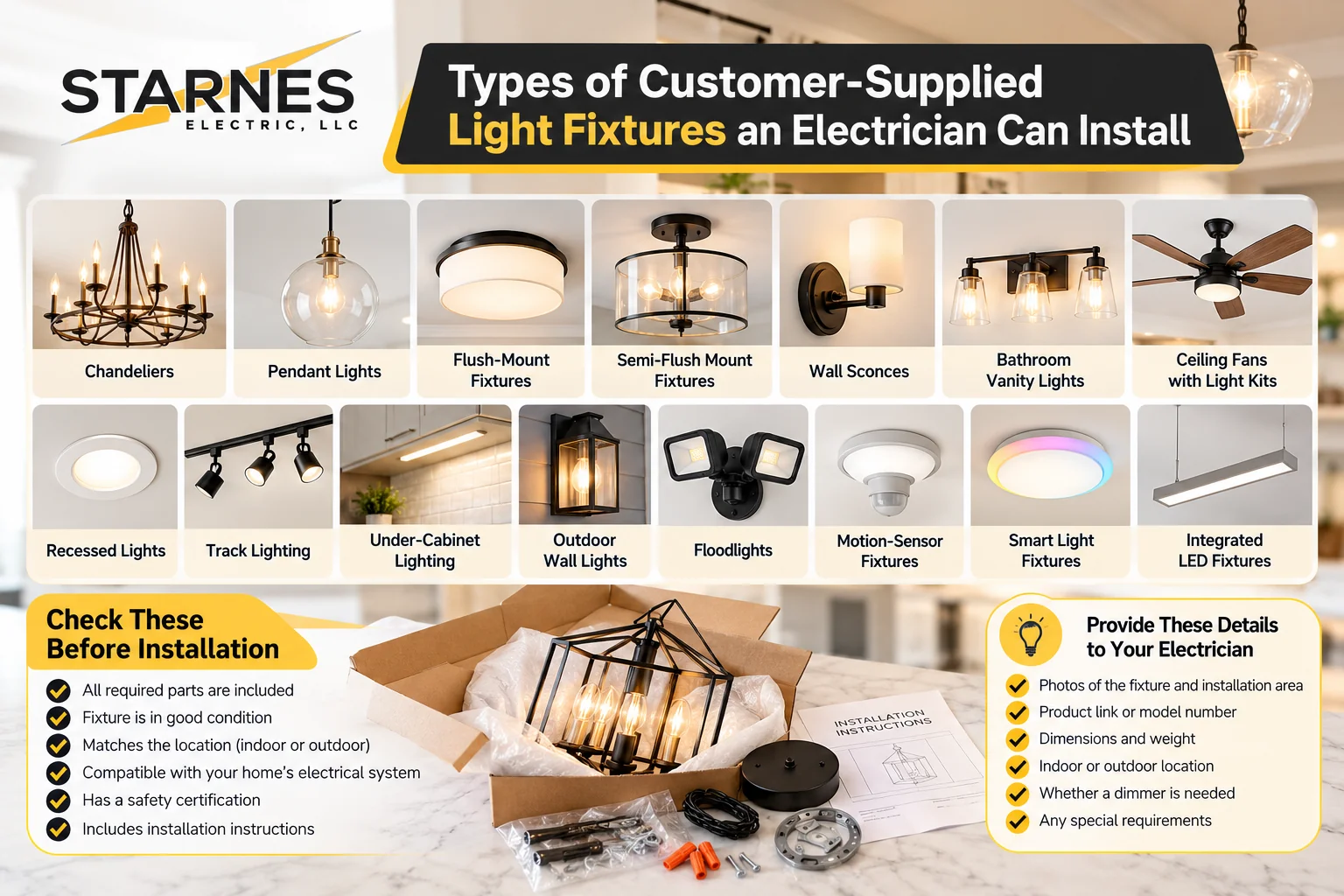
An electrician can typically install customer-supplied:
-
Chandeliers
-
Pendant lights
-
Flush-mount fixtures
-
Semi-flush-mount fixtures
-
Wall sconces
-
Bathroom vanity lights
-
Ceiling fans with light kits
-
Track lighting
-
Recessed lights
-
Under-cabinet lighting
-
Outdoor wall lights
-
Floodlights
-
Motion-sensor fixtures
-
Smart light fixtures
-
Integrated LED fixtures
The electrician will usually inspect the fixture and installation area before beginning the work. If the product is incomplete, damaged, incompatible, or unsafe, the installer may recommend returning or replacing it.
What Is Included in the Installation?
The exact service depends on the electrician and the condition of the installation area.
A standard fixture installation may include:
-
Turning off and testing the circuit
-
Removing the existing fixture
-
Inspecting the electrical box
-
Checking the condition of the wiring
-
Installing the mounting bracket
-
Connecting the fixture wires
-
Grounding the fixture
-
Securing the canopy or cover
-
Installing bulbs or shades
-
Restoring power
-
Testing the fixture and switch
-
Cleaning the work area
Some services may also include basic fixture assembly. However, large chandeliers, detailed crystal fixtures, or products with many individual components may require additional labor.
Ask whether the estimate includes removal, assembly, disposal, dimmer installation, electrical box replacement, and drywall repair. These services may be priced separately.
Why Would a Homeowner Supply the Fixture?
The main reason is choice.
Lighting fixtures are available in a wide range of styles, materials, colors, sizes, and price points. A homeowner may want a fixture that matches existing hardware, furniture, cabinetry, or architectural details.
Supplying the fixture also allows homeowners to:
-
Compare prices between retailers
-
Shop during sales
-
Choose a specific brand
-
Order a custom design
-
Match fixtures throughout the home
-
Select energy-efficient lighting
-
Buy directly from a lighting showroom
-
Use a fixture received as a gift
-
Replace an outdated fixture with a preferred style
This arrangement can work well as long as the fixture is appropriate for the space and installation.
The electrician is responsible for installing it safely. The homeowner is generally responsible for selecting and purchasing the product.
Will the Electrician Inspect the Fixture First?
A professional electrician should inspect the fixture before installing it.
The inspection may include checking:
-
The fixture’s condition
-
The listed voltage
-
The weight
-
The mounting bracket
-
The wiring
-
The grounding connection
-
The included hardware
-
The location rating
-
The bulb requirements
-
Dimmer compatibility
-
The manufacturer’s instructions
-
The electrical certification label
The electrician may also compare the fixture requirements with the existing electrical box, wiring, and circuit.
A fixture can look ideal in product photos and still be unsuitable for the planned location. For example, an indoor fixture should not be installed on an exposed porch, and a heavy chandelier should not be attached to a lightweight ceiling box.
What Parts Should Be Included With the Fixture?
Before the electrician arrives, open the package and confirm that all required parts are present.
A light fixture may include:
-
Mounting bracket
-
Canopy
-
Mounting screws
-
Decorative nuts
-
Wire connectors
-
Grounding screw
-
Chain or downrod
-
Fixture body
-
Shades
-
Glass panels
-
Bulbs
-
Remote control
-
Receiver
-
Transformer or LED driver
-
Installation instructions
Do not throw away the packaging until the fixture has been installed and tested.
Small hardware can easily become lost inside cardboard, foam, or plastic packaging. Missing screws, brackets, chain links, or decorative pieces can delay the appointment.
If the fixture arrives damaged or incomplete, contact the retailer before installation day. An electrician may not be able to safely substitute every missing part.
Can an Electrician Install a Fixture Bought Online?
Yes. Electricians can install fixtures purchased online as long as the product is suitable for residential use and meets applicable electrical safety requirements.
Online shopping provides many options, but product quality can vary.
Before purchasing, look for:
-
Recognized safety certification
-
Clear installation instructions
-
Accurate dimensions
-
Fixture weight
-
Voltage requirements
-
Bulb specifications
-
Indoor or outdoor rating
-
Damp- or wet-location rating
-
Warranty information
-
Replacement-part availability
-
Dimmer compatibility
Be cautious with products that have unclear wiring instructions, missing certification information, weak mounting hardware, or inconsistent product descriptions.
An electrician may refuse to install a fixture that appears unsafe, damaged, improperly manufactured, or unsuitable for the intended location.
This is not the electrician being difficult. It is a reasonable safety decision.
Can an Electrician Install a Fixture From Another Country?
Possibly, but imported fixtures may create compatibility concerns.
Electrical systems, voltage standards, wire colors, socket types, grounding methods, and product certifications vary between countries.
A fixture purchased overseas may be designed for a different voltage or frequency. It may also use bulb sockets or components that are difficult to replace locally.
The electrician should review:
-
Voltage rating
-
Frequency
-
Wire size
-
Grounding provisions
-
Socket type
-
Bulb availability
-
Driver or transformer requirements
-
Safety certification
-
Mounting hardware
-
Installation instructions
Some imported fixtures may be modified or rewired for local use, but doing so can affect the warranty and may require additional parts or specialist work.
Never assume that a fixture can be safely installed simply because its wires look similar to local products.
What If the Fixture Is Missing Instructions?
An experienced electrician may still be able to install a basic fixture without instructions, but the process may take longer.
Instructions are especially important for:
-
Integrated LED fixtures
-
Smart lighting
-
Multi-tier chandeliers
-
Ceiling fans
-
Low-voltage fixtures
-
Fixtures with remote controls
-
Custom mounting systems
-
Fixtures with transformers
-
Multi-part pendant systems
The manual may explain the wire connections, assembly order, weight requirements, dimmer compatibility, and mounting details.
If the instructions are missing, check the manufacturer’s website before the appointment. Search by model number rather than only by product name.
A screenshot or printed copy can help prevent unnecessary delays.
Can an Electrician Refuse to Install a Customer-Supplied Fixture?
Yes. An electrician may decline the installation if the fixture appears unsafe, damaged, incomplete, incompatible, or inappropriate for the location.
Common reasons include:
-
Missing safety certification
-
Damaged wiring
-
Cracked sockets
-
Broken mounting hardware
-
Missing grounding provisions
-
Incorrect voltage
-
Unsupported fixture weight
-
An indoor fixture intended for outdoor use
-
An incompatible electrical box
-
Missing parts
-
Unclear manufacturer instructions
-
Signs of poor-quality construction
An electrician may also pause the installation if the existing wiring or electrical box is unsafe.
For example, removing an old light may reveal brittle insulation, loose connections, scorched wiring, or a box attached only to drywall. Those issues should be corrected before the new fixture is installed.
Does the Existing Electrical Box Matter?
Yes. The electrical box must be suitable for the fixture’s type and weight.
A standard box may support a lightweight ceiling fixture, but it may not be appropriate for:
-
Heavy chandeliers
-
Large pendant lights
-
Ceiling fans
-
Oversized decorative fixtures
-
Fixtures with long downrods
-
Multi-light installations
The electrician may need to replace the existing box with:
-
A reinforced fixture box
-
A fan-rated box
-
A brace-mounted box
-
A box attached directly to framing
-
A heavy-duty support system
The fixture should never hang from its electrical wires.
If the box moves, cracks, bends, or lacks proper support, it should be repaired or replaced before installation.
Can a Customer-Supplied Ceiling Fan Be Installed?
Yes. An electrician can usually install a ceiling fan purchased by the homeowner.
However, the existing electrical box must be listed for fan support. A standard light-fixture box should not automatically be used for a ceiling fan.
The electrician may also need to determine:
-
Whether separate fan and light controls are available
-
Whether a remote receiver will fit inside the canopy
-
Whether the fan is suitable for the ceiling height
-
Whether a downrod is needed
-
Whether the ceiling is sloped
-
Whether the fan is rated for outdoor use
-
Whether the blades have enough clearance
-
Whether the circuit and switch are compatible
Ceiling fans create movement and vibration, so secure structural support is essential.
Can an Electrician Install a Customer-Supplied Chandelier?
Yes. Chandeliers are among the most common customer-supplied fixtures installed by electricians.
The installation cost and complexity depend on:
-
Fixture weight
-
Ceiling height
-
Chandelier size
-
Assembly requirements
-
Number of crystals or shades
-
Electrical box support
-
Chain or downrod length
-
Accessibility
-
Dimmer compatibility
-
Lift or scaffolding requirements
A small dining room chandelier may be a straightforward replacement. A large fixture in a two-story foyer may require multiple technicians, special lifting equipment, and structural reinforcement.
Before the appointment, provide the electrician with the chandelier’s weight, dimensions, installation instructions, and photos of the installation area.
Can Outdoor Fixtures Be Customer-Supplied?
Yes, but the fixture must be rated for the outdoor environment.
Outdoor fixtures may need to be listed for damp or wet locations.
A damp-location fixture may be suitable for a covered porch where it is protected from direct rain. A wet-location fixture is designed for areas exposed to rain, snow, or water.
Depending on the location and applicable requirements, an outdoor installation may also need:
-
Weather-resistant electrical boxes
-
Gaskets
-
Sealed connections
-
Corrosion-resistant hardware
-
GFCI protection
-
Outdoor-rated wiring methods
-
Proper fixture orientation
An attractive indoor wall sconce should not be installed outside simply because it fits the space.
Moisture can damage the fixture and create electrical hazards.
Can an Electrician Install Smart Light Fixtures?
Yes, but smart fixtures and switches may require additional setup.
The electrician can usually handle the physical wiring and installation. App configuration, Wi-Fi setup, account creation, voice-assistant integration, and automation may or may not be included.
Smart lighting may require:
-
A neutral wire
-
A compatible wall switch
-
Strong Wi-Fi coverage
-
A hub
-
A specific app
-
Firmware updates
-
Compatible LED bulbs
-
A minimum electrical load
Some smart switches allow a small amount of current to pass through the fixture, which can cause certain LED lights to glow or flicker when switched off.
Before purchasing, confirm that the product is compatible with the home’s wiring and the preferred smart-home system.
Who Is Responsible if the Fixture Is Defective?
When the homeowner supplies the fixture, the product warranty generally remains with the retailer or manufacturer.
The electrician may warranty the installation work but not the fixture itself.
For example, if the electrician installs the fixture correctly and the LED driver fails two weeks later, the homeowner may need to contact the retailer or manufacturer for a replacement.
The electrician may charge for:
-
Removing the defective fixture
-
Troubleshooting the problem
-
Installing the replacement
-
Returning for a second appointment
Keep the receipt, packaging, warranty information, and model number until the fixture has operated properly for a reasonable period.
Will an Electrician Warranty a Customer-Supplied Fixture?
Many electricians warranty their workmanship but exclude customer-supplied materials from the product warranty.
This means the electrician may stand behind the wiring connections, mounting, and installation. However, the warranty may not cover a faulty motor, LED driver, remote receiver, socket, or decorative component supplied by the homeowner.
Ask about the warranty before the work begins.
Useful questions include:
-
Is the installation labor warranted?
-
Are customer-supplied fixtures excluded from the product warranty?
-
What happens if the fixture is defective?
-
Is there a charge for removing and reinstalling a replacement?
-
Does the warranty cover mounting problems?
-
How long does the workmanship warranty last?
Clear expectations can prevent confusion later.
Should You Replace Old Light Fixtures Before Selling Your Home?
Replacing old light fixtures before selling your home can be [...]
Learn More
Should You Assemble the Fixture Before the Electrician Arrives?
Only if the manufacturer recommends it and the fixture can be moved safely after assembly.
Some fixtures are easier to assemble on the floor. Others should be partially assembled after they are mounted.
Large chandeliers may become too heavy or fragile if fully assembled before installation. Glass shades and crystals are often added after the main frame is secured.
A practical approach is to:
-
Open the package
-
Confirm that all parts are present
-
Read the instructions
-
Keep the hardware organized
-
Avoid attaching fragile pieces
-
Ask the electrician whether preassembly would help
Do not make permanent modifications to the fixture before confirming that it fits the space and mounting system.
What Information Should You Give the Electrician?
Providing accurate information helps the electrician prepare the right tools, equipment, and labor.
Share:
-
A photo of the existing fixture
-
A photo of the ceiling or wall
-
Ceiling height
-
Fixture dimensions
-
Fixture weight
-
Product link
-
Model number
-
Installation manual
-
Whether the location is indoors or outdoors
-
Whether a dimmer is installed
-
Whether the fixture is replacing an existing light
-
Whether new wiring is needed
-
Whether attic access is available
For a high ceiling or staircase, include wide photos showing the room layout and access conditions.
The more information the electrician has, the less likely the project is to be delayed by missing equipment or unexpected support requirements.
How Much Does It Cost to Install a Customer-Supplied Fixture?
The cost depends on the type of fixture, installation location, ceiling height, wiring condition, and support requirements.
A basic fixture replacement may cost less than installing a chandelier, ceiling fan, or new fixture where no wiring currently exists.
The price may increase if the electrician needs to:
-
Assemble the fixture
-
Replace the electrical box
-
Repair damaged wiring
-
Install a dimmer
-
Add a wall switch
-
Run new cable
-
Work on a high ceiling
-
Use scaffolding or a lift
-
Install several fixtures
-
Reinforce the mounting point
The fixture’s purchase price does not always reflect the difficulty of installation. An inexpensive chandelier with hundreds of small pieces may take longer to install than a costly but simple pendant light.
Is Buying Your Own Fixture Cheaper?
It can be, but the lowest-priced fixture is not always the least expensive option overall.
A poorly made fixture may take longer to assemble, arrive without proper hardware, or fail shortly after installation. Returning and replacing it can result in additional labor costs.
A better value often comes from choosing a fixture that is:
-
Properly certified
-
Well reviewed
-
Complete
-
Easy to maintain
-
Compatible with commonly available bulbs
-
Suitable for the location
-
Supported by a warranty
-
Made with durable mounting hardware
Buying during a sale can save money, but quality and compatibility should still come first.
What Should You Check Before Buying a Fixture?
Before purchasing, confirm that:
-
The fixture dimensions fit the room
-
The planned location can support the weight
-
The canopy will cover the electrical box opening
-
The fixture is suitable for the ceiling height
-
The voltage matches the home’s electrical system
-
The required bulbs are easy to find
-
The fixture is dimmer-compatible, if needed
-
The finish matches nearby hardware
-
The fixture is rated for damp or wet areas, when applicable
-
Replacement glass or parts are available
-
Installation instructions are included
For pendant lights and chandeliers, check the maximum hanging length. Some fixtures do not include enough chain, cord, or downrod for tall ceilings.
For low ceilings, make sure the fixture will not hang too far into the room.
Should You Ask the Electrician Before Buying?
For complicated fixtures, asking the electrician first can help prevent expensive mistakes.
Professional guidance is especially useful when purchasing:
-
Heavy chandeliers
-
Ceiling fans
-
Smart fixtures
-
Outdoor fixtures
-
Low-voltage lighting
-
Integrated LED fixtures
-
Large multi-light systems
-
Fixtures for vaulted ceilings
-
Lights requiring new wiring
-
Imported fixtures
An electrician may help confirm whether the existing box, switch, wiring, and circuit can support the fixture.
A short conversation before ordering can be much easier than repacking a large chandelier after discovering that it will not work in the intended location.
Bring the Fixture, and Let Starnes Electric Handle the Installation
Customer-supplied light fixtures can usually be installed by a qualified electrician as long as they are safe, complete, compatible, and appropriate for the location. Choosing your own fixture gives you control over the style, while professional installation helps ensure that it is securely mounted, properly grounded, and correctly connected.
At Starnes Electric, we install homeowner-supplied chandeliers, pendant lights, ceiling fans, wall sconces, vanity lights, outdoor fixtures, and other residential lighting. Our team can inspect the fixture, evaluate the existing electrical box, repair questionable wiring, install compatible switches, and complete the installation safely.
Whether you already have the fixture waiting in its box or are still deciding what to purchase, Starnes Electric can help determine whether your lighting choice will work with your home’s electrical system.
Contact Starnes Electric to schedule professional light-fixture installation and turn your carefully chosen fixture into a safe, finished part of your home.
Bought New Lights? We'll Install Them!
Get professional installation for your customer-supplied light fixtures. Call Starnes Electric LLC today!
About the Author: Dalton Starnes