
How to Prepare Your Home for Standby Generator Installation
Table of Contents
Quick Answer
A standby generator project goes more smoothly when the property is ready before installation day. The important questions are not only which generator to buy, but also which loads matter most during an outage, whether the existing electrical equipment is ready for the connection, where the generator can be placed, and how utility and generator power will be transferred safely.
Get Your Home Generator-Ready!
Prepare for a safe, hassle-free standby generator installation. Call today for professional electrical service!
Key Takeaways
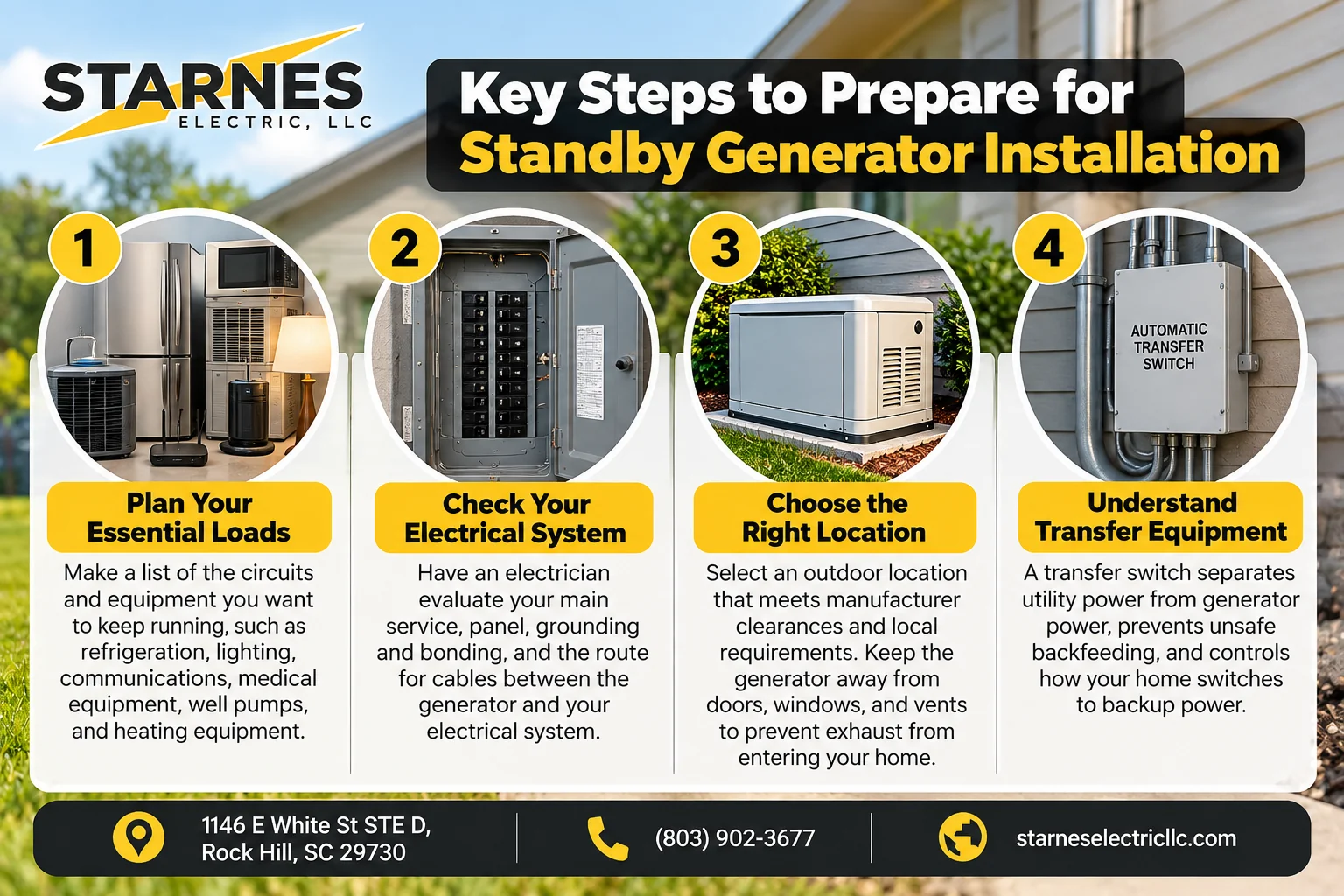
- Make a practical list of the circuits and equipment you consider essential during an outage. Refrigeration, selected lighting, communications, medical equipment, well pumps, heating equipment, or other loads may have very different starting and running demands.
- The installer needs to evaluate the main service, panel, grounding and bonding arrangement, and the route between the generator, transfer equipment, and the electrical system.
- Standby generators need an outdoor location that complies with the equipment manufacturer’s clearances and applicable local requirements. Exhaust must not be allowed to enter the home through doors, windows, or vents.
- A transfer switch or listed transfer equipment separates utility power from generator power and prevents unsafe backfeeding. It also determines how the home changes from normal utility power to backup power.
At a Glance
| Question | Short answer | Why it matters |
| Start With the Loads You Want to Keep Running | Make a practical list of the circuits and equipment you consider essential during an outage. Refrigeration, selected lighting, communications, medical equipment, well pumps, heating equipment, or other loads may have very different starting and running demands. | Avoid choosing generator size from square footage alone. The electrical loads that must operate—and whether some of them need to start at the same time—are more useful planning inputs. |
| Clear Access to the Panel and Service Equipment | The installer needs to evaluate the main service, panel, grounding and bonding arrangement, and the route between the generator, transfer equipment, and the electrical system. | If the panel is crowded, damaged, obsolete, or already near its practical capacity, that may affect the scope. It does not automatically mean a panel replacement is required, but it should be evaluated before the generator is connected. |
| Plan Generator Placement Before Installation Day | Standby generators need an outdoor location that complies with the equipment manufacturer’s clearances and applicable local requirements. Exhaust must not be allowed to enter the home through doors, windows, or vents. | Fuel type, site access, drainage, nearby structures, and the path to the electrical equipment can all affect placement. |
| Understand the Role of Transfer Equipment | A transfer switch or listed transfer equipment separates utility power from generator power and prevents unsafe backfeeding. It also determines how the home changes from normal utility power to backup power. | Whole-home systems may use automatic transfer equipment, while other designs may supply selected loads. The right arrangement depends on the generator, electrical service, and project goals. |
For homeowners comparing options or preparing for professional work, see Starnes Electric’s Whole Home Generator Rock Hill SC for the service scope and local next steps.
Start With the Loads You Want to Keep Running?
Make a practical list of the circuits and equipment you consider essential during an outage. Refrigeration, selected lighting, communications, medical equipment, well pumps, heating equipment, or other loads may have very different starting and running demands.
Avoid choosing generator size from square footage alone. The electrical loads that must operate—and whether some of them need to start at the same time—are more useful planning inputs.
Bring equipment information to the estimate when you have it. A qualified installer can use the actual electrical requirements to determine an appropriate design.
Clear Access to the Panel and Service Equipment?
The installer needs to evaluate the main service, panel, grounding and bonding arrangement, and the route between the generator, transfer equipment, and the electrical system.
If the panel is crowded, damaged, obsolete, or already near its practical capacity, that may affect the scope. It does not automatically mean a panel replacement is required, but it should be evaluated before the generator is connected.
Keeping the work area accessible helps the electrician inspect existing equipment and plan cable or conduit routes without unnecessary disruption.
Related reading: Whole-Home Generator Installation Costs in Rock Hill, SC.
Plan Generator Placement Before Installation Day?
Standby generators need an outdoor location that complies with the equipment manufacturer’s clearances and applicable local requirements. Exhaust must not be allowed to enter the home through doors, windows, or vents.
Fuel type, site access, drainage, nearby structures, and the path to the electrical equipment can all affect placement.
Do not assume that the closest spot to the electrical panel is automatically the best location. Placement has to satisfy both safety and installation requirements.
When Your Appliances Start Talking: How Smart Tech Is Changing the Way We ‘Listen’ at Home
Every homeowner eventually faces a crucial decision: when something breaks [...]
Learn More
Understand the Role of Transfer Equipment?
A transfer switch or listed transfer equipment separates utility power from generator power and prevents unsafe backfeeding. It also determines how the home changes from normal utility power to backup power.
Whole-home systems may use automatic transfer equipment, while other designs may supply selected loads. The right arrangement depends on the generator, electrical service, and project goals.
Ask the installer to explain which circuits will be supplied, what happens during an outage, and how the system returns to utility power.
Related reading: Electrical Panel Upgrades Rock Hill SC.
What to Have Ready for the Estimate?
Prepare a list of outage priorities, note any large electric appliances or recent electrical upgrades, and make sure the electrician can access the service equipment.
If you are considering future additions such as an EV charger, electric water heating, a hot tub, or major HVAC changes, mention them. Those plans can influence how the electrical system should be evaluated today.
A clear scope before installation helps avoid a generator design that solves today’s problem but conflicts with near-term electrical plans.
When Should You Call an Electrician?
Call a qualified electrician when the project requires opening electrical equipment, modifying wiring, adding circuits, diagnosing repeated breaker trips, or working near service equipment. Seek prompt help for smoke, active arcing, severe overheating, burning odors, or other signs of an immediate electrical hazard.
What Should You Ask Before Approving the Work?
- What did you find during the inspection?
- Which work corrects the current problem, and which recommendations are optional upgrades?
- Will the project affect the panel, service, permits, inspections, or utility coordination?
- How will the completed work be tested and documented?
Frequently Asked Questions
Do I need to know the exact generator size before calling an installer?
No. It is more useful to know which loads you want to support. The installer can evaluate those loads and the existing electrical system before recommending equipment.
Does every standby generator require a panel upgrade?
No. A panel upgrade depends on the existing equipment, service condition, capacity, and the planned generator connection.
Why is a transfer switch important?
Transfer equipment separates utility and generator power and helps prevent backfeeding. ESFI identifies transfer switches as the safe method for connecting a generator to a home electrical system.
Next Step
If you want the electrical system evaluated on site, contact Starnes Electric and describe the symptoms, equipment, or project goals you want reviewed.
Ready for Backup Power?
Make sure your home is ready for standby generator installation. Call now to schedule an expert assessment!
About the Author: Dalton Starnes