
Copper vs. Aluminum Wiring: A 2026 Safety and Conductivity Showdown
Table of Contents
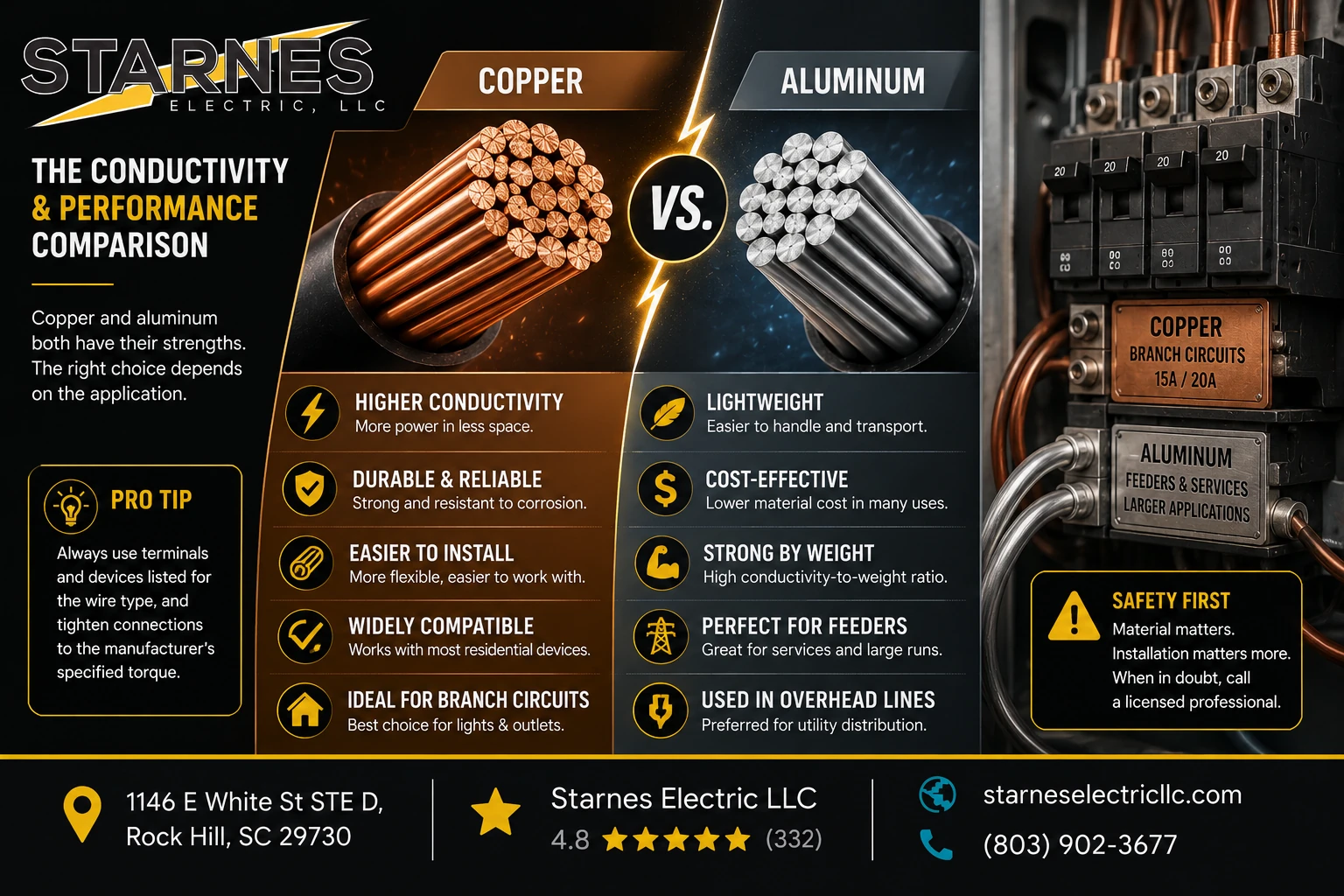
The copper-versus-aluminum debate sounds simple until someone opens an electrical panel and discovers that both materials may already be working inside the same house. Copper usually wins for standard residential branch circuits because it offers stronger conductivity, durable connections, and broad compatibility with switches and receptacles. Aluminum, however, is not automatically unsafe or outdated. Modern aluminum-alloy conductors remain useful for larger electrical services, feeders, and utility distribution when they are sized, terminated, and installed correctly.
That distinction is the heart of the 2026 wiring conversation. Older solid aluminum branch-circuit wiring deserves serious attention, but it should not be confused with every aluminum conductor manufactured today. A properly installed modern aluminum feeder is a very different product from the small-gauge aluminum wiring used in many homes during the late 1960s and 1970s.
In our view at Starnes Electric, choosing a wiring material should never become a popularity contest. Copper is not magical, and aluminum is not electrical trouble wrapped in plastic. Safety depends on conductor type, size, connections, equipment listings, workmanship, maintenance, and the condition of the complete electrical system.
Old Wiring Could Be Putting Your Home at Risk
Upgrade unsafe copper or aluminum wiring with trusted electrical solutions. Call today for a professional inspection.
Is copper or aluminum wiring safer for homes in 2026?
For most household lighting and receptacle circuits, copper remains the safer and more practical choice in 2026. It is highly conductive, mechanically durable, widely accepted by residential wiring devices, and less sensitive to installation mistakes at connection points.
Copper conductors can still be damaged, overheated, overloaded, or improperly installed. A copper wire squeezed under the wrong terminal or connected to an oversized breaker is not protected by its good reputation. Still, copper generally gives electricians a larger margin for dependable residential connections.
Aluminum requires more careful discussion because the word covers several generations and types of conductors.
Older solid aluminum branch-circuit wiring became common when copper prices increased during the 1960s and 1970s. It was used for smaller circuits supplying lights, switches, and receptacles. Over time, safety concerns emerged at connections where the aluminum wire met devices and splices. The Electrical Safety Foundation International (ESFI) notes that reports of fires revealed hazardous conditions associated with this older residential aluminum wiring.
The conductor itself does not typically burst into flames for dramatic effect. Trouble usually develops at a loose, deteriorated, or incompatible connection. Aluminum expands and contracts more than copper as it heats and cools. It can also experience surface oxidation and connection movement when terminals are not designed or installed properly. Resistance may increase at the connection, producing more heat, which creates a rather unpleasant cycle.
Modern aluminum wiring is different. Electrical-grade aluminum alloys, larger conductor sizes, improved terminals, and listed equipment have made aluminum a practical option for many feeders and service conductors. NFPA notes that certain aluminum and copper-clad aluminum conductors must use recognized electrical-grade aluminum alloys and be properly listed.
For homeowners, the safest approach is not to declare one metal good and the other evil. It is to ask better questions:
- Is the wire copper, older solid aluminum, modern aluminum alloy, or copper-clad aluminum?
- What circuit does it supply?
- Is the conductor correctly sized?
- Are the terminals listed for that material?
- Were connections prepared and tightened correctly?
- Are there signs of overheating, corrosion, or previous repairs?
- Is the breaker properly sized for the circuit?
A modern aluminum service entrance installed by a qualified electrician can be safe and dependable. Old small-gauge aluminum wiring connected to incompatible receptacles is a different situation and should be professionally evaluated.
Does copper or aluminum have better conductivity?
Copper has better electrical conductivity by volume. In simple terms, a copper conductor can carry the same amount of current as an aluminum conductor while using a smaller cross-sectional area.
This is why an aluminum wire generally needs to be larger than a copper wire to serve a comparable electrical load. Two conductors with the same visible diameter are not automatically equal just because they both fit through the same opening.
Copper’s conductivity makes it particularly convenient in crowded residential panels, device boxes, and branch circuits. Smaller conductors are often easier to route, bend, terminate, and fit behind switches or receptacles.
Aluminum responds with a different advantage: conductivity relative to weight. The Aluminum Association states that aluminum has a strong conductivity-to-weight ratio and provides approximately twice the conductivity per pound compared with copper.
That means copper wins the compactness contest, while aluminum wins the lightweight contest. Think of it as a showdown between a smaller heavyweight and a larger lightweight. Both can carry substantial current, but they do it with different dimensions and physical characteristics.
Copper usually provides:
- Higher conductivity for a given conductor size
- Smaller wire sizes for comparable loads
- Strong mechanical durability
- Easier use with common residential devices
- Broad familiarity among electricians and inspectors
Aluminum usually provides:
- Lower weight
- Lower material cost in many applications
- Easier handling for large conductors
- Strong conductivity relative to weight
- Practical value for services, feeders, and utility lines
Conductivity is only one part of wire selection. Engineers and electricians also consider ampacity, insulation rating, installation environment, terminal compatibility, voltage drop, physical protection, conductor length, cost, and code requirements.
The best conductor is not always the one with the highest conductivity. It is the one properly selected for the actual circuit.
Is aluminum wire better than copper wire for residential electrical systems?
Aluminum is not generally better than copper for every part of a residential electrical system. For standard 15-amp and 20-amp lighting and receptacle circuits, copper is usually preferred because it fits common devices well, handles repeated bending effectively, and offers dependable connection performance.
For larger circuits, aluminum can make excellent financial and practical sense.
A home may use aluminum for:
- Main service-entrance conductors
- Subpanel feeders
- Large appliance circuits
- Detached garage feeders
- HVAC equipment circuits
- Electric vehicle charging feeders
- Other high-amperage applications
Larger aluminum conductors are lighter and often less expensive than comparable copper conductors. Those savings become meaningful when a project requires long runs or large wire sizes.
Still, aluminum cannot simply be substituted for copper size-for-size. Because aluminum has lower conductivity by volume, the conductor normally must be larger. The equipment must also be listed for aluminum conductors, and the connection must be prepared according to manufacturer instructions.
The terminal marking matters. Equipment may be labeled for copper only, aluminum only, or both copper and aluminum. Common markings include CU, AL, or CU/AL. A conductor should never be forced into a terminal that is not approved for it.
Proper aluminum installation may also involve:
- Correct conductor preparation
- Listed connectors and terminals
- Appropriate oxide-inhibiting compound when required
- Accurate tightening to the manufacturer’s torque specification
- Proper bending space
- Protection against physical damage
- Correct conductor and breaker sizing
The tightening requirement deserves more attention than it usually receives. Electrical connections should not be tightened using the traditional “that feels about right” method. Too loose can create resistance and heat. Too tight can damage the conductor or terminal.
A calibrated torque tool allows the connection to be tightened to the equipment manufacturer’s specified value. It is not glamorous, but neither is explaining why a scorched lug was installed based on wrist confidence.
Our opinion is straightforward: copper is usually the better all-around option for small residential branch circuits, while aluminum can be the smarter option for properly designed larger circuits. A good electrical system can contain both materials without becoming a neighborhood scandal.
Can aluminum wiring be used safely in a house lighting circuit?
Aluminum wiring can be used safely only when the conductor, devices, connectors, and installation methods are specifically approved for that application. However, installing new solid aluminum wiring for ordinary residential lighting circuits is generally not the preferred approach.
The larger concern is existing older aluminum branch-circuit wiring. Homes built or rewired during the late 1960s and 1970s may contain solid aluminum conductors supplying ceiling lights, switches, and receptacles. These circuits can remain hidden for decades, quietly waiting behind wall plates like an electrical surprise nobody requested.
Homeowners should not assume that functioning lights prove the wiring is safe. A deteriorating connection can continue carrying current while generating excessive heat inside a box.
Warning signs may include:
- Warm or discolored switch plates
- Flickering or dimming lights
- A burning or hot-plastic odor
- Buzzing or sizzling sounds
- Intermittent power at lights or receptacles
- Sparks when operating a switch
- Loose-feeling switches or outlets
- Frequently tripping breakers
- Evidence of overheating inside electrical boxes
ESFI recommends professional inspection when a home is more than 40 years old and has aluminum wiring, particularly if it has not recently undergone an electrical safety inspection. It also advises homeowners to treat flickering lights, unusual sounds, hot or discolored devices, shocks, and damaged insulation as warning signs that require qualified evaluation.
Homeowners should not remove devices and tighten aluminum connections themselves. Disturbing an old conductor can damage it, and replacing a receptacle with an ordinary copper-only device may make the installation less safe.
Safe repair requires an electrician who understands aluminum branch-circuit wiring and uses approved repair methods.
Tripped Breakers: Common Electrical Issues
Are you tired of having to constantly reset tripped breakers [...]
Learn More
Why is aluminum preferred over copper for overhead electrical cables?
Aluminum is often preferred for overhead power lines because it delivers useful conductivity without the enormous weight and cost that equivalent copper systems could bring.
Overhead conductors must span long distances between poles and towers. Weight matters because heavier conductors create greater mechanical loads on poles, crossarms, insulators, and support structures. They can also sag more substantially unless the infrastructure is designed to carry them.
Aluminum’s conductivity-to-weight ratio makes it especially useful for transmission and distribution. The Aluminum Association notes that aluminum has been used in utility transmission and distribution systems since before World War II and remains a preferred material in those applications.
Many overhead conductors combine aluminum strands with a reinforced core. The aluminum carries electrical current, while the reinforced core helps provide the mechanical strength needed for long spans.
Compared with copper, aluminum offers utilities several benefits:
- Lower conductor weight
- Reduced structural loading
- Lower material cost
- Easier handling during installation
- Efficient long-distance power delivery
- Strong conductivity relative to weight
This is a good example of why broad statements about wiring materials can be misleading. Copper may be the preferred conductor inside a bedroom wall, while aluminum may be the obvious choice several stories above the street.
Different jobs require different tools. Nobody criticizes a ladder for being worse than a screwdriver. They simply use each one where it belongs.
When should homeowners replace or repair aluminum wiring?
Homeowners should arrange an inspection when they know or suspect that older solid aluminum branch-circuit wiring is present. Inspection becomes especially important when warning signs appear, devices are being replaced, renovations are planned, or the home has no documented history of aluminum-wiring repairs.
Repair or replacement may be appropriate when:
- Connections show signs of overheating
- Switches or receptacles are incompatible with aluminum
- Wiring has been altered using unapproved connectors
- Insulation is brittle, damaged, or burned
- Previous repairs are inconsistent or undocumented
- Circuits experience flickering, buzzing, or intermittent power
- A renovation will expose walls and make rewiring easier
- An insurer, buyer, lender, or inspector raises concerns
- The electrical system no longer meets the household’s needs
Complete replacement with copper branch-circuit wiring is the most comprehensive solution. The Consumer Product Safety Commission (CPSC) describes copper rewiring as the best available repair method, although it acknowledges that full replacement may be impractical or too expensive in some homes.
When complete rewiring is not practical, certain approved connection-repair systems may be considered. CPSC guidance has identified professionally installed COPALUM connections and AlumiConn connectors as repair methods that meet its safety recommendations for older aluminum wiring.
Not every product labeled for aluminum should automatically be treated as an equivalent whole-home repair. Repair methods must be selected and installed according to their listings and the conditions of the wiring system.
A proper evaluation may involve opening representative devices, inspecting connections, identifying conductor markings, checking for overheating, reviewing breaker sizes, examining previous splices, and documenting where aluminum circuits are located.
The result may not always be “rewire the entire house.” Some homes need targeted correction. Others contain widespread problems that make complete replacement the sensible long-term choice.
What homeowners should not do is ignore the wiring because the lights still turn on. Electrical systems rarely announce connection deterioration with a polite calendar invitation.
Give Older Wiring a Safer Next Chapter
Copper and aluminum both have legitimate roles in residential electrical systems. Copper remains our preferred choice for most lighting and receptacle branch circuits because of its conductivity, durability, and compatibility. Modern aluminum can be a reliable, economical option for larger feeders and service conductors when it is correctly sized and terminated.
The real concern is not the mere presence of aluminum. It is older small-gauge branch-circuit wiring, incompatible devices, loose connections, poor repairs, and electrical work completed without the right materials or methods.
At Starnes Electric, we inspect aluminum wiring with the full system in mind. We identify the conductor type, examine connection points, look for overheating, review breaker sizing, and explain whether repair, partial replacement, or complete copper rewiring makes sense for the home.
If your house contains aluminum wiring, shows signs of electrical trouble, or is due for a safety evaluation, contact Starnes Electric. We will help you understand what is behind the walls and create a practical plan for safer, more dependable power.
Don't Wait for Wiring Problems to Get Worse
Prevent overheating, loose connections, and costly repairs with a professional electrical evaluation. Call today.
About the Author: Starnes Electric