
The “Rotten Egg” Electrical Smell: Why Fishy or Sulfur Smells Mean Your Wires Are Melting
Table of Contents
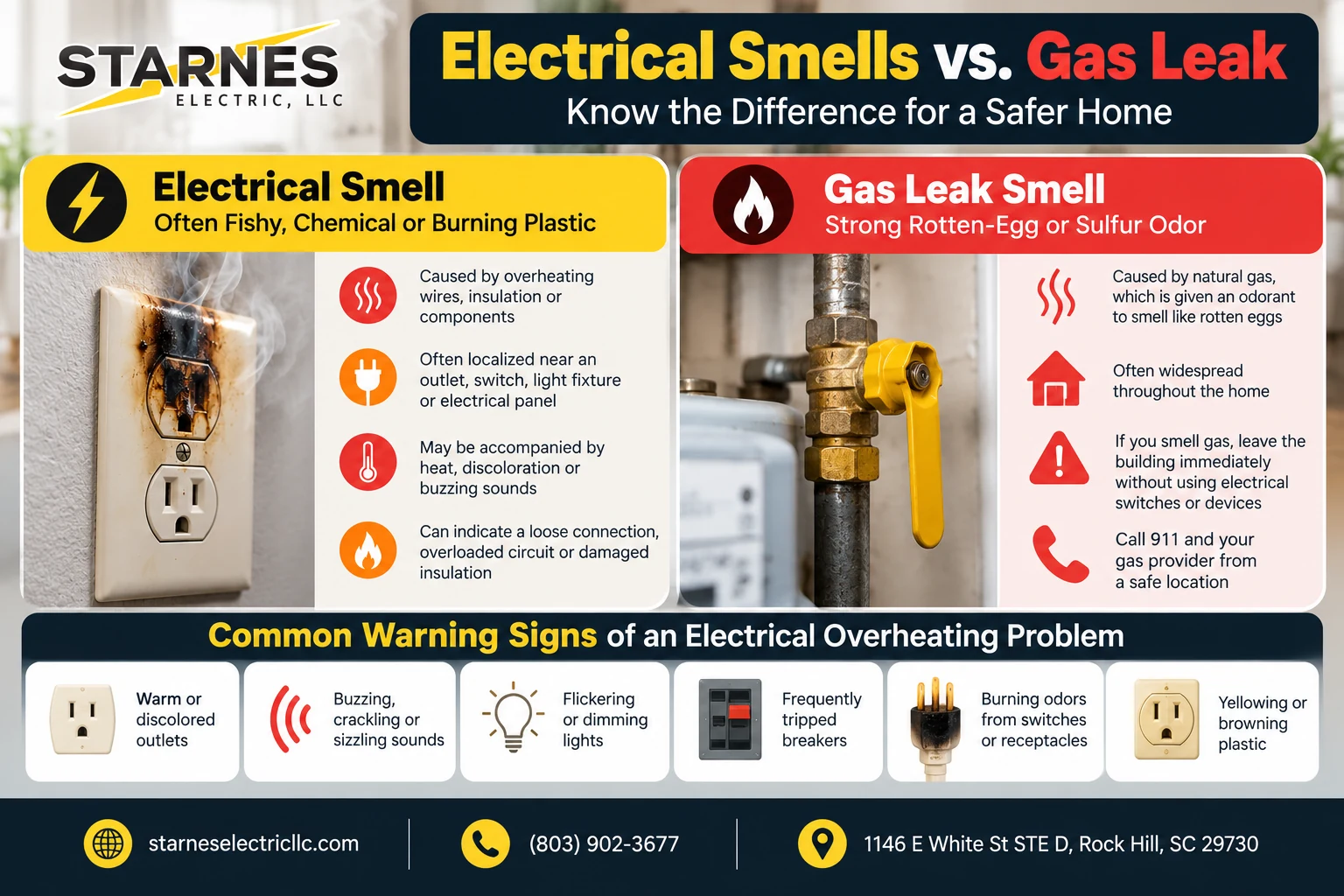
A strange fishy, chemical, or burning-plastic smell near an outlet, switch, light fixture, or electrical panel can be a warning that electrical components are overheating. Insulation, plastic housings, connections, and other materials can become hot enough to discolor, soften, or eventually melt.
But there is an important distinction: a true rotten-egg smell can also indicate a natural gas leak. If the odor strongly resembles rotten eggs and gas could be present, leave the building without operating lights, switches, breakers, phones, or other electrical devices, then call 911 and your gas provider from a safe location. South Carolina natural-gas safety guidance gives the same advice.
Once a gas leak has been ruled out, though, a mysterious fishy smell around electrical equipment deserves immediate attention. Electrical Safety First specifically identifies strong fish-like odors as a possible sign of overheating electrical equipment.
And in our opinion, electrical odors belong in the category of household problems you do not solve by lighting a candle and hoping for the best.
Smell Something Fishy or Burning?
Don’t ignore unusual electrical odors. Call Starnes Electric LLC now for fast, professional electrical troubleshooting.
Why Do My Electrical Wires Smell Like Fish?
Electrical wires themselves are made primarily of conductive metal, usually copper or aluminum, surrounded by insulation and protective materials. When homeowners describe an electrical problem as smelling “fishy,” they are usually smelling heated insulation, plastic, terminals, wiring accessories, or another electrical component rather than the copper conductor itself.
Electrical Safety First notes that overheating electrical equipment can produce a strong odor that people often describe as fish-like. It has also warned that an unusual fishy smell around plug sockets can be associated with overheated or burning plastic.
So why would electrical equipment become hot enough to smell?
There are several possibilities.
A loose electrical connection
Loose connections can create resistance at terminals and connection points.
Instead of electricity flowing cleanly through a solid connection, heat can build at the weak point. The surrounding insulation, receptacle body, wire connector, or other plastic material may begin overheating.
That is one reason a problem can exist even when the outlet still technically works.
The lamp may turn on.
The television may continue running.
The receptacle may look perfectly normal from six feet away.
Behind the wall, however, a connection could be getting hotter every time current passes through it.
Electrical problems do not always have the courtesy to stop working before becoming dangerous.
An overloaded circuit or receptacle
Putting too much demand on a circuit can also contribute to overheating.
The Electrical Safety Foundation International lists several warning signs of electrical overloads, including:
- Warm or discolored wall plates
- Buzzing, cracking, or sizzling sounds
- Frequently tripped breakers
- Flickering or dimming lights
- Burning odors from switches or receptacles
If the outlet smells strange whenever a space heater, microwave, toaster oven, hair dryer, or other high-demand appliance is running, that is useful information.
It is not, however, an invitation to keep experimenting until you identify exactly how many appliances it takes to produce the smell.
Damaged insulation
Electrical insulation can deteriorate due to age, excessive heat, physical damage, poor connections, or previous electrical problems.
ESFI specifically warns that overheated wiring can produce the smell of hot insulation.
Once insulation is damaged, the problem can progress beyond an unpleasant odor. Damaged insulation may expose conductors or increase the risk of arcing, short circuits, shocks, and fire.
That is why the smell matters.
Your nose may notice the problem before your eyes do.
Why Does My Electrical Outlet Smell Like Rotten Eggs?
This question requires a little caution because “rotten eggs” means different things depending on where the smell is coming from.
If you have natural gas service and suddenly notice a strong rotten-egg odor in the home, do not assume the outlet is responsible.
Natural gas is naturally odorless, so utilities add an odorant that gives leaks their recognizable rotten-egg or sulfur-like smell. South Carolina gas authorities advise anyone who suspects a leak to leave immediately and avoid operating electrical switches or appliances because a spark could ignite accumulated gas.
That means you should not start walking around flipping breakers in an attempt to determine whether the smell disappears.
If gas is a realistic possibility, get outside first.
Once natural gas has been ruled out, an odor that seems concentrated around an outlet may indicate overheating electrical material.
Look for warning signs without taking the outlet apart yourself:
- Discoloration around the receptacle
- Yellowing or browning plastic
- A warm wall plate
- Crackling or buzzing
- Intermittent power
- A loose-fitting plug
- Recent breaker trips
- A smell that becomes stronger when an appliance operates
- Visible melting or deformation
Electrical Safety First specifically notes that yellowing electrical outlets can be a sign of overheating, especially when accompanied by a fishy odor.
One common mistake is assuming that because the breaker has not tripped, everything must be fine.
A circuit breaker is an important safety device, but it cannot diagnose every loose connection or localized heating problem in exactly the way homeowners imagine.
A poor connection at one receptacle, for example, may generate significant heat while current remains below the breaker’s normal trip threshold.
That is why smell, heat, buzzing, and discoloration should not be dismissed simply because the electrical panel appears happy.
Can An Electrical Issue Cause A Fishy Smell?
Absolutely.
A fish-like smell is one of the stranger but recognized warning signs associated with overheated electrical components.
And yes, it sounds ridiculous the first time you hear it.
Someone walks into the living room and asks, “Did somebody cook fish?”
Nobody did.
Five minutes later, everyone is sniffing couch cushions while an electrical receptacle quietly overheats behind the television.
The important thing is to investigate the possibility of an electrical source rather than assuming the smell must be food, plumbing, garbage, or something outdoors.
Electrical problems that may produce unusual odors include:
- Loose receptacle connections
- Overheated switches
- Damaged wiring insulation
- Overloaded receptacles
- Failing light fixtures
- Faulty electrical equipment
- Overheated extension cords
- Damaged power strips
- Failing appliance connections
- Problems inside an electrical panel
- Arcing or deteriorating connections
ESFI advises homeowners to contact a qualified electrician when they notice burning odors along with other warning signs such as warm outlets, discoloration, buzzing, or flickering lights.
Location is one of your best clues.
If the smell gets stronger near a particular outlet, fixture, appliance, switch, or electrical panel, that deserves attention.
You may also notice that it appears only under certain conditions.
Perhaps the smell starts when:
- The dryer is running
- A portable heater is turned on
- Several kitchen appliances operate together
- An air conditioner starts
- A particular light has been on for an hour
- An EV charger is operating
- An old power strip is heavily loaded
That pattern can help an electrician troubleshoot the issue.
What you should not do is remove the receptacle, open the panel, or begin probing electrical connections just because you have narrowed down the location.
Finding the smell is useful.
Finding out what 240 volts feels like is considerably less useful.
What Causes Dead Outlets and How an Electrician Can Help Revive Them
Dead electrical outlets can be more than just an inconvenience; [...]
Learn More
Why Do Electrical Problems Sometimes Smell Like Sulfur?
Electrical overheating does not produce one perfectly standardized odor.
Depending on which material is heating, people may describe the smell as:
- Fishy
- Acrid
- Chemical
- Metallic
- Burning plastic
- Hot rubber
- Ozone-like
- Sulfur-like
Human descriptions of smells are wonderfully imprecise. One person’s “burning plastic” is another person’s “dead fish,” and a third person walks into the room and says, “It smells like something weird.”
That makes sulfur especially tricky.
A sulfur or rotten-egg odor should first raise the possibility of a gas leak, particularly if the smell is widespread, near gas equipment, or accompanied by hissing.
Natural-gas safety agencies in South Carolina specifically identify rotten-egg odor as a gas-leak warning sign. They advise occupants to leave immediately and avoid operating electrical switches, phones, garage door openers, vehicles, or anything else that might create a spark.
Once gas has been ruled out, an unusual chemical or sulfur-like smell may still warrant checking electrical equipment.
Electrical components contain many materials beyond copper wire. Plastic insulation, circuit-board components, receptacle bodies, adhesives, protective coatings, and appliance electronics can produce unpleasant odors when overheated.
That means the right question is not:
“Does electricity always smell like sulfur?”
It does not.
The better question is:
“Is there an unexplained odor near electrical equipment, and are there any other warning signs?”
For example, consider an outlet that suddenly smells strange and is also warm.
Or a light switch that smells chemical and has started making a faint crackling sound.
Or an electrical panel accompanied by an acrid smell and repeated breaker trips.
Those combinations are much more concerning than smell alone.
Other potential non-electrical sources should also be considered. Plumbing traps, drains, sewer gas, spoiled food, batteries, gas appliances, and natural-gas leaks can all produce unpleasant odors.
The goal is not to identify the smell perfectly with your nose.
The goal is to recognize when something needs professional investigation.
Your nose is a surprisingly good warning system.
It is a terrible multimeter.
Does A Fishy Or Rotten Egg Smell Mean Electrical Wires Are Overheating?
A fishy or burning-plastic odor can absolutely indicate electrical overheating, but it does not automatically prove that wires are literally melting.
That distinction matters.
The smell may be coming from:
- Wire insulation
- A receptacle body
- A switch
- An electrical connector
- An appliance component
- A power supply
- A light fixture
- An overloaded extension cord
- A breaker or panel component
Sometimes the material may only be getting excessively hot.
In more severe cases, overheating can discolor, deform, soften, char, or melt insulation and plastic components.
Electrical Safety First advises people not to ignore melted plastic, burn marks, hot plugs or outlets, buzzing, or breaker trips.
The progression is exactly why an unusual odor should be treated as an early warning, not something to monitor for a few weeks.
Consider the difference between these two approaches:
Approach A:
“That’s a weird smell. We’ll see if it’s still there tomorrow.”
Approach B:
“That’s a weird smell coming from an electrical outlet. Nobody uses that outlet until we know why.”
We strongly prefer Approach B.
If the smell is clearly localized to electrical equipment and there is no reason to suspect a gas leak, stop using the affected outlet, switch, appliance, or circuit and contact an electrician.
If you see smoke, sparks, active burning, or signs of an electrical fire, get people out and call emergency services. Do not pour water onto energized electrical equipment.
And again, if the smell is strongly like rotten eggs and natural gas is possible, treat it as a gas emergency first. Do not flip the breaker or unplug appliances on the way out. Even operating an electrical switch can create an ignition source.
A homeowner should also pay attention to related symptoms such as:
- Flickering lights
- Repeated breaker trips
- Buzzing
- Crackling
- Warm receptacles
- Brown or yellow discoloration
- Melted plastic
- Appliances losing power intermittently
- Sparks when plugging equipment in
- Previous electrical repairs in the affected area
One warning sign is enough to investigate.
Three or four warning signs together are not your house being quirky.
They are your house asking for an electrician.
If Your House Smells Wrong, Don’t Wait for Smoke With Starnes Electric LLC
Electrical problems are frustrating because some of the most serious ones begin with something small.
A faint smell.
A slightly warm outlet.
A breaker that trips twice in one week.
A switch that suddenly makes a quiet buzzing noise.
It is tempting to ignore those things because the electricity is still working. But at Starnes Electric LLC, we believe unusual electrical smells deserve attention precisely because they may appear before a complete failure.
If you notice a fishy, burning-plastic, acrid, or chemical odor around an outlet, switch, light fixture, electrical panel, appliance connection, or other electrical equipment, stop treating the smell as a household mystery.
There may be a loose connection, damaged device, overloaded circuit, deteriorated insulation, or another source of overheating that needs to be identified.
Our team at Starnes Electric LLC can inspect the affected electrical system, trace the source of the problem, and determine what needs to be repaired rather than simply covering up the symptom.
And we cannot emphasize the gas distinction enough: if what you smell is genuinely similar to rotten eggs and a natural gas leak is possible, leave the building immediately without using switches or electrical devices and contact emergency services and your gas provider from a safe location.
Once a gas emergency has been ruled out, we can deal with the electrical side.
Nobody needs to become an expert at distinguishing “hot PVC” from “overheated receptacle” based on smell alone.
You just need to recognize that a new electrical odor is not normal.
Starnes Electric LLC can take it from there.
Because when wiring starts giving you clues through your nose, waiting until you can see smoke is waiting far too long.
Rotten Egg Smell Near an Outlet?
Electrical overheating can become dangerous quickly. Get your wiring inspected by Starnes Electric LLC today.
About the Author: Dalton Starnes