
Why Does My New LED Light Fixture Flicker?
Table of Contents
A new LED light fixture should turn on smoothly and provide steady, reliable light. When it starts flickering, pulsing, flashing, or dimming unexpectedly, the problem can be frustrating, especially when the fixture was installed only recently.
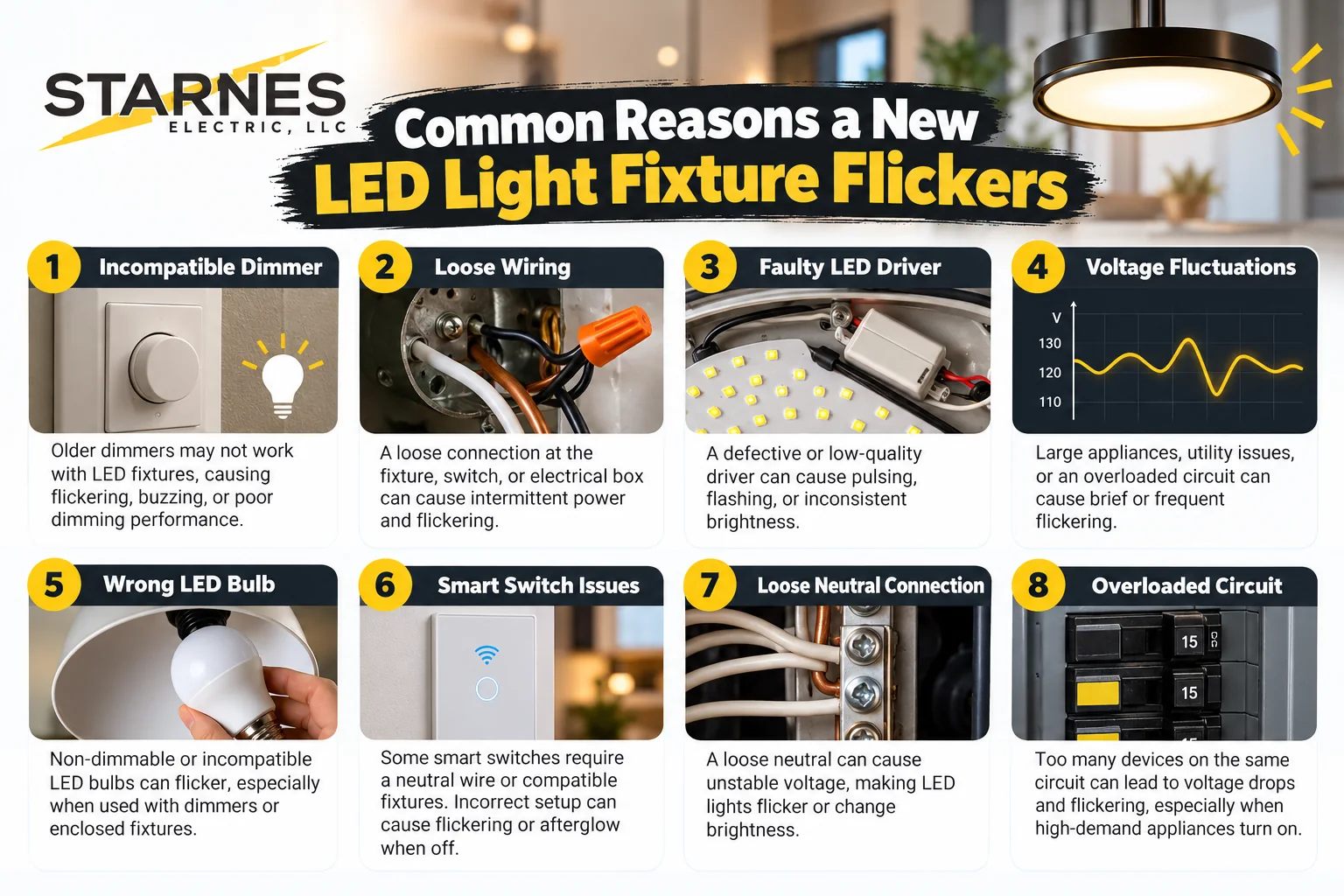
In many cases, a new LED light fixture flickers because of an incompatible dimmer switch, a loose wiring connection, an unstable power supply, or a defective LED driver. The cause may be as simple as a bulb that is not fully seated, but it can also point to a more serious electrical issue that requires professional attention.
The type of flicker can offer useful clues. A fixture that flickers only when dimmed may have a compatibility problem, while a light that flashes when a large appliance turns on may be reacting to voltage fluctuations. A fixture that flickers constantly could have loose wiring, a failing internal component, or a circuit problem.
The important thing is not to ignore it. Occasional flickering may seem harmless, but persistent or worsening flicker can signal a connection that is overheating or beginning to fail.
New LED Light Flickering?
Get expert troubleshooting from Starnes Electric LLC. Call now for safe, reliable electrical repairs.
Is It Normal for a New LED Light Fixture to Flicker?
No. Regular flickering is not considered normal for a properly installed LED fixture.
A brief flash when the light is switched on may occur with certain fixtures, particularly those with built-in electronic controls. However, continuous flickering, repeated pulsing, buzzing, delayed startup, or random flashing should be investigated.
LED fixtures operate differently from traditional incandescent lights. An incandescent bulb uses a heated filament, while an LED fixture relies on electronic components that regulate electrical current. These components are sensitive to voltage changes, dimmer compatibility, wiring quality, and fixture design.
Because LEDs use less electricity, even small electrical irregularities can become noticeable. A wiring issue that did not visibly affect an old incandescent bulb may cause a new LED fixture to flicker.
That does not necessarily mean the LED fixture is poorly made. It may simply be revealing a problem that was already present.
Could the Dimmer Switch Be Causing the Flicker?
An incompatible dimmer switch is one of the most common causes of LED flickering.
Older dimmers were designed for incandescent or halogen bulbs. These lights use more power and respond differently to changes in electrical current. LED fixtures generally require dimmers designed to work with low-wattage electronic lighting.
When an older dimmer is paired with an LED fixture, the fixture may:
-
Flicker at low brightness
-
Buzz or hum
-
Refuse to dim smoothly
-
Turn off before reaching the lowest setting
-
Flash when switched on
-
Continue glowing after being switched off
-
Change brightness without warning
The problem often becomes more noticeable when the dimmer is set near its lowest level.
How Can You Tell Whether the Dimmer Is Incompatible?
Try setting the dimmer to full brightness. If the flickering stops or becomes less noticeable, the dimmer is a likely cause.
You can also check whether the fixture and dimmer are listed as compatible by their manufacturers. Some LED fixtures work only with specific dimmer types.
Common dimmer categories include:
-
Leading-edge dimmers
-
Trailing-edge dimmers
-
LED-rated dimmers
-
Smart dimmers
-
Universal dimmers
A licensed electrician can confirm which type is installed and replace it if necessary. In some cases, adjusting the dimmer’s minimum-load or low-end setting may improve performance.
Can a Loose Wire Make an LED Fixture Flicker?
Yes. Loose wiring is another common and potentially serious cause of flickering.
A connection may be loose at the fixture, switch, electrical box, junction point, or circuit breaker. When electrical contact is inconsistent, the fixture may flicker as power briefly cuts in and out.
Loose wiring may result from:
-
A wire connector that was not tightened properly
-
A conductor that was not fully inserted
-
A loose terminal screw
-
Damaged wire insulation
-
Movement during installation
-
An improperly secured fixture
-
Old wiring that loosened or broke when handled
The fixture may work normally at first and begin flickering days or weeks later as the connection shifts.
Loose connections can create heat and electrical arcing. This makes them more than a nuisance. They can damage the fixture, overheat the wiring, and increase the risk of an electrical fire.
Turn off the circuit and contact an electrician if the fixture flickers along with crackling sounds, heat, burning odors, discoloration, or repeated breaker trips.
Could the LED Driver Be Causing the Problem?
Many LED fixtures contain an internal component called a driver. The driver converts household electricity into the type and level of power the LEDs need.
If the LED driver is faulty, poorly designed, damaged, or incompatible with the circuit, the light may flicker.
A failing LED driver can cause:
-
Rapid pulsing
-
Random flashing
-
Delayed startup
- Reduced brightness
-
Intermittent operation
-
Buzzing
-
Complete fixture failure
Integrated LED fixtures do not use replaceable bulbs in the traditional sense. The LED chips and driver are often built into the fixture. If the driver fails, the entire fixture or its internal power supply may need to be replaced.
A new fixture can still have a defective driver. Manufacturing defects, shipping damage, overheating, and low-quality components can all contribute.
Before replacing the fixture, an electrician may test the voltage and wiring to confirm that the problem is not coming from the home’s electrical system.
Why Does the Fixture Flicker When the Air Conditioner Turns On?
Large appliances can cause brief voltage changes when they start.
Air conditioners, heat pumps, refrigerators, pumps, dryers, and other motor-driven equipment draw a large amount of electricity during startup. This can cause nearby lights to dim or flicker momentarily.
A slight, brief dimming may not always indicate a serious problem. However, frequent or dramatic flickering can suggest:
-
An overloaded circuit
-
Loose electrical connections
-
Undersized wiring
-
Voltage drop
-
A weak neutral connection
-
Problems at the electrical panel
- An issue with the utility supply
If several lights flicker whenever an appliance starts, the problem may extend beyond the new fixture.
An electrician can evaluate the circuit, panel connections, appliance load, and voltage levels. This is especially important if the flickering has worsened over time.
Can the Wrong LED Bulb Cause Flickering?
If the fixture uses replaceable LED bulbs, the bulb itself may be the problem.
Not every LED bulb is compatible with every fixture or dimmer. A non-dimmable bulb used on a dimmer circuit may flicker, buzz, or fail prematurely.
A bulb may also flicker if it is:
-
Loose in the socket
-
Damaged
-
Poorly manufactured
-
The wrong wattage
-
The wrong base type
-
Not designed for an enclosed fixture
-
Incompatible with the dimmer
- Overheating
Turn off the power and allow the bulb to cool before checking it. Make sure it is seated properly without overtightening it.
You can also test the fixture with a known, high-quality LED bulb approved for the application. If the flickering stops, the original bulb was likely the problem.
For enclosed fixtures, confirm that the bulb is rated for enclosed use. Heat can build up inside the fixture and damage bulbs that are not designed for that environment.
Why Does the LED Flicker When It Is Turned Off?
Some LED lights flicker faintly or flash occasionally even after the wall switch is off.
This can happen because LEDs require very little power to produce light. A small amount of electrical current may be enough to charge the fixture’s internal components and create a brief flash.
Possible causes include:
-
An illuminated wall switch
-
A smart switch without a neutral wire
-
Current leaking through the circuit
-
Improper switch wiring
-
Induced voltage from nearby wiring
-
A low-quality LED driver
-
A defective fixture
This behavior is sometimes called ghosting or afterglow.
Although it may not always indicate an immediate safety hazard, it should still be addressed. The fixture should turn off fully, and repeated flashing can shorten the life of its internal components.
An electrician may recommend replacing the switch, correcting the wiring, installing a compatible bypass device, or replacing the fixture.
Enhancing Business Ambiance: The Importance of Indoor Lighting in Commercial Spaces
The right indoor lighting can completely transform a commercial space, [...]
Learn More
Can an Overloaded Circuit Cause LED Flickering?
Yes. An overloaded circuit carrying too much electrical load may experience voltage changes that cause LED lights to flicker.
This may happen when several appliances, outlets, and lights share the same circuit. The problem may become more obvious when a high-demand device is turned on.
Signs of an overloaded or struggling circuit include:
-
Flickering lights
-
Frequently tripped breakers
-
Warm outlets or switches
-
Buzzing sounds
-
Lights dimming when appliances run
-
Slow or inconsistent appliance performance
-
Burning odors
Do not replace a breaker with a larger one to solve the problem. The breaker size must match the wiring. Installing an oversized breaker can allow wires to overheat without proper protection.
An electrician can calculate the circuit load and determine whether circuits should be separated or upgraded.
Could a Loose Neutral Connection Be Responsible?
A loose neutral connection can cause flickering, changing brightness, and unstable voltage.
The neutral wire helps complete the electrical circuit. If it becomes loose at the fixture, switch box, panel, meter, or utility connection, voltage can become unpredictable.
The problem may affect one fixture, several rooms, or the entire house.
Warning signs include:
-
Lights becoming brighter and dimmer
-
Multiple fixtures flickering
-
Some lights becoming unusually bright
-
Appliances behaving unpredictably
-
Electronics resetting
-
Buzzing at the panel
-
Burning odors
-
Intermittent power loss
A loose service neutral can damage appliances and create dangerous voltage conditions. If lights throughout the home are flickering or changing brightness, turn off sensitive electronics and contact an electrician promptly.
If the problem is on the utility side, the electrician may recommend contacting the power company.
Why Does the Fixture Flicker Only at Certain Brightness Levels?
Flickering at certain dimmer settings usually points to a compatibility or minimum-load issue.
LEDs use much less power than incandescent bulbs. An older dimmer may require a higher electrical load to operate properly. When the LED fixture draws less power than the dimmer expects, the output may become unstable.
The result is often flickering near the lowest brightness setting.
Possible solutions include:
-
Installing an LED-compatible dimmer
-
Adjusting the dimmer’s low-end trim
-
Using compatible LED bulbs
-
Replacing the fixture
-
Installing a manufacturer-approved control
The lowest dimming level may need to be set slightly higher. A qualified electrician can adjust it so the fixture dims smoothly without dropping into the flicker range.
Can Smart Switches Cause LED Fixtures to Flicker?
Smart switches can cause flickering when they are incorrectly installed or incompatible with the fixture.
Some smart switches require a neutral wire to power their internal electronics. Others are designed to work without one by allowing a small amount of current to pass through the fixture.
That small current may cause LED lights to glow, pulse, or flash when switched off.
Smart-lighting problems may also result from:
-
Incompatible bulbs
-
Incorrect wiring
-
Firmware issues
-
A switch that cannot handle the fixture’s load
-
A low minimum wattage requirement
-
Multiple smart devices on the same circuit
Weak Wi-Fi may affect app control or responsiveness, but it is less likely to cause the light itself to flicker because of an electrical problem.
The solution may involve replacing the smart switch, adding a neutral wire, installing a compatible bypass device, or choosing a fixture recommended by the switch manufacturer.
Could the Electrical Panel Be Causing the Flicker?
Yes, especially if the flickering affects several lights or circuits.
Loose breaker connections, damaged bus bars, failing breakers, corrosion, and neutral problems can all create unstable power.
Panel-related warning signs include:
-
Flickering in several rooms
-
Crackling or buzzing near the panel
-
Frequently tripped breakers
-
Heat around breakers
-
Burning odors
-
Rust or water damage
-
Lights changing brightness suddenly
The electrical panel should only be inspected by a qualified electrician. Even when the main breaker is turned off, parts of the panel may remain energized.
A flickering fixture may be the first visible symptom of a larger electrical issue.
Can the Power Company Cause LED Flickering?
Sometimes, the source of the problem is outside the home.
Utility voltage fluctuations, transformer problems, damaged service lines, loose utility connections, and changes in neighborhood power demand can cause lights to flicker.
You may suspect a utility issue when:
-
The whole house is affected
-
Neighbors report the same problem
-
Flickering happens at certain times of day
-
The problem began after a storm
-
Outdoor service equipment appears damaged
-
Voltage changes continue after the home’s wiring has been checked
An electrician can test the incoming voltage and determine whether the problem is inside the home or on the utility side.
Should You Replace the Fixture?
Replacing the fixture may solve the problem if the LED driver or internal electronics are defective.
Before buying another fixture, confirm that the wiring, switch, dimmer, and circuit are working properly. Otherwise, the replacement fixture may develop the same problem.
Replacement is more likely to be necessary when:
-
The fixture flickers on a known-good circuit
-
The driver makes buzzing sounds
-
The light overheats
-
The fixture has visible damage
-
The manufacturer confirms a defect
-
The fixture continues flickering with a standard switch
-
The LED output is uneven
-
The fixture shuts down after warming up
Check the product warranty before discarding a new fixture. Many manufacturers cover defective drivers or integrated LED components.
When Should You Call an Electrician?
Call an electrician when the cause is not obvious or when the fixture shows signs of an electrical hazard.
Professional troubleshooting is especially important if:
-
The flickering is continuous
-
Several lights are affected
-
The breaker trips
-
The switch or fixture feels warm
-
You hear buzzing or crackling
-
You notice a burning smell
-
The light becomes unusually bright
-
The wiring is old or damaged
-
The fixture was recently installed
-
The problem worsens when appliances run
Turn off the circuit immediately if there is smoke, sparking, severe heat, or a strong burning odor.
A qualified electrician can test the voltage, inspect the wiring, evaluate the dimmer, check the electrical panel, and determine whether the fixture is defective.
How Can You Prevent LED Flickering?
Careful product selection and proper installation can prevent many common LED problems.
Before purchasing or installing a fixture:
-
Choose a reputable LED fixture
-
Confirm dimmer compatibility
-
Use LED-rated switches
-
Check fixture and bulb requirements
-
Avoid exceeding circuit capacity
-
Make sure wiring connections are secure
-
Use bulbs rated for enclosed fixtures when required
-
Follow the manufacturer’s installation instructions
-
Have old wiring inspected
-
Replace damaged electrical boxes or switches
Keep the fixture instructions and model information. These details can make future troubleshooting easier.
Stop the Flicker Before It Becomes a Bigger Electrical Problem
A flickering new LED fixture may be caused by something simple, such as a loose bulb or an incompatible dimmer. It may also reveal a loose wire, overloaded circuit, failing neutral connection, or problem at the electrical panel.
At Starnes Electric, we help homeowners identify the actual cause of LED light flickering instead of relying on trial and error. Our team can inspect the fixture, test the wiring, check dimmer compatibility, evaluate the circuit, and replace defective components when necessary.
Whether the flicker happens constantly, only when the lights are dimmed, or whenever a major appliance turns on, Starnes Electric can help restore steady, reliable lighting.
Contact Starnes Electric to schedule professional LED lighting troubleshooting and find out whether your new fixture is defective or your electrical system is signaling a larger problem.
LED Lights Won't Stop Flickering?
Don't ignore possible electrical problems. Trust Starnes Electric LLC to inspect and fix your lighting safely.
About the Author: Dalton Starnes