10 Best Ways to Lower Your Duke Energy Bill With Electrical Upgrades
Table of Contents
The best way to lower a Duke Energy bill is to reduce the amount of electricity used by the home’s largest loads, especially heating, cooling, and water heating. Smart thermostats, efficient heat pumps, LED lighting, load controls, energy monitoring, and properly designed electrical upgrades can all help, but the biggest savings usually come from fixing the systems that run for hours rather than replacing one rarely used appliance.
That may sound obvious, yet plenty of homeowners begin with the least important item in the house. They unplug a phone charger, sit back proudly, and wait for the electric bill to collapse. Meanwhile, an aging heat pump is working overtime, ductwork is leaking into the attic, and an electric water heater is warming water around the clock.
In our opinion at Starnes Electric, lowering an electric bill requires more than buying gadgets labeled “smart.” It means understanding where the power is going and choosing upgrades that reduce waste without making the home uncomfortable.
For Duke Energy customers in South Carolina, it is also worth checking current utility programs before beginning a project. Duke Energy expanded several residential efficiency and demand-response incentives in South Carolina in August 2025, and available offers may help offset the cost of qualifying improvements.
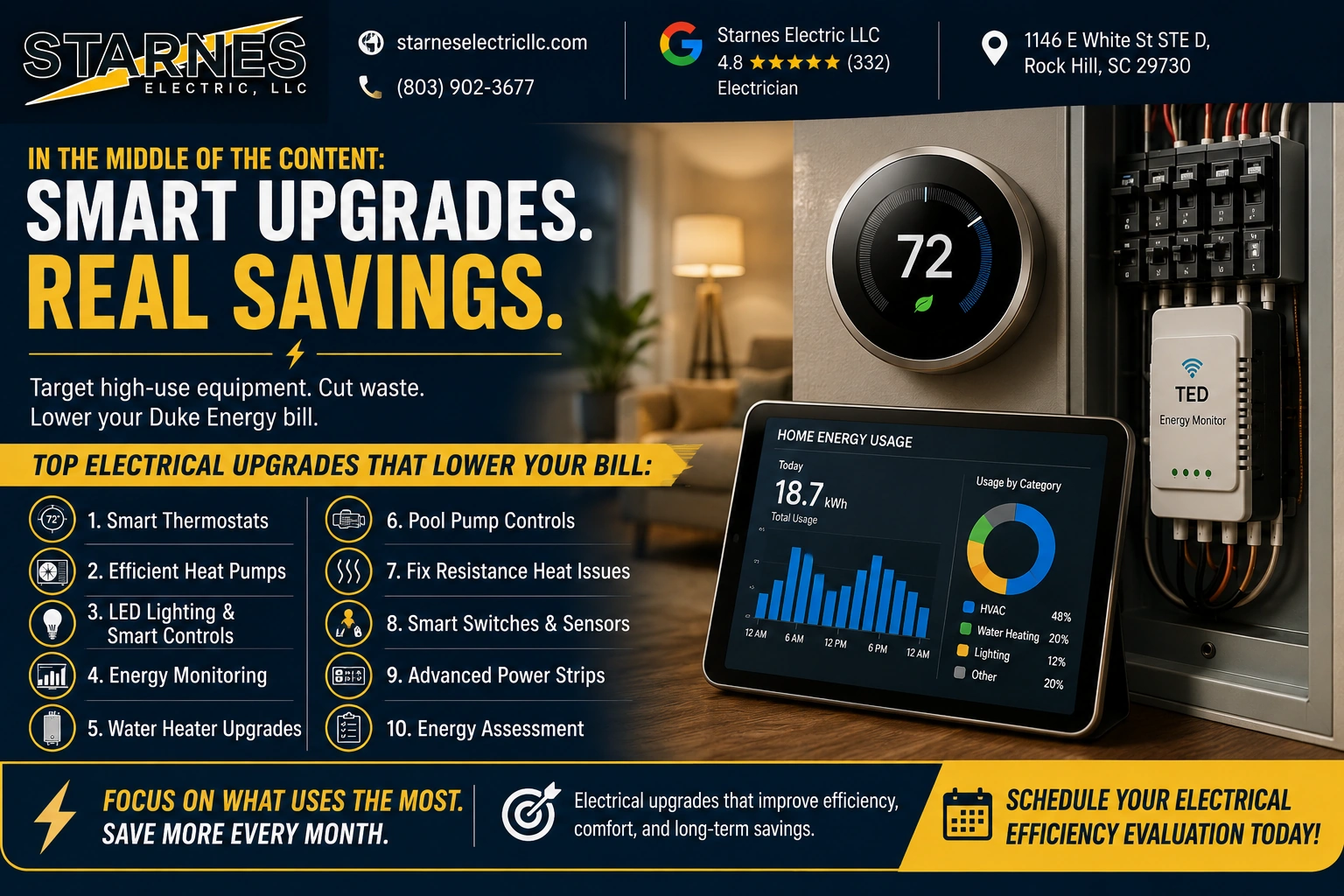
Here are ten electrical upgrades and strategies we believe deserve serious consideration:
- Install a compatible smart thermostat.
- Replace outdated heating and cooling equipment.
- Upgrade the electrical system for a high-efficiency heat pump.
- Convert frequently used lighting to LEDs.
- Install occupancy sensors, timers, or smart switches.
- Add energy monitoring at the electrical panel.
- Replace an inefficient electric water heater or improve its controls.
- Use smart power strips for entertainment and office equipment.
- Correct inefficient wiring, damaged circuits, and voltage problems.
- Schedule an energy assessment before spending heavily.
The best starting point depends on the home. A 1990s house with an aging HVAC system needs a different plan than a newer home filled with lights and electronics that remain on all night.
Tired of High Duke Energy Bills?
Discover affordable electrical upgrades that can help lower your monthly energy costs. Call today for a professional consultation.
What is the best way to lower a Duke Energy bill with electrical upgrades?
The best approach is to identify the home’s largest electrical loads and work downward. Heating and cooling usually deserve attention first because they represent a substantial share of household energy use. ENERGY STAR reports that nearly half of the average American home’s annual energy bill can go toward heating and cooling.
That means replacing three hallway bulbs may help, but it will not compete with improving a heat pump that runs eight hours on a hot afternoon.
1. Install an electrical energy monitor
A whole-home energy monitor can help homeowners see how much electricity the property is using in real time. Some systems connect inside the electrical panel and track individual circuits. Others use utility data or smart-device integrations.
The purpose is not to spend each evening staring at a graph of the refrigerator. The value comes from identifying patterns.
An energy monitor may reveal that:
- The HVAC system runs longer than expected.
- The electric water heater cycles constantly.
- A pool pump operates during unnecessary hours.
- A dehumidifier runs continuously.
- Office equipment remains powered overnight.
- An older freezer uses more electricity than anticipated.
- A well pump cycles because of a plumbing or pressure problem.
Once the major electrical loads are visible, homeowners can make informed changes instead of guessing.
2. Upgrade an outdated heat pump or air conditioner
An older HVAC system can become one of the home’s most expensive electrical habits. As components wear, the system may run longer to produce the same amount of cooling. Poor airflow, weak capacitors, dirty coils, duct leakage, and incorrect sizing can make the problem worse.
Duke Energy currently advertises home-improvement rebates for qualifying heat pumps and air-conditioning systems, although eligibility, amounts, service territory, and contractor requirements should be confirmed before work begins.
A new HVAC system is not purely an electrical upgrade, but the electrical side matters. The project may require:
- A correctly sized branch circuit
- A compatible disconnect
- Updated overcurrent protection
- Surge protection
- New thermostat wiring
- Load-management equipment
- Panel-capacity evaluation
Replacing equipment without evaluating the electrical supply is like buying a new boat and forgetting to inspect the trailer.
3. Prepare the home for efficient heat-pump technology
A high-efficiency heat pump can provide both heating and cooling. ENERGY STAR includes certified heat pumps among its major recommended home-energy upgrades because they can provide efficient year-round climate control.
However, some homes need electrical preparation before a heat pump can be installed. An electrician may need to add circuits, replace an undersized panel, evaluate service capacity, or install wiring for indoor and outdoor equipment.
The goal should not be electrification for its own sake. The goal is selecting efficient equipment that suits the home, climate, insulation level, and electrical system.
Can a smart thermostat help lower a Duke Energy bill?
Yes. A smart thermostat can lower a Duke Energy bill by reducing unnecessary heating and cooling when the house is empty, during sleeping hours, or when indoor conditions do not require full operation.
ENERGY STAR-certified smart thermostats are evaluated using actual field data to confirm that they save energy. They can automatically adjust schedules, learn household patterns, provide usage reports, and allow temperature changes through a phone or computer.
ENERGY STAR estimates that homes with high heating and cooling expenses, especially those left unoccupied for part of the day, may save around $100 per year with a certified smart thermostat. Actual savings depend on the climate, equipment, schedule, insulation, and previous thermostat habits.
4. Install a compatible smart thermostat
A smart thermostat works best when it is compatible with the HVAC system and installed correctly. Not every thermostat works with every heat pump, variable-speed system, communicating system, or multi-stage unit.
Incorrect installation can create problems such as:
- Emergency heat operating unnecessarily
- Auxiliary heat running too often
- Short cycling
- Incorrect fan control
- Loss of staged heating or cooling
- Transformer or control-board damage
- Thermostat power problems caused by a missing common wire
A thermostat that causes expensive resistance heat to operate all afternoon is technically smart only in the same way a cat is smart when it learns to open the food cabinet.
Before purchasing one, confirm the system type, voltage, number of stages, wiring configuration, and manufacturer requirements.
Duke Energy also operates an online savings store for South Carolina customers that may offer discounted smart thermostats and other efficiency products. Product prices and eligibility can change, so homeowners should check the current offers associated with their account.
Can Duke Energy control your thermostat?
Duke Energy can make brief temperature adjustments to a qualifying smart thermostat only when a customer voluntarily enrolls in an applicable demand-response program and agrees to the program’s terms.
For certain Duke Energy Progress customers in South Carolina, the EnergyWise Home smart thermostat program currently offers a $150 enrollment bill credit. In return, participants agree to allow brief thermostat adjustments during periods of high electric demand.
Duke Energy has also promoted a $150 initial bill credit plus annual rewards for eligible smart-thermostat participation in certain service areas and programs. Exact offers depend on the customer’s utility, location, equipment, and current program terms.
This does not mean Duke Energy secretly takes control of every thermostat connected to Wi-Fi. Participation is optional. A customer must enroll a qualifying device and accept the conditions.
Demand-response events are intended to reduce pressure on the electric grid during periods when many customers are using large amounts of energy at once. On a very hot afternoon, thousands of air conditioners may operate simultaneously. Small thermostat adjustments across participating homes can reduce peak demand.
Before enrolling, homeowners should review:
- How often events may occur
- How long adjustments may last
- Whether adjustments can be overridden
- What rewards are available
- Which thermostats qualify
- Whether the HVAC system is eligible
- How leaving the program affects incentives
In our opinion, voluntary thermostat programs can make sense for households that are comfortable with modest temporary adjustments. They may be less suitable for homes with medical temperature needs, unusual occupancy schedules, or HVAC systems that struggle to maintain comfort.
What electrical upgrades reduce electricity costs the most?
The upgrades that reduce costs the most are those affecting equipment with high wattage and long operating times. HVAC equipment, electric water heating, pool pumps, resistance heaters, and frequently used lighting should generally be reviewed before small plug-in devices.
5. Replace or control an inefficient electric water heater
Electric water heating can become a major monthly expense, especially in a household with several occupants. A failing thermostat, sediment buildup, hot-water leak, or damaged heating element can increase operating time.
Depending on the home, an upgrade may involve:
- Installing a heat-pump water heater
- Replacing an aging standard electric unit
- Adding a properly installed timer
- Correcting damaged wiring
- Installing a dedicated circuit
- Using load management
- Repairing an unsafe disconnect
- Improving panel capacity for new equipment
A timer is not appropriate for every household or every water heater. It must be correctly rated, installed, and scheduled. Turning off hot water during low-use periods may help in some homes, but efficient modern equipment and sensible temperature settings often provide better long-term results.
Upgrading Your Home with Smart Electrical Appliances and Automation
In an era where technology is evolving rapidly, upgrading your [...]
Learn More
6. Upgrade pool-pump controls
South Carolina homeowners with pools should pay close attention to pump operating schedules. A high-powered single-speed pump running far longer than necessary can quietly consume a significant amount of electricity.
An electrician can install or update:
- Digital timers
- Smart pump controls
- Proper disconnects
- Dedicated GFCI-protected circuits
- Wiring for a variable-speed pump
- Freeze-protection controls
- Interlocks for related equipment
A variable-speed pump can operate at lower speeds for routine circulation and increase speed only when needed. The exact savings depend on pool size, equipment, schedule, and local requirements, but reducing unnecessary motor runtime is usually more productive than policing every bedside lamp.
7. Correct electric resistance heating problems
Electric resistance heat uses considerable power. Heat strips in a heat pump air handler may be necessary during cold conditions or defrost cycles, but they should not operate unnecessarily because of thermostat errors, control failures, or improper wiring.
Warning signs can include:
- Very high winter bills
- An “auxiliary heat” indicator staying on
- Rooms becoming unusually hot
- A heat pump running constantly
- Breakers or wiring overheating
- Large bill increases without a clear weather explanation
An electrician and HVAC technician may need to work together to determine whether the issue is electrical, mechanical, or control-related.
How can LED lighting and smart switches help reduce energy bills?
LED lighting and smart controls reduce energy costs by using less electricity and preventing lights from operating when no one needs them.
8. Convert frequently used fixtures to LED lighting
LEDs are most valuable in fixtures used for several hours each day. Kitchens, living rooms, exterior security lights, garages, hallways, offices, and commercial-style home workspaces are good places to begin.
Replacing a lamp in a closet opened twice per month will not transform the utility bill. Replacing multiple recessed lights that burn every evening is much more useful.
Homeowners should select LEDs based on more than wattage. Consider:
- Brightness measured in lumens
- Color temperature
- Fixture compatibility
- Dimming compatibility
- Wet- or damp-location ratings
- Enclosed-fixture approval
- Expected operating life
Installing a non-dimmable LED on an old dimmer may produce buzzing, flickering, poor range, or premature lamp failure. Sometimes the bulb is not the problem. The dimmer simply belongs to another era.
9. Add smart switches, occupancy sensors, and timers
Smart switches and occupancy sensors can turn off lighting automatically in places where people frequently forget.
Useful locations include:
- Bathrooms
- Laundry rooms
- Garages
- Closets
- Storage areas
- Children’s rooms
- Exterior lighting
- Workshops
- Guest spaces
Timers are particularly useful for porch lights, landscape lighting, seasonal displays, and other predictable loads. Photocells can control exterior lights based on daylight, while smart schedules can adjust throughout the year.
Smart switches should be selected carefully. Some require a neutral conductor in the box, and older homes may not have one at every switch location. Devices must also be compatible with the connected lighting load.
10. Use advanced power strips for electronics
Televisions, gaming consoles, monitors, printers, speakers, and chargers can continue drawing power while appearing off. ENERGY STAR recommends smart-home controls and advanced power strategies as part of reducing unnecessary household energy use.
An advanced power strip can shut down secondary devices when the main device turns off. For example, switching off a television may also disconnect power to speakers, a game console, and accessories.
The savings from one power strip may be modest, but several entertainment and office areas can add up. More importantly, the solution requires little daily effort after setup.
What can homeowners do first to reduce monthly energy costs?
The first step should be an energy review, not an expensive purchase. Look at several months of energy bills, consider seasonal changes, and identify equipment that runs often.
Duke Energy offers qualifying South Carolina customers access to energy-efficiency programs, including home assessments and incentives for certain improvements. Duke has promoted free in-home or virtual energy assessments through its Home Energy House Call program, although availability should be confirmed for the customer’s current account and service territory.
A practical order of action is:
- Review twelve months of energy use.
- Compare summer and winter peaks.
- Check thermostat schedules.
- Test HVAC performance.
- Inspect electric water-heating operation.
- Identify motors and pumps with long schedules.
- Replace frequently used bulbs with LEDs.
- Add timers or sensors where lights are commonly left on.
- Check Duke Energy rebates before purchasing equipment.
- Have the electrical panel and major circuits evaluated before large upgrades.
Homeowners should also avoid assuming that an electrical-panel replacement alone will lower the bill. A modern electrical panel improves safety, capacity, and reliability, but it does not automatically make appliances consume less electricity.
Panel work can support energy-saving upgrades, however. A new panel may make it possible to add an efficient heat pump, heat-pump water heater, energy monitor, load controls, or correctly sized circuits for modern equipment.
The same caution applies to voltage-saving devices and products promising dramatic reductions without changing actual energy use. Residential electric bills are largely based on kilowatt-hours consumed. A small plug-in box cannot erase the energy required to run an air conditioner, water heater, or range.
Good energy savings usually come from straightforward improvements rather than electrical wizardry.
Make Your Next Duke Energy Bill Less Interesting
An electric bill should not be the most suspenseful thing that arrives each month. The best way to reduce it is to focus on high-use equipment, control unnecessary operation, and make electrical upgrades that support efficient heating, cooling, lighting, and water heating.
At Starnes Electric, we help homeowners determine which electrical upgrades can make a meaningful difference and which products are unlikely to justify their cost. We install smart thermostats, timers, occupancy sensors, LED-compatible controls, energy monitors, dedicated circuits, surge protection, pool controls, and electrical infrastructure for efficient HVAC and water-heating equipment.
We also evaluate panel capacity, damaged wiring, overloaded circuits, and control problems that may cause equipment to operate inefficiently. Before recommending a major project, we consider how the household actually uses electricity.
Contact Starnes Electric to schedule an electrical efficiency evaluation. We will help you build a practical upgrade plan that supports lower energy use, better comfort, and fewer unpleasant surprises when the next Duke Energy bill arrives.
Start Saving on Energy Today
Upgrade your home's electrical system with trusted solutions designed to improve efficiency and reduce your Duke Energy bill.
About the Author: Starnes Electric