
Standard Breakers vs. AFCI/GFCI: Understanding the New “Arc Fault” Safety Laws
Table of Contents
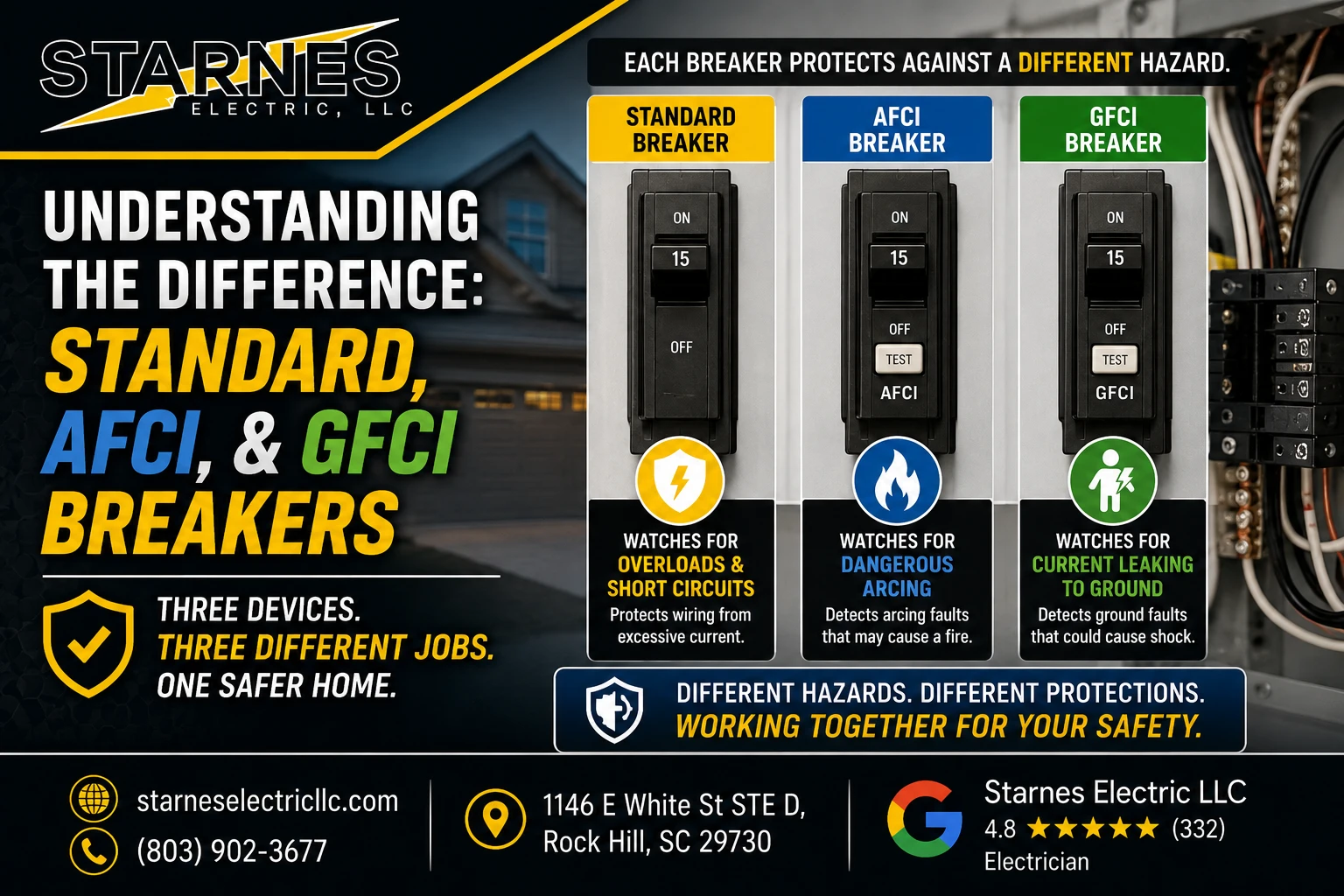
A standard circuit breaker, an arc-fault circuit interrupter (AFCI), and a ground-fault circuit interrupter (GFCI) may occupy similar-looking spaces in an electrical panel, but they do very different jobs. A standard breaker primarily protects wiring from excessive current. An AFCI looks for dangerous electrical arcing that may start a fire. A GFCI watches for electrical leakage that could shock or electrocute a person.
That distinction is important because modern homes contain more wiring, electronics, chargers, appliances, and extension-powered devices than homes did a generation ago. Electrical codes have responded by expanding AFCI and GFCI protection into more residential locations.
Some homeowners see the test buttons and assume newer breakers are simply expensive versions of the old ones. Others blame every trip on an “overly sensitive” device. In our opinion at Starnes Electric, both reactions miss the point. Modern protective breakers are designed to identify hazards that an ordinary breaker may never notice.
They are not perfect, and they are not interchangeable. However, when correctly selected and installed, they provide a layer of protection that standard breakers cannot deliver.
Protect Your Home From Hidden Electrical Hazards
Modern AFCI and GFCI breakers help prevent fires and electrical shocks. Call today for a professional inspection.
What is the difference between standard breakers, AFCI breakers, and GFCI breakers?
The easiest way to understand the three devices is to consider what each one is trying to protect.
A standard circuit breaker protects conductors from excessive electrical current. If too many appliances overload a circuit or a short circuit causes a sudden current increase, the breaker should trip before the wiring overheats.
An AFCI breaker, or arc-fault circuit interrupter, protects against certain hazardous arcing conditions. Arcing may develop when a wire is damaged, a connection becomes loose, insulation deteriorates, or a cord is crushed or pierced. UL describes an AFCI as a device that reduces the effects of arcing faults by de-energizing the circuit when dangerous arcing is detected.
A GFCI breaker, or ground-fault circuit interrupter, protects people against electrical shock. It compares the current leaving the circuit with the current returning. If a small amount escapes through an unintended path, possibly through water, grounded metal, or a person, the device quickly shuts off power.
The Electrical Safety Foundation International (ESFI) summarizes the difference clearly: AFCIs address arc faults that may cause fires, while GFCIs address ground faults that may cause severe shock or electrocution.
Here is the practical comparison:
- Standard breaker: Watches for overloads and short circuits
- AFCI breaker: Watches for dangerous electrical arcing
- GFCI breaker: Watches for current leaking to ground
- Dual-function breaker: Provides both AFCI and GFCI protection when properly listed for both functions
A standard breaker may allow a small arcing fault to continue because the total current remains below its trip rating. Imagine a loose wire connection producing a hot, sparking point inside a wall. The circuit may draw only 10 amps on a 15-amp breaker. To the standard breaker, nothing appears wrong.
An AFCI analyzes the electrical waveform and looks for characteristics associated with hazardous arcing. If it identifies a dangerous condition, it opens the circuit.
Similarly, a small ground fault may involve far less current than required to trip a standard breaker. That current may still be enough to seriously injure someone. A GFCI is designed to detect that imbalance much earlier.
The ordinary breaker is still necessary. AFCI and GFCI protection do not eliminate overcurrent protection. Modern devices usually combine traditional circuit-breaker functions with one or both advanced protective functions.
What is the difference between GFCI and AFCI breakers?
The main difference is the hazard each breaker is designed to detect.
A GFCI is focused on shock protection. An AFCI is focused on fire prevention.
GFCI protection is especially important where electricity and moisture may meet. Bathrooms, kitchens, garages, basements, laundry areas, outdoor locations, crawl spaces, and other damp or wet environments are common examples.
A hair dryer dropped near a sink, a damaged extension cord lying on wet grass, or an appliance leaking current through its metal housing may create a ground-fault hazard. The GFCI responds when current leaves the intended path.
ESFI reports that GFCIs have contributed to a major reduction in electrocutions involving consumer products and recommends installation by a qualified electrician wherever the National Electrical Code (NEC) requires protection.
AFCI protection is concerned with situations such as:
- A nail or screw damaging a cable inside a wall
- A loose receptacle connection producing sparks
- A lamp cord crushed beneath furniture
- A wire damaged by rodents
- Aging insulation cracking around a conductor
- A loose splice inside a junction box
- A damaged appliance cord arcing intermittently
- An overheated or stressed wiring connection
Arc faults can be tricky because they may not produce enough current to trip a conventional breaker. They may appear only when a cord is moved, a device vibrates, or a connection heats up.
ESFI describes AFCIs as advanced devices intended to stop electrical fires by detecting hazardous arcing associated with damaged, overheated, stressed, or worn wiring.
A GFCI may not detect a series arc occurring along one conductor because the outgoing and returning current may remain balanced. An AFCI may not respond to a small current leaking through a person unless the event also produces detectable arcing.
That is why some circuits require both protections. It is not duplication. It is two safety systems watching for two different problems.
What is the difference between a standard breaker and an arc-fault breaker?
A standard breaker primarily reacts to the amount of electrical current flowing through the circuit. An arc-fault breaker also evaluates characteristics of that current to identify patterns associated with hazardous arcing.
Consider a loose terminal on a bedroom receptacle. The connection may spark as a plugged-in heater or vacuum draws power. The sparking point can become extremely hot, but the overall circuit current may remain below the standard breaker’s rating.
A 15-amp breaker does not trip simply because one connection looks unhappy. It responds when current exceeds its designed limits for a certain amount of time or when a major short circuit occurs.
An AFCI provides another set of eyes. It monitors the electrical activity and distinguishes, as far as its design allows, between ordinary events and suspicious arcing.
Normal electrical equipment can create harmless arcs. A light switch may produce a tiny arc when opened. Motors have brushes or switching components that create electrical noise. Plugging in a running vacuum may create a brief spark.
The challenge is separating those normal events from dangerous arcing. Modern AFCIs are tested and listed to recognize specified hazardous conditions without tripping every time someone turns on a blender.
That does not mean every AFCI trip is convenient or immediately understandable. A breaker may trip because of damaged wiring, a loose neutral, a failing appliance, an incorrect connection, shared-neutral problems, or incompatible equipment. The breaker itself can also fail, although automatically blaming the breaker is a mistake.
A 2025 ESFI survey involving electrical contractors in Georgia and South Carolina reported that 84 percent of AFCI-related tripping calls examined were connected to arc-fault conditions. The survey also identified improper wiring, incorrect equipment selection, overloads, maintenance issues, and do-it-yourself work among recurring problems.
In other words, an AFCI trip is often a message, not a personality flaw.
Resetting the breaker repeatedly without investigating the cause is like silencing a smoke alarm while leaving the toast in the oven. The noise may stop briefly, but the underlying issue remains.
Why do newer homes need AFCI breakers?
Newer homes need AFCI protection because electrical fires can begin from damaged or deteriorating wiring even when an ordinary breaker sees no overload.
A new house is not immune to wiring damage. Cables can be pinched during construction, struck by drywall screws, damaged by staples, connected loosely, or stressed when devices are pushed into crowded boxes. Furniture, pets, vacuum cleaners, and everyday use can damage cords after the occupants move in.
New homes also contain more energized equipment than ever:
- Phone and tablet chargers
- Computers and gaming systems
- Televisions and entertainment equipment
- Smart-home devices
- Adjustable beds
- Exercise equipment
- Portable heaters
- Kitchen countertop appliances
- Home-office systems
- Battery-charging stations
More devices mean more cords, connections, plug strips, and opportunities for damage.
The idea that AFCI protection is only for old wiring is therefore incorrect. Older homes may face age-related deterioration, but newer homes still face installation damage, loose connections, and damaged cords.
The National Electrical Code (NEC) began requiring AFCI protection in limited residential areas and expanded those requirements across later editions. Today, AFCI protection applies broadly to many dwelling-unit branch circuits, subject to the adopted code edition, circuit voltage and rating, listed protection method, and local amendments.
From our perspective, the resistance to AFCIs often comes from misunderstanding their purpose. Homeowners see a breaker trip and think the device created the problem. Usually, the device exposed a condition that a standard breaker might have allowed to continue.
That can be annoying when dinner is half-cooked or the television goes dark during a game. It is still preferable to leaving an arcing connection active behind a wall.
Which governing electrical code or standard is required for AFCI protection?
AFCI requirements are primarily established by NFPA 70, the National Electrical Code (NEC), commonly called the NEC. NFPA describes the NEC as the benchmark for safe electrical design, installation, and inspection across the United States.
The NEC is revised every three years. The 2026 edition was released in late 2025 and continues the code’s ongoing development around electrical hazards, new equipment, and updated protection technologies.
However, publication of a new NEC edition does not mean every jurisdiction immediately enforces it.
States, counties, and municipalities adopt electrical codes on their own schedules. Some adopt the latest edition quickly. Others remain on an earlier edition or add local amendments. The authority having jurisdiction, often the local electrical inspection department, determines which rules apply to a specific project.
AFCI protection is generally addressed in NEC Section 210.12, while GFCI requirements are primarily covered in Section 210.8. The exact language, covered areas, exceptions, and approved installation methods can differ among code editions.
Product standards matter too. Breakers and protective devices must be listed and marked for their intended function. UL guidance explains that combination-type AFCI breakers are specifically marked so they are not confused with ordinary circuit breakers or GFCI-only devices.
Homeowners should avoid making code decisions based on an online checklist alone. Whether AFCI protection must be added during a remodel, panel replacement, circuit extension, or receptacle relocation may depend on:
- The code edition adopted locally
- The type and scope of the electrical work
- Whether a circuit is new, extended, replaced, or modified
- The circuit voltage and amperage
- The rooms or outlets being supplied
- Available code exceptions
- Local amendments
- The inspector’s interpretation
- Manufacturer instructions and equipment listings
The code is not simply a shopping list of breakers. It is a system of requirements governing how protection must be applied.
2026 NEC GFCI Requirements for Outdoor HVAC Units
The 2026 NEC includes important GFCI requirements that affect how [...]
Learn More
Where are AFCI and GFCI breakers required in a home?
AFCI and GFCI protection requirements overlap in several residential areas, but they are not identical.
Under recent NEC editions, AFCI protection generally applies to many 120-volt, single-phase, 15- and 20-amp branch circuits supplying outlets or devices in common living areas. Depending on the adopted edition, these areas may include:
- Bedrooms
- Living rooms
- Family rooms
- Dining rooms
- Hallways
- Closets
- Recreation rooms
- Libraries
- Dens
- Sunrooms
- Laundry areas
- Kitchens
- Similar habitable rooms or spaces
GFCI protection is generally required in locations where shock risk is increased by moisture, grounded surfaces, or proximity to plumbing. Common locations include:
- Bathrooms
- Garages
- Outdoors
- Crawl spaces
- Basements
- Kitchens
- Laundry areas
- Areas near sinks
- Boathouses
- Certain appliance outlets
- Other damp, wet, or code-specified locations
Exact requirements depend on the locally adopted code. Newer editions have expanded GFCI protection beyond the familiar bathroom and countertop receptacles. Some requirements now apply to outlets supplying specific appliances or equipment, not merely receptacles within a certain distance of water.
A kitchen circuit is a good example of overlapping protection. It may need AFCI protection because it supplies an area covered by the arc-fault rule and GFCI protection because it serves countertop outlets or appliances in a location covered by the ground-fault rule.
That protection can be provided using a listed dual-function breaker or another code-approved arrangement.
Homeowners should not assume every breaker with a test button does the same thing. Labels may include:
- AFCI
- Combination AFCI
- GFCI
- Dual Function
- CAFCI
- Ground Fault
- Arc Fault
The panel directory should also identify which circuit the device protects. Unfortunately, many panel directories are written in mysterious handwriting with labels such as “plugs,” “back room,” or the timeless classic, “???”
A professional circuit evaluation and accurate labeling can make future testing, troubleshooting, and maintenance much easier.
Is it okay to use AFCI and GFCI devices in series?
Yes, AFCI and GFCI devices can sometimes be installed in series, provided the arrangement is allowed by the devices’ listings, manufacturer instructions, electrical code, and circuit design.
For example, a circuit may use an AFCI breaker in the panel and a GFCI receptacle at the first required outlet. The AFCI breaker protects against specified arc faults, while the GFCI receptacle provides ground-fault protection to itself and properly connected downstream outlets.
This arrangement can be code-compliant when installed correctly.
However, placing devices in series can make troubleshooting more confusing. If a downstream GFCI trips, the homeowner may check the panel first and find the AFCI breaker still on. If the AFCI trips, several GFCI receptacles downstream may lose power. A person unfamiliar with the layout may spend a considerable amount of time pressing every button in the house.
A dual-function breaker can simplify some installations by providing both AFCI and GFCI protection at the panel. UL recognizes breakers listed to combine standard overcurrent protection with both ground-fault and combination-type arc-fault functions.
Still, a dual-function breaker is not automatically the best answer for every circuit. Panel compatibility, neutral configuration, wiring method, equipment characteristics, access to reset devices, local requirements, and cost all matter.
Problems can develop when:
- Line and load terminals are reversed
- Neutrals from separate circuits are mixed
- Shared neutrals are not handled correctly
- A downstream GFCI is connected improperly
- The wrong breaker is installed in the panel
- The breaker’s neutral lead is connected incorrectly
- Equipment leakage causes repeated ground-fault trips
- Existing wiring contains faults that older breakers did not reveal
Two safety devices in series do not normally create “too much safety,” but poor design or incorrect installation can create unnecessary tripping and confusing diagnostics.
A licensed electrician can determine whether separate AFCI and GFCI devices, a dual-function breaker, or another approved method is best for the circuit.
Stop Treating the Test Button Like a Warning Label
Standard breakers, AFCIs, and GFCIs are not competing versions of the same product. They are layers of protection designed for different electrical hazards.
A standard breaker guards conductors against overloads and short circuits. An AFCI responds to specified arcing conditions that may lead to fire. A GFCI reacts to current leakage that may place a person in the path of electricity.
At Starnes Electric, we believe the best electrical system is not the one that never trips. It is the one that trips for the right reason and is properly investigated when it does.
We inspect nuisance tripping, replace damaged or incompatible breakers, install AFCI and GFCI protection, correct neutral and wiring problems, and evaluate older panels during renovations or service upgrades. We also explain which requirements apply under the locally adopted electrical code rather than assuming every home needs the same solution.
If your breakers keep tripping, your panel contains only older standard breakers, or you are renovating and unsure which circuits require updated protection, contact Starnes Electric. We can evaluate the panel, test the affected circuits, and help bring your home’s electrical protection in line with modern safety expectations.
Stay Code-Compliant & Protected
Upgrade to AFCI/GFCI protection with help from licensed electricians. Call now for expert recommendations and safe installation.
About the Author: Starnes Electric