
The 2026 HVAC Code Alert: Why AC Units Require a GFCI Breaker
Table of Contents
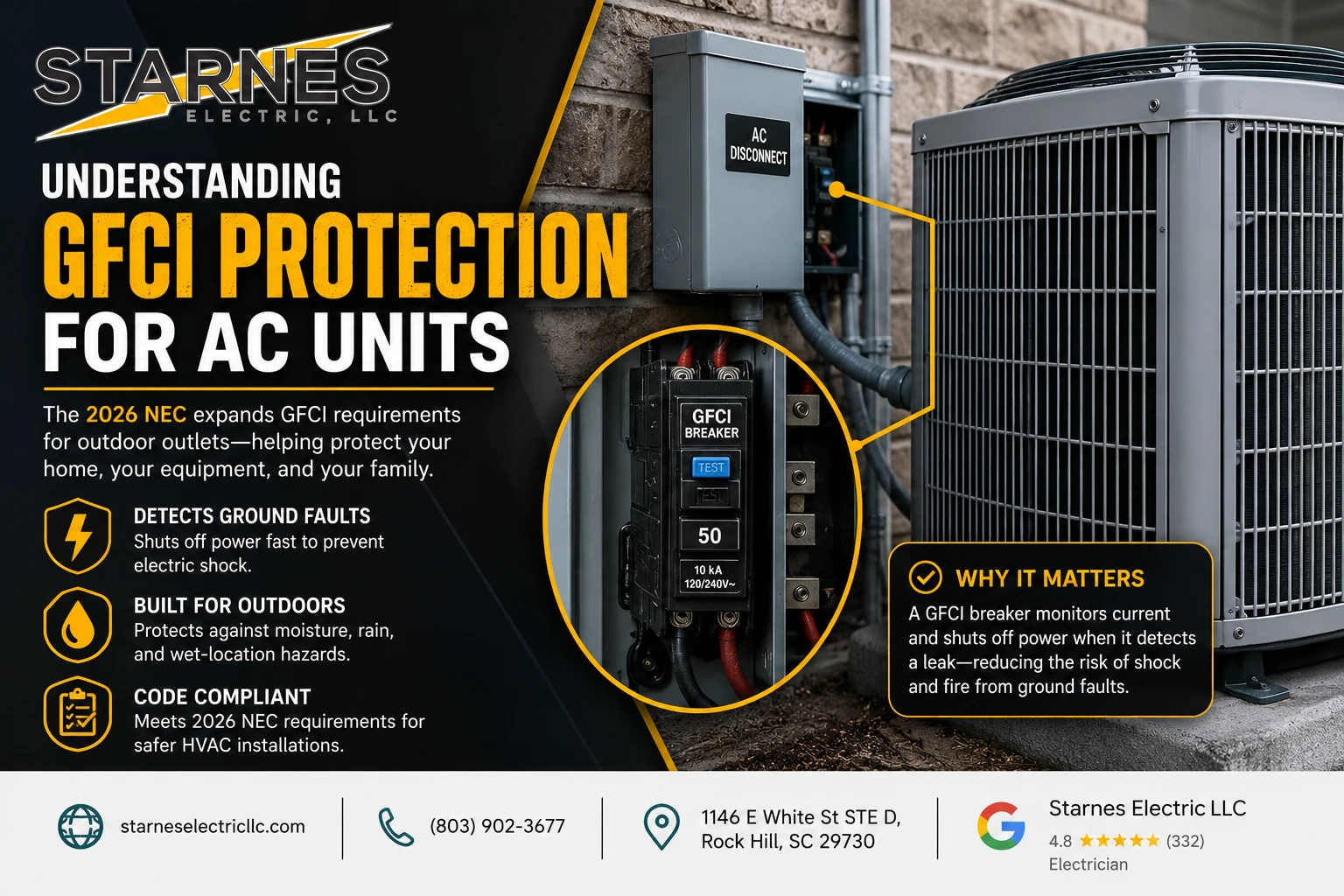
Air conditioners have always mixed electricity, metal, moisture, and outdoor exposure, which is not exactly a relaxing combination. The 2026 National Electrical Code (NEC) addresses that risk by expanding ground-fault protection requirements for outdoor outlets, including many circuits supplying HVAC equipment.
Still, the rule is not as simple as saying every air conditioner in America must immediately receive a standard GFCI breaker. The applicable code edition, equipment rating, circuit design, manufacturer instructions, local amendments, and decisions made by the authority having jurisdiction (AHJ) all matter. The NEC is a nationally recognized safety standard, but it becomes enforceable only when adopted by a state or local jurisdiction.
That distinction matters because homeowners often hear “new HVAC code” and assume their existing system has suddenly become illegal. Usually, code changes affect new installations, replacements, major alterations, and permitted electrical work rather than forcing every homeowner to upgrade an untouched system overnight.
Even so, the direction of the electrical code is clear. Electrical safety standards are paying closer attention to outdoor HVAC equipment, leakage current, wet-location hazards, and the protective devices available for modern air-conditioning systems.
Why do AC units require a GFCI breaker under the 2026 HVAC code?
AC units may require ground-fault protection because outdoor equipment operates in conditions where electricity can take an unintended path to ground. Condensers sit in rain, humidity, irrigation spray, mud, leaves, insects, and changing temperatures. Refrigerant lines, cabinets, disconnects, wiring, and electrical components can all be exposed to moisture or physical deterioration.
A ground-fault circuit interrupter (GFCI) monitors the electrical current traveling through a circuit. When it detects an imbalance that suggests current is leaking somewhere it should not, it disconnects power quickly. That rapid interruption is intended to reduce the risk of electric shock.
The 2026 NEC expanded Section 210.8(F), which addresses outdoor outlets. NFPA’s summary of the 2026 changes explains that outlets rated 60 amperes or less now generally require GFCI protection under this section. It also notes a new exception permitting a listed Class C special-purpose ground-fault circuit interrupter for certain listed HVAC equipment.
That Class C option is important. Traditional personnel-protection GFCI devices generally react at a very low leakage threshold. Some HVAC equipment, particularly systems containing variable-speed motors, inverters, electronic filters, or power-conversion components, may have normal operating characteristics that do not work well with every standard GFCI device.
The 2026 NEC language recognizes that HVAC protection cannot always be treated like the receptacle beside a bathroom sink. The goal is still ground-fault safety, but the protective equipment may need to be specifically listed and coordinated with the air conditioner.
From a practical standpoint, the requirement aims to protect people who may come into contact with:
- A metal condenser cabinet that has become energized
- Wet ground surrounding damaged equipment
- A deteriorated disconnect or whip
- Wiring insulation damaged by age, animals, vibration, or weather
- HVAC equipment with an internal electrical fault
- Service areas where technicians are working around grounded metal
Nobody wants an outdoor condenser to become a very expensive electrified lawn ornament. GFCI protection adds another layer of defense when ordinary circuit breakers may not respond quickly enough to a small but dangerous leakage current.
Don't Ignore the 2026 HVAC Code Update
A quick inspection today can help prevent costly electrical problems tomorrow.
Does HVAC need a GFCI breaker?
Some HVAC equipment needs GFCI protection, but that does not automatically mean every HVAC component must use the same type of GFCI breaker.
Outdoor air-conditioning and heat-pump circuits are the main focus of the current discussion. Indoor furnaces, air handlers, condensate pumps, service receptacles, rooftop equipment, and commercial HVAC systems can fall under different requirements depending on their location and wiring method.
A circuit may receive ground-fault protection through a breaker installed in the electrical panel, but other listed protective arrangements may also be permitted. Under the 2026 NEC changes highlighted by NFPA, certain listed HVAC equipment may use a listed Class C special-purpose GFCI where the applicable exception is satisfied.
Homeowners should also understand that “required by the NEC” and “required in my city today” are not always identical. The NEC is updated every three years, but jurisdictions adopt editions on their own schedules. One area may enforce the 2026 NEC while another still uses an earlier edition with local amendments. NFPA identifies the 2026 edition as the current NEC, but local adoption determines which rules an inspector will enforce on a specific project.
An electrician evaluating an HVAC circuit will normally consider:
- The code edition adopted locally
- Whether the work is new, replacement, repair, or alteration
- The condenser’s voltage and amperage ratings
- The maximum overcurrent protection listed on the equipment
- Manufacturer installation instructions
- Whether the equipment is listed for the proposed protection
- Local inspection policies
- Existing panel capacity and breaker compatibility
This is why buying a random GFCI breaker online and snapping it into the panel is a bad plan. Breakers must be listed for the panel, correctly sized, installed according to the panel manufacturer’s requirements, and coordinated with the connected equipment.
What does AC GFCI mean?
“AC GFCI” usually refers to ground-fault protection installed on the branch circuit supplying an air-conditioning condenser, heat pump, or related HVAC equipment.
It does not mean the GFCI is controlling the temperature, improving efficiency, or protecting the compressor from every possible failure. Its primary job is to detect certain current imbalances associated with electrical leakage to ground.
A regular circuit breaker and a GFCI device perform different tasks.
A standard breaker primarily protects conductors and equipment against excessive current caused by overloads or short circuits. A GFCI focuses on current leaving the intended circuit path. A small leakage current may be dangerous to a person even when it is nowhere near large enough to trip a conventional 30-, 40-, or 50-amp breaker.
For example, imagine that damaged insulation allows current to energize the metal cabinet of an outdoor condenser. The current may be too low to trip the ordinary breaker immediately. However, it can still present a shock hazard to someone touching the cabinet while standing on wet soil.
A properly selected ground-fault device is designed to recognize that imbalance and interrupt the circuit.
The phrase can also create confusion because “AC” may mean air conditioning or alternating current. In this context, it normally means GFCI protection for an air-conditioning circuit, although the electrical supply itself is also alternating current. Electrical terminology occasionally enjoys making simple conversations more complicated than necessary.
The $4,000 SC Panel Rebate: How to Qualify for Federal “HEAR” Funding
The $4,000 SC panel rebate refers to a possible electrical [...]
Learn More
Are GFCI breakers required by code for outdoor AC units?
Under the 2026 NEC, many outdoor outlets rated 60 amperes or less are subject to GFCI protection requirements. NFPA specifically identifies this expansion in its review of the major 2026 changes and explains that a Class C special-purpose GFCI option was added for qualifying listed HVAC equipment.
However, several details affect whether a particular outdoor AC unit must be protected and what device may be used.
First, the local jurisdiction must adopt and enforce the relevant NEC edition. The NEC itself is not automatically federal law. It serves as a model safety standard that authorities can adopt into local regulations.
Second, code requirements are commonly applied when equipment is newly installed, replaced, relocated, or substantially modified. Inspectors may not require an immediate retrofit of every existing condenser simply because a newer code edition has been published.
Third, exceptions and equipment listings matter. A system may require a standard Class A GFCI, a Class C special-purpose device, or another code-compliant arrangement based on the equipment and installation.
Fourth, local amendments can be stricter, more flexible, or differently worded. The authority having jurisdiction has the final say on whether an installation is accepted.
Homeowners planning an AC replacement in 2026 should discuss the electrical requirements before installation day. Discovering that the panel needs a compatible protective breaker, new wiring, a disconnect replacement, or additional troubleshooting after the condenser arrives can create delays and unexpected costs.
What breaker is required for an AC unit?
The correct breaker for an AC unit is determined primarily by the equipment nameplate and manufacturer instructions, not by guesswork based on the size of the house.
Outdoor condensers typically display two important values:
- Minimum Circuit Ampacity (MCA): This helps determine the minimum conductor capacity required for the circuit.
- Maximum Overcurrent Protection (MOCP): This states the maximum permitted fuse or circuit-breaker rating for the equipment.
The breaker may appear large compared with the unit’s normal operating current because compressors draw a higher amount of current during startup. HVAC equipment rules account for motor and compressor characteristics that do not behave like ordinary lighting circuits.
That does not mean “bigger is better.” Installing a breaker above the nameplate maximum can leave conductors or equipment inadequately protected. Installing one that is too small may cause unnecessary tripping during startup.
The required breaker must also match:
- The condenser’s voltage
- The number of poles required
- The equipment nameplate
- The conductor size and insulation rating
- The electrical panel’s approved breaker types
- Applicable GFCI or special-purpose ground-fault requirements
- Manufacturer instructions
- Local code rules
A common residential condenser may use a two-pole breaker because it operates at approximately 240 volts, but the amperage can vary significantly. One unit may call for 25 amps while another requires 40, 50, or 60 amps. There is no universal “AC breaker size.“
The 2026 NEC also includes requirements concerning the placement of ground-fault devices around power-conversion equipment and motors. An NFPA-issued interim amendment states that GFCI and special-purpose GFCI devices must not be installed between power-conversion equipment output terminals and a motor.
That rule illustrates why HVAC breaker work belongs with someone who understands the entire circuit. Protective devices need to be installed in the correct location, not simply added wherever space happens to be available.
Can an old AC unit trip a new GFCI breaker?
Yes. An older AC unit can trip a newly installed GFCI breaker, and the trip should not automatically be dismissed as a defective breaker.
A standard breaker may have allowed the unit to operate for years while small amounts of leakage current went unnoticed. Once sensitive ground-fault protection is installed, existing electrical weaknesses may finally become visible.
Potential causes include:
- Moisture inside the condenser, disconnect, or wiring
- Deteriorated compressor-winding insulation
- Damaged wire insulation
- Contaminated electrical terminals
- Current leakage from motors or capacitors
- Failing crankcase heaters
- Inverter or variable-speed electronics
- Multiple small leakage sources adding together
- Incorrect neutral or grounding connections
- A damaged whip or underground feeder
- A breaker that is incompatible with the equipment or panel
Sometimes the trip occurs only during rain. Sometimes it happens during compressor startup. In other cases, the unit runs for several minutes before shutting down as components warm up.
Repeatedly resetting the breaker is not a repair strategy. It is the electrical equivalent of covering the check-engine light with tape. The trip is information, and a qualified electrician or HVAC technician needs to determine what it means.
Troubleshooting may include insulation-resistance testing, leakage-current measurements, inspection of the disconnect and conductors, isolation of individual components, confirmation of breaker compatibility, and review of the manufacturer’s installation requirements.
In some cases, the solution may be a repair. In others, the older unit may not be reasonably compatible with the required protection. The correct response depends on the test results, equipment listing, code requirements, and the local inspector’s interpretation.
Keep Your Cool Without Ignoring the Circuit
A new air conditioner should not be connected to an electrical system based on assumptions. The 2026 NEC gives greater attention to ground-fault protection for outdoor equipment, but the correct installation still depends on the condenser nameplate, panel type, wiring condition, manufacturer instructions, and locally adopted code.
At Starnes Electric, we help homeowners determine whether an HVAC circuit needs a standard GFCI breaker, special-purpose protection, wiring corrections, panel work, or further troubleshooting. We inspect the complete electrical path instead of treating the breaker as an isolated part.
If you are replacing an AC unit, dealing with repeated GFCI trips, or preparing for an HVAC inspection, contact Starnes Electric. We can evaluate the circuit, explain the applicable requirements, and complete the electrical work needed to keep your cooling system safe, dependable, and ready for the next hot day.
2026 GFCI Code Could Affect Your AC
Make sure your HVAC system meets current electrical code. Call today for a professional inspection.
About the Author: Starnes Electric