The $4,000 SC Panel Rebate: How to Qualify for Federal “HEAR” Funding
Table of Contents
The $4,000 SC panel rebate refers to a possible electrical panel upgrade rebate under the federal Home Electrification and Appliance Rebates (HEAR) program. For Rock Hill homeowners, the key detail is that South Carolina’s HEAR rebates are planned but not yet available as of June 30, 2026, so homeowners should confirm program launch details before starting work.
This rebate can be valuable for homes that need electrical upgrades to support modern energy improvements. That may include a heat pump, heat pump water heater, electric cooking equipment, EV charger planning, or other qualified electrification work. However, the rebate is not automatic. It depends on income, program rules, equipment requirements, contractor requirements, and South Carolina’s final application process.
At Starnes Electric LLC, we want homeowners to understand the opportunity without getting misled by rebate headlines. A panel upgrade is a serious electrical project. The rebate may help reduce cost, but the work still needs to be planned, permitted when required, and completed safely by a qualified electrical professional.
Upgrade Your Panel & Save Thousands
Get professional help navigating HEAR rebate requirements and electrical panel upgrades with confidence.
What Is the SC Energy Rebate Program?
The SC Energy Rebate Program refers to South Carolina’s Home Energy Rebates, funded by the federal Inflation Reduction Act. South Carolina’s Energy Office says two separate rebate programs will be available: Home Electrification and Appliance Rebates (HEAR) and Home Efficiency Rebates (HOMES). The state also says these rebates are not yet available and that its rebate website will serve as the central hub for updates, eligibility information, and application details.
HEAR is focused on high-efficiency electric upgrades for low- and moderate-income households. It is designed to help eligible homeowners move toward cleaner, more efficient electric appliances and systems.
HOMES is different. It focuses on whole-home energy improvements. Instead of paying for one specific appliance only, HOMES is based on improving the home’s overall energy performance.
For Rock Hill homeowners, the difference matters. HEAR may help pay for specific electrification projects, including electrical panel work when that work supports a qualifying upgrade. HOMES may help with broader energy-saving improvements, such as insulation, air sealing, and other measures that reduce energy use across the home.
The important point is that these programs are state-administered. Even though the money comes from a federal program, South Carolina controls the local rollout, application process, eligible contractors, documentation rules, and timing. Homeowners should not assume that a national article applies perfectly to South Carolina.
Before making a decision, check whether the program is open, whether your household qualifies, and whether your planned project meets the rules.
What Is the $4,000 SC Panel Rebate?
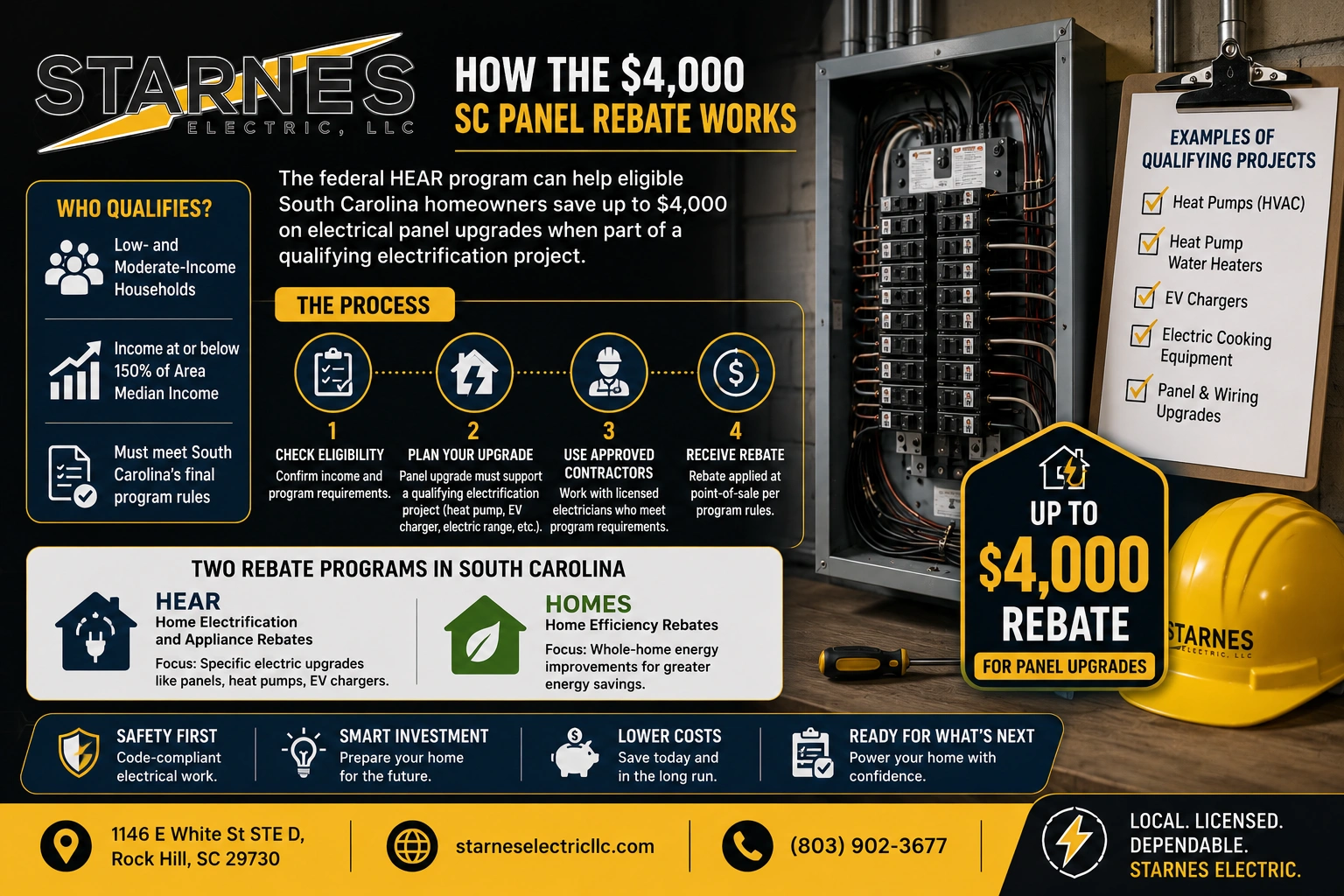
The $4,000 SC panel rebate is tied to the HEAR program’s electrical panel upgrade category. The U.S. Department of Energy homeowner guidance says eligible households may be able to save up to $14,000 total on covered upgrades, including up to $4,000 for an electrical panel, up to $2,500 for electrical wiring, up to $8,000 for a heat pump for space heating and cooling, and up to $1,750 for a heat pump water heater.
That does not mean every homeowner automatically gets $4,000 for any panel replacement. The panel work usually needs to be connected to a qualifying electrification project. In simple terms, the rebate is meant to help when the existing electrical system is not ready to support eligible energy upgrades.
For example, an older electrical panel may not have enough capacity, breaker space, or proper configuration for a new heat pump, heat pump water heater, electric range, or other covered equipment. In that situation, the panel upgrade may be part of the project pathway.
This is where homeowners need to be careful. A panel upgrade done only for convenience may not qualify. A panel upgrade needed to support a covered HEAR project may have a stronger case, depending on South Carolina’s final rules.
The rebate may also be applied differently depending on the program design. HEAR is commonly described as a point-of-sale rebate, which means the discount may reduce the cost at the time of purchase or installation through a participating contractor or vendor. However, South Carolina’s final process should be confirmed before assuming how payment will work.
For Starnes Electric LLC customers, the practical first step is not chasing the rebate. It is determining whether your panel actually needs replacement, whether your home can support the planned upgrade, and whether the work aligns with expected rebate requirements.
Who Qualifies for Federal HEAR Funding in South Carolina?
HEAR funding is intended for low- and moderate-income households. ENERGY STAR describes the HEAR program as focused on efficient electrification projects for households with income less than 150% of area median income.
That means eligibility is not based only on being a South Carolina resident. It also depends on household income, household size, county or local area median income, property type, project type, and the final state application rules.
In general, homeowners at or below 80% of area median income may qualify for the highest rebate level. Households between 80% and 150% of area median income may qualify for a reduced rebate level. Households above 150% of area median income generally should not expect to qualify for HEAR, although they may still want to watch other programs, utility incentives, or HOMES eligibility.
Income verification will likely matter. Homeowners may need to provide documentation before the project begins. That could include tax records, proof of participation in certain assistance programs, or other approved documents. The exact process depends on South Carolina’s final program design.
Contractor participation may also matter. Some rebate programs require the use of approved or participating contractors. This is especially likely for complex work such as heat pump installation, electrical panel upgrades, and wiring upgrades.
This is why timing matters. If a homeowner completes a panel upgrade before South Carolina opens the program or before receiving any required approval, the project may not qualify for reimbursement later. It is safer to verify the rules first.
Rock Hill homeowners should treat the rebate as a planning opportunity, not a guaranteed refund.
Can the HEAR Rebate Cover an Electrical Panel Upgrade?
Yes, the HEAR rebate can include electrical panel upgrades, but only when the project meets program requirements. The Department of Energy lists electrical panels as one of the covered upgrade categories, with a potential rebate of up to $4,000 depending on state rules and household eligibility.
The panel upgrade generally needs to support electrification. That means the electrical work should be tied to a qualified energy upgrade, not just a cosmetic or optional replacement.
Common examples may include preparing the home for a heat pump HVAC system, heat pump water heater, electric cooking equipment, or other eligible electric appliance. In some homes, wiring upgrades may also be needed to safely serve the new equipment.
For older Rock Hill homes, this can be an important issue. Many homes were built before today’s electrical demands became common. Homeowners are now adding EV chargers, smart panels, larger appliances, home offices, battery systems, and higher-efficiency HVAC equipment. An older panel may not have the room or capacity to handle these loads safely.
A proper electrical assessment can help answer several questions:
- Does the panel have enough capacity?
- Does the panel have enough breaker space?
- Is the existing wiring safe and code-compliant?
- Will the new equipment require a dedicated circuit?
- Will the home need a service upgrade?
- Can load management solve the issue without replacing everything?
These questions matter whether a rebate is involved or not. A rebate can help with cost, but it should never be the only reason for making an electrical decision.
At Starnes Electric LLC, we recommend starting with the electrical need first. If the home needs a panel upgrade to support a qualifying project, then the rebate may become part of the financial planning.
Portable Generator vs. Standby Generac: Which Fits the “Rock Hill Storm” Profile?
Rock Hill storm outages can happen fast, and the right [...]
Learn More
How Do Income Limits Affect South Carolina HEAR Rebate Eligibility?
Income limits are one of the biggest factors in HEAR rebate eligibility. The program is not designed for every household. It is targeted toward low- and moderate-income homeowners and renters.
The main threshold is 150% of area median income. ENERGY STAR identifies HEAR-eligible low- to moderate-income households as those with income less than 150% of area median income.
Area median income is not one flat number for every family in South Carolina. It can change by location and household size. A single homeowner and a family of four will not have the same income threshold. A household in one county may also have a different threshold than a household in another area.
This is why homeowners should avoid relying on a general number from a national rebate article. The correct limit depends on the official income calculator or verification process used by South Carolina when the program launches.
The rebate amount may also change based on income tier. Lower-income households may qualify for a larger share of project costs, while moderate-income households may qualify for a smaller share. Some households may qualify for no HEAR funding if income is above the program limit.
Income can also affect the project strategy. A homeowner who qualifies for HEAR may focus on specific eligible electrification upgrades. A homeowner who does not qualify for HEAR may want to look at HOMES, utility rebates, financing options, or long-term energy savings instead.
The best approach is to gather accurate information before scheduling work. Confirm your household income category, check South Carolina’s program status, and make sure the project is eligible before assuming the rebate will apply.
When Will South Carolina HEAR Rebates Be Available?
As of June 30, 2026, South Carolina’s official Energy Office rebate page says the Home Energy Rebates are not yet available. The state says its website will provide program updates, eligibility information, and application details as they become available.
This is one of the most important points for Rock Hill homeowners. The rebate may be real, but timing controls whether you can use it.
Many homeowners see “up to $4,000 for a panel upgrade” and assume they can schedule the work immediately, save the invoice, and receive money later. That may not be how the program works. Some rebate programs require pre-approval. Some require the use of participating contractors. Some require the rebate to be applied at the point of sale. Some require documentation before installation begins.
Until South Carolina finalizes and opens its program, homeowners should be cautious. If your electrical panel is unsafe, overloaded, damaged, outdated, or preventing necessary work, you may not want to delay the upgrade only for a possible rebate. Safety should come first.
However, if your project is flexible and you are specifically hoping to use HEAR funding, it may be worth preparing now. That preparation can include reviewing your panel, identifying future electrification goals, gathering income documentation, watching state updates, and speaking with a qualified electrical contractor.
Starnes Electric LLC can help Rock Hill homeowners understand what electrical work may be needed before adding high-demand equipment. That way, when the rebate program becomes available, you are not starting from scratch.
Electrical Panel Rebate Planning From Starnes Electric LLC
The $4,000 SC panel rebate could help qualifying Rock Hill homeowners reduce the cost of electrical panel upgrades tied to eligible electrification projects. But the details matter. South Carolina’s HEAR program is planned, income-based, and not yet available as of June 30, 2026.
A panel upgrade should always begin with safety and proper electrical planning. Rebates can help with affordability, but they do not replace the need for correct installation, code-compliant work, and an honest evaluation of your home’s electrical system.
Starnes Electric LLC helps homeowners understand whether their panel is ready for modern electrical demands, including heat pumps, EV chargers, smart panels, dedicated circuits, and backup power planning.
If you are considering a panel upgrade in Rock Hill, start with a professional electrical assessment. The right plan can help you prepare for future rebates, avoid unsafe shortcuts, and make sure your home is ready for the next stage of energy-efficient living.
Want to Qualify for the $4,000 Panel Rebate?
Find out if your electrical panel upgrade qualifies for federal HEAR funding. Call Starnes Electric LLC for expert guidance today.
About the Author: Starnes Electric