
Best Whole-Home Surge Protectors for Rock Hill’s Summer Storms
Table of Contents
The best whole-home surge protector for a Rock Hill residence is a properly sized, UL-listed Type 1 or Type 2 surge protective device (SPD) that matches the home’s electrical service and panel. It should have a low voltage protection rating, adequate surge-current capacity, clear status indicators, and professional installation with short, properly routed conductors.
That answer may sound less exciting than naming one shiny box and declaring it the champion. However, surge protection is not a beauty contest, and the product with the largest number printed on the package is not automatically the best choice for every house.
Rock Hill summers can bring heat, humidity, lightning, strong winds, and sudden thunderstorms. The National Weather Service notes that most lightning in the United States occurs during summer, making seasonal electrical protection a practical concern rather than a sales gimmick.
Today’s homes also contain far more sensitive electronics than homes did a few decades ago. HVAC control boards, smart refrigerators, televisions, computers, security systems, garage door openers, internet equipment, induction ranges, and connected appliances all rely on electronics that may be affected by voltage spikes.
In our opinion at Starnes Electric, whole-home surge protection is one of the most sensible electrical upgrades a homeowner can make. It is not a force field, and it cannot promise that lightning will never damage anything. What it can do is reduce the amount of surge energy that reaches equipment throughout the house.
Storms can destroy electronics in seconds.
Protect your entire home with a professionally installed whole-home surge protector. Call Starnes Electric LLC today.
Which Is The Best Whole House Surge Protector For Summer Storms?
There is no single surge protector that is best for every home. The right device depends on the electrical service, panel manufacturer, installation location, available breaker space, grounding system, connected equipment, and the homeowner’s protection goals.
For most Rock Hill homes, we generally favor a whole-home surge protective device installed at or near the main electrical service. A Type 1 SPD may be installed in locations permitted for service-side or load-side protection, depending on the device listing and system design. A Type 2 SPD is normally installed on the load side of the service disconnect, often at the main panel or a distribution panel.
The National Electrical Manufacturers Association (NEMA) describes Type 1 SPDs as permanently connected devices intended to address external surges, including those associated with lightning and utility switching. Type 2 SPDs are also permanently connected and are designed to protect sensitive electronics from residual lightning energy, motor-generated surges, and other internally produced surge events.
A good residential surge protector should have several important qualities:
- A listing to the applicable UL 1449 surge-protection standard
- Compatibility with the home’s voltage and electrical system
- A suitable Type 1 or Type 2 designation
- A clearly stated voltage protection rating
- Adequate nominal discharge and surge-current ratings
- Protection across the necessary electrical modes
- Visible status lights or another monitoring feature
- A short, direct connection to the electrical system
- An enclosure suitable for its installation environment
- A replaceable module or straightforward replacement plan when practical
Homeowners frequently focus on the maximum surge-current number, often shown in kiloamps (kA). That number matters, but it is not the entire story. A 100 kA device installed with long, looping wires may perform less effectively than a well-selected unit installed correctly with short conductors.
Surges move quickly. Extra conductor length can increase the voltage that reaches the equipment. This is one reason installation quality matters almost as much as the device itself.
Our preferred strategy is layered protection. Install a whole-home SPD at the service or main panel, then use quality point-of-use protection for especially sensitive electronics. NEMA classifies plug-in strips, direct plug-in protectors, and surge-protective receptacles as Type 3 devices.
The panel-mounted SPD handles larger incoming and internally generated surges. The point-of-use device adds protection closer to televisions, computers, entertainment systems, and networking equipment. One device does not have to fight every electrical battle alone.
Do Surge Protectors Help During Thunderstorms?
Yes, surge protectors can help during thunderstorms. They work by limiting transient overvoltage and diverting surge energy away from connected equipment.
A nearby lightning strike can induce voltage on electrical, cable, telephone, or data lines. A strike does not need to hit the roof directly to cause trouble. Surge energy may enter through utility wiring or other conductive systems connected to the house.
Whole-home surge protection is intended to reduce that energy before it travels through branch circuits and reaches appliances. NEMA states that a quality surge protective device can help prevent damage to electrical and electronic products.
However, a surge protector does not make a home lightning-proof.
A direct lightning strike can involve an enormous amount of energy. No ordinary residential SPD should be marketed as a guarantee against every possible lightning event. The goal is risk reduction, not invincibility.
For stronger protection, several parts of the electrical system must work together:
- A properly installed whole-home SPD
- An effective grounding electrode system
- Correct bonding of electrical and metal systems
- Suitable protection for cable, telephone, and data lines
- Point-of-use protection for valuable electronics
- Sound electrical connections throughout the service
- Proper installation according to the SPD manufacturer’s instructions
Grounding and bonding are particularly important. A surge protector needs a suitable path for diverting surge energy. Installing a premium SPD on a poorly bonded or deteriorated electrical system is a little like installing a great sump pump without giving the water anywhere to go.
Thunderstorms are not the only source of electrical surges, either. Utility switching, transformer events, power restoration, and equipment cycling inside the home can also produce transient voltage changes.
Large motors and compressors are common internal contributors. Air conditioners, heat pumps, pumps, and other motor-driven equipment switch on and off repeatedly. These events are usually smaller than lightning-related surges, but repeated disturbances can still place stress on electronic components.
Whole-home protection therefore earns its keep even when the sky is perfectly blue.
What Type Of Whole-home Surge Protector Is Best For Homes In Rock Hill?
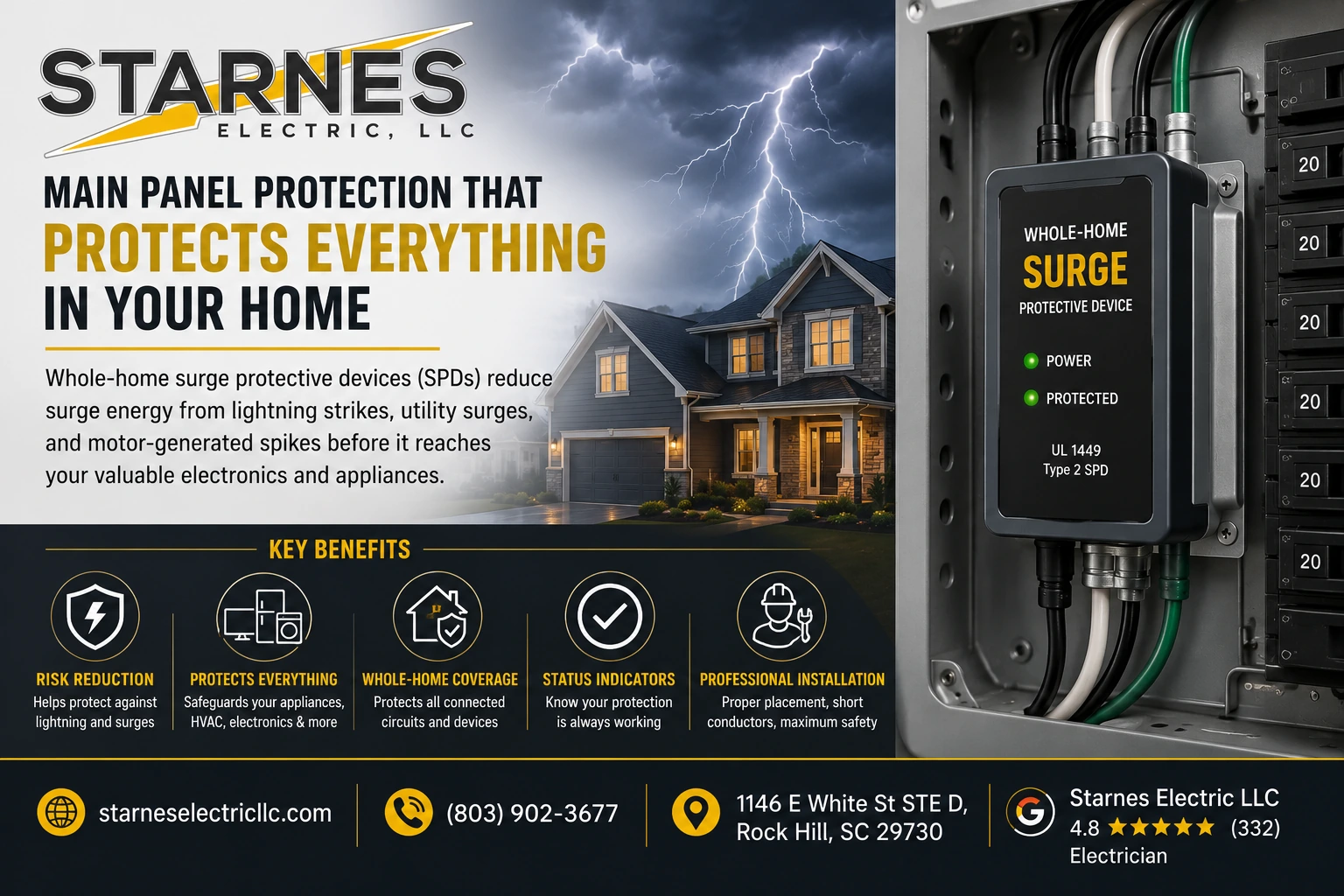
For many Rock Hill residences, a Type 2 SPD installed at the main electrical panel is a strong practical choice. It protects circuits throughout the home and is commonly suited to residential panel installations.
A Type 1 device may be selected when the installation design calls for protection at the service equipment or in a location where a Type 1 listing is needed. UL guidance notes that devices investigated for Type 1 applications are also suitable for Type 2 applications, while a device marked only as Type 2 is not automatically suitable for a Type 1 application.
The best decision should be based on the actual electrical system, not a general internet ranking. An electrician needs to confirm:
- Service voltage and configuration
- Main service rating
- Panel manufacturer and model
- Available breaker positions
- Main disconnect location
- Indoor or outdoor installation conditions
- Grounding and bonding condition
- The SPD’s required overcurrent protection
- Manufacturer installation requirements
- Local electrical-code requirements
Some panel manufacturers offer plug-on surge protectors designed to fit specific panel lines. These can create a compact installation with short internal connections. Other products are externally mounted beside the panel and connected through a dedicated breaker.
Neither design is automatically superior. A plug-on model must be approved for the panel. An externally mounted model needs suitable conductors, breaker protection, enclosure placement, and routing.
We also recommend looking at the voltage protection rating rather than judging a protector only by its total kA rating. The voltage protection rating reflects the level at which the device limits voltage under standardized testing conditions. Generally, lower protective values can mean less voltage is passed through to connected equipment, provided the device is appropriate for the system.
Another useful feature is a status indicator. Surge-protection components can wear out after absorbing repeated events. A green light, audible alarm, remote contact, or replaceable module can help homeowners recognize when protection is no longer active.
Without an indicator, a failed surge protector can sit quietly in the panel looking productive while doing very little. It is the electrical version of someone attending a meeting with their camera off and microphone muted.
Cold Weather, High Risk: The Overlooked Electrical Surges of the Holiday Season
When winter arrives, most homeowners prepare for cold temperatures, icy [...]
Learn More
What Is The Best Surge Protector For HVAC Systems?
The best surge protector for an HVAC system is one specifically listed and rated for the equipment’s voltage, wiring configuration, and installation location. It should be installed close to the outdoor unit or at another manufacturer-approved point with conductors kept as short and direct as possible.
A whole-home SPD provides valuable protection for the HVAC system, but dedicated HVAC surge protection may offer an additional layer at the condenser or heat pump.
This matters because modern HVAC systems contain sensitive and expensive electronics, including:
- Compressor control modules
- Inverter boards
- Variable-speed motor controls
- Defrost boards
- Communication modules
- Contactor circuits
- Sensors
- Smart thermostats
- Low-voltage control equipment
Traditional single-stage air conditioners contain electrical components that can be damaged by surges. Variable-speed and communicating systems often have even more electronic controls to protect.
For HVAC equipment, the SPD must match the supply. Many residential outdoor units use a 240-volt circuit, but an electrician should confirm the actual equipment configuration rather than making assumptions.
The installation should also follow the HVAC and SPD manufacturers’ instructions. Placing the device in the wrong location, using overly long conductors, selecting an incompatible product, or routing wires poorly can reduce performance.
We generally view HVAC surge protection as part of a layered plan:
- Install whole-home surge protection at the electrical service or main panel.
- Add dedicated surge protection at high-value HVAC equipment when appropriate.
- Verify grounding, bonding, disconnects, breakers, and wiring.
- Consider protection for thermostat and communication circuits when approved equipment is available.
- Have the system checked after a major electrical event if problems appear.
A dedicated HVAC surge protector does not replace whole-home protection. It protects one important piece of equipment. Meanwhile, refrigerators, televisions, computers, and other electronics remain exposed unless broader protection is installed.
Likewise, a whole-home SPD does not always eliminate the value of protection at the HVAC unit. Layers help reduce surge energy in stages.
What Is The Most Powerful Surge Protector For A House?
The most powerful surge protector is not necessarily the one with the largest kA rating printed in the biggest font.
Residential products may be rated to handle tens of thousands or even hundreds of thousands of amps of surge current under specific testing conditions. A higher number can suggest greater surge-handling capacity, but homeowners should not compare devices using that figure alone.
A meaningful comparison should include:
- UL 1449 listing
- SPD type
- Voltage protection rating
- Nominal discharge current rating
- Maximum continuous operating voltage
- Short-circuit current rating
- Protected electrical modes
- Surge-current capacity
- Warranty terms
- Status monitoring
- Panel compatibility
- Installation requirements
UL Solutions provides testing and certification for surge protective devices, including permanently connected residential products. Choosing a properly listed product helps confirm that it has been evaluated to applicable safety and performance requirements.
The “most powerful” device may also be unnecessary for a small residence if it is difficult to install correctly or is not compatible with the panel. More is not always better when the specification does not fit the application.
We would rather install a correctly matched, reputable SPD with short connections than an oversized unit selected only because its marketing department discovered a larger number.
Homeowners should also remember that surge capacity is cumulative only within the limits of the product design and testing. A device can endure some events and eventually reach the end of its useful life. That is why status indicators and periodic inspections matter.
After a strong storm or known electrical event, check the SPD’s indicator. If the light shows loss of protection, the unit or module may need replacement. Do not assume that because the house still has power, the surge protector is still functioning.
Should A Whole-home Surge Protector Be Installed By A Licensed Electrician?
Yes. A whole-home surge protector should be installed by a licensed electrician.
Panel-mounted surge protectors connect directly to the home’s electrical distribution system. Installation may require removing the panel cover, working near energized service components, adding a circuit breaker, verifying conductor routing, and checking grounding and bonding.
These are not good conditions for a first electrical do-it-yourself project.
The National Electrical Code (NEC) requires surge protection for many new and replaced dwelling-unit services under Section 230.67. NFPA explains that this requirement was introduced to provide service-level protection for residential electrical systems. The edition enforced in a particular location depends on state and local adoption, permitting rules, and the authority having jurisdiction. The NEC remains the national benchmark for safe electrical design and installation.
A licensed electrician can determine:
- Whether the SPD is compatible with the panel
- Whether a Type 1 or Type 2 device is appropriate
- Which breaker is required
- Where the device should be mounted
- How conductors should be routed
- Whether the grounding and bonding system needs attention
- Whether the panel has signs of corrosion, overheating, or damage
- Whether additional protection is needed for HVAC or other equipment
Professional installation also helps preserve product warranties. Some manufacturers require installation by a qualified electrician or documentation of proper installation before honoring connected-equipment coverage.
A whole-home surge protector is only as good as its connection. An incorrectly installed product may provide reduced protection, create code problems, or introduce a new electrical hazard.
Saving money on installation is not much of a victory if the device is connected improperly beside a live service panel.
Do Not Let the Next Storm Pick Your Repair Budget
Summer storms do not send a calendar invitation before placing stress on a home’s electrical system. By the time lights flicker, the internet disappears, or an HVAC control board stops responding, the damaging surge may already be over.
At Starnes Electric, we help Rock Hill homeowners select whole-home surge protection based on their actual panel, service, equipment, and electrical needs. We do not simply install the product with the biggest number on the box. We evaluate compatibility, grounding, conductor routing, breaker requirements, HVAC protection, and the overall condition of the electrical system.
Our view is simple: the best surge protector is a listed, properly sized device installed correctly as part of a layered protection plan. That plan may include a Type 1 or Type 2 whole-home SPD, dedicated HVAC protection, point-of-use devices, and updates to grounding or bonding where necessary.
Contact Starnes Electric to schedule a whole-home surge protection evaluation before Rock Hill’s next round of summer storms. We will help you build practical protection around the appliances, electronics, and comfort systems your household relies on every day.
Protect your home before the next storm.
Don't wait for a power surge to damage your appliances. Schedule your surge protection installation today.
About the Author: Starnes Electric