
Smart Panel vs. Smart Plugs: The Best Way to Automate Your Rock Hill Home
Table of Contents
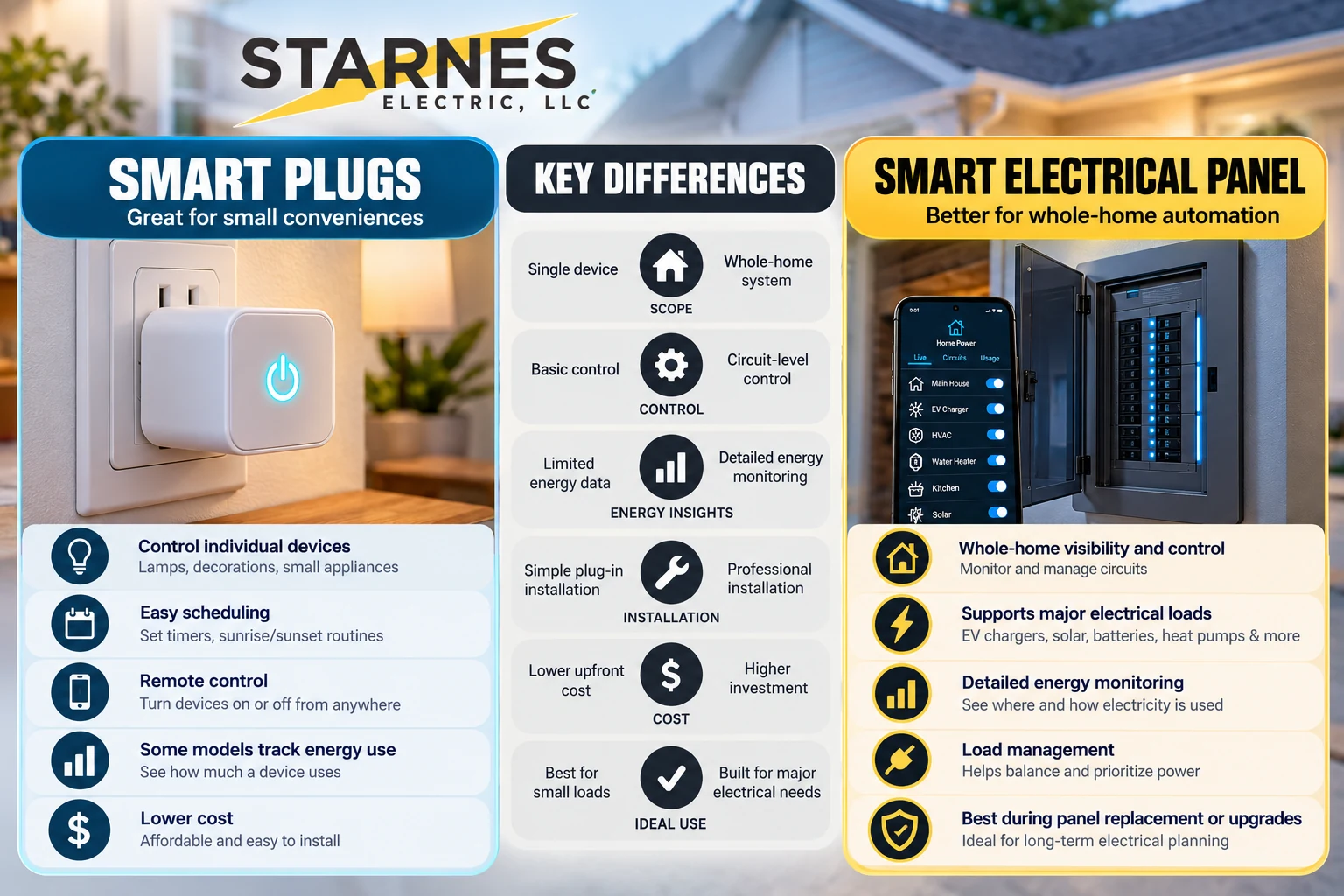
Smart plugs are an inexpensive way to automate a few lamps and appliances. A smart electrical panel takes a completely different approach, giving homeowners visibility and, depending on the system, control at the circuit level.
For Rock Hill homeowners, our opinion is pretty simple: smart plugs are great for small conveniences, while a smart panel makes more sense when you want to rethink how the entire house uses electricity. Most homes do not need to choose one or the other, either. The smartest setup is often a combination of smart plugs, switches, and electrical infrastructure that fits how you actually live.
Start Your Smart Home Upgrade
Not sure whether you need smart plugs or a smart panel? Call Starnes Electric LLC for professional recommendations and installation.
Is It Better To Use Smart Plugs Or Install A Smart Electrical Panel?
Smart plugs and smart electrical panels technically belong to the same “smart home” category, but comparing them directly is a bit like comparing a bicycle to a pickup truck.
Both can get something from Point A to Point B.
They are not designed for the same job.
A smart plug sits between a standard receptacle and a compatible plug-in device. Depending on the model, you may be able to turn the connected device on and off remotely, create schedules, monitor energy use, or connect it with a voice assistant or automation platform.
They are excellent for things such as:
- Table lamps
- Holiday decorations
- Some small appliances
- Decorative lighting
- Certain fans or electronics when permitted by the plug’s specifications
- Devices you routinely forget to switch off
A smart electrical panel works at a much larger scale.
Systems such as SPAN can provide circuit-level monitoring and control from an app, while smart load-center products from manufacturers such as Leviton can combine whole-home energy monitoring with compatible smart circuit breakers. SPAN currently offers configurations with up to 48 controllable circuits, while Leviton’s second-generation smart breakers can provide remote on/off control and circuit scheduling when paired with its Whole Home Energy Monitor.
That means instead of asking:
“Did I leave the lamp on?”
you can start asking:
“Why is this part of the house consuming so much electricity?”
That is a much more interesting question.
A smart panel can be particularly useful when the home has or may eventually have:
- An EV charger
- Solar panels
- Battery storage
- A heat pump
- Electric water heating
- Major electric appliances
- Backup power
- Multiple large electrical loads
SPAN, for example, uses circuit-level controls and load management to coordinate large electrical loads, batteries, and EV charging. Schneider Electric’s Square D Energy Center takes a similar whole-home approach, integrating energy monitoring with provisions for solar, EV charging, batteries, and generators.
But does that mean every Rock Hill homeowner should immediately replace a perfectly functional panel?
No.
If you simply want your living-room lamp to turn on at sunset, installing an entire smart panel would be rather like buying a commercial generator because you needed fresh batteries for the flashlight.
Smart plugs win on simplicity.
Smart panels win on visibility, load management, and whole-home electrical planning.
What Are The Disadvantages Of Using Smart Plugs In Your Home?
We like smart plugs, but they have limitations.
The biggest problem comes when people assume that because an appliance fits into the smart plug, the smart plug is automatically appropriate for the appliance.
That is not how electrical ratings work.
Every smart plug has limits regarding voltage, current, connected load, and sometimes the type of load it can control. Motor-driven appliances can also produce significant startup current.
TP-Link, for example, warns that its Tapo and Kasa smart plugs should be matched carefully to connected loads. Its current guidance notes that high-power motor-driven equipment such as some air conditioners, refrigerators, and washing machines can create inrush current that may exceed a plug’s rating.
In other words, do not buy one smart plug and begin connecting everything in the house to it because the app has a nice icon.
Other disadvantages include:
They can make outlets bulky
Some smart plugs are reasonably small.
Others are shaped like somebody tried to squeeze a Wi-Fi router into a marshmallow.
In a crowded receptacle location, one plug can block the second outlet or make furniture placement awkward.
They depend on connectivity
Wi-Fi-based smart plugs can lose some remote features when your network or internet connection is unavailable.
That may not be a disaster for the reading lamp.
It becomes considerably more annoying if you have built twenty household routines around cloud-connected devices and your router decides Tuesday evening is a good time for a personality crisis.
They create app clutter
This is one of the least discussed problems with home automation.
One plug uses one app.
The kitchen lights use another.
The thermostat needs another.
The robot vacuum has its own little digital kingdom.
Soon you have eight apps and cannot remember which one operates the porch lamp.
Choosing devices within a compatible ecosystem helps.
They do not control hardwired loads
A smart plug cannot directly automate hardwired ceiling lights, built-in fans, many HVAC components, electric water heaters, or other loads connected directly to the electrical system.
That is where smart switches, relays, controls, or panel-level solutions become relevant.
They are not a substitute for electrical repairs
If a receptacle is loose, damaged, overheating, or overloaded, adding a smart plug does not fix the problem.
It adds another connection point to an already questionable situation.
No amount of Wi-Fi can repair a burned receptacle.
Are Smart Plugs Better Than Traditional Outlet Timers?
For many everyday applications, yes, we think smart plugs are better than the old mechanical outlet timer.
If you remember traditional timers, you probably remember the experience of trying to press fourteen tiny plastic tabs around a little rotating wheel while wondering whether you had just scheduled the lamp for 6:30 p.m. or 3:15 in the morning.
They worked.
They were also a wonderful test of patience.
Smart plugs generally provide much easier scheduling through an app. Depending on the device and ecosystem, you may be able to:
- Turn devices on or off remotely
- Create multiple schedules
- Set sunrise or sunset routines
- Create vacation routines
- Monitor energy use
- Integrate the plug with other smart-home devices
- Use voice controls
- Change schedules without crawling behind furniture
For holiday lights, table lamps, decorative lighting, and similar loads, that added flexibility is genuinely useful.
Traditional outlet timers still have one big advantage: simplicity.
A basic timer does not need Wi-Fi.
It does not need an account.
It does not need a firmware update.
It does not wake up one morning and announce that you need to agree to a new privacy policy before the Christmas tree can turn on.
There is something admirable about that.
For homeowners who simply want a lamp to turn on at 7 p.m. every evening, a traditional timer may still be perfectly adequate.
But if you frequently change schedules, want remote operation, or already have a smart-home system, a properly rated smart plug is usually the more convenient choice.
Our rule is straightforward:
Use smart plugs where the “smart” feature solves an actual inconvenience.
Automating something simply because it can be automated is how you eventually end up asking your phone for permission to turn on a lamp that has a perfectly good switch six inches away.
What Is The Best Smart Switch For Home Automation?
For whole-home lighting, we generally prefer smart wall switches over smart bulbs in places where people expect a normal wall switch to work.
And for many homeowners, Lutron Caséta is one of our favorite starting points.
Why?
Because smart lighting should still behave like ordinary lighting.
Guests should not need instructions.
Your parents should not have to download an app.
Nobody should yell, “Don’t touch that switch! You’ll disconnect the smart bulb!”
A properly designed smart-switch system gives you automation while preserving familiar wall controls.
Lutron’s current Caséta lineup includes smart switches, dimmers, accessory controls, and remote-control options. Wiring requirements depend on the specific product. For example, Lutron’s current Claro smart switch requires a neutral conductor, while some Caséta accessory devices do not.
That detail matters in older Rock Hill homes.
Depending on the age and wiring configuration of the house, the existing switch box may not contain the neutral conductor required by a particular smart switch.
This is exactly why we recommend checking the wiring before ordering a dozen matching smart switches.
The prettiest app in the world does not make a missing conductor magically appear inside the wall.
When choosing smart switches, consider:
- Whether a neutral wire is required
- Maximum lighting or motor load
- LED compatibility
- Dimming requirements
- Three-way or multi-location switching
- Whether ceiling fans need separate controls
- Compatibility with your preferred smart-home system
- How the switch behaves if Wi-Fi or internet service fails
- Whether physical controls remain intuitive
There is also nothing wrong with mixing conventional and smart switches.
You might automate the porch, kitchen, living room, primary bedroom, and exterior lights while leaving a closet light completely ordinary.
Your coat closet does not necessarily need cloud computing.
Smart-home planning works best when technology disappears into daily life rather than constantly reminding you how clever it is.
Can a Chandelier Be Installed on an Existing Electrical Box?
Yes, a chandelier can sometimes be installed on an existing [...]
Learn More
Is A Smart Electrical Panel Worth It For A Rock Hill Home?
Sometimes absolutely.
Sometimes not even slightly.
A smart panel makes the most sense when the homeowner already has a reason to perform significant electrical work.
For example, suppose your existing panel is old, undersized, full, or due for replacement. At the same time, you are planning to install:
- An EV charger
- Solar
- Battery backup
- A generator
- An electric heat pump
- An induction range
- An electric water heater
- Additional circuits during a renovation
That is the point where a smart electrical panel starts becoming very interesting.
Instead of thinking about today’s electrical needs alone, you can create an electrical system that provides better insight into tomorrow’s loads.
Circuit-level energy monitoring is particularly useful.
It allows you to see more detail about where electricity is actually going rather than looking at one monthly utility bill and wondering why August somehow required enough electricity to power a minor airport.
Certain smart panels can also manage loads.
SPAN says its system can automatically balance electricity use when adding major equipment and can prioritize circuits when integrated with home battery backup. Its app also allows circuit-level monitoring and control.
Leviton’s smart load-center ecosystem takes a somewhat different approach. Homeowners with compatible Leviton equipment can add smart circuit breakers incrementally rather than necessarily making every breaker smart at once. Its Whole Home Energy Monitor provides energy data and enables compatible smart-breaker functions such as trip notifications, scheduling, and remote control.
That flexibility may appeal to homeowners who like smart electrical capabilities but do not necessarily want the entire system to depend on one all-or-nothing upgrade.
When we think a smart panel is worth considering
A Rock Hill homeowner should seriously consider one when:
- The electrical panel already needs replacement
- Major electrification projects are planned
- EV charging is being added
- Solar or battery storage is planned
- Backup-power management is important
- Electrical loads are approaching service limitations
- Detailed energy monitoring genuinely matters to the homeowner
- A major renovation already involves extensive electrical work
When we would probably skip it
A smart panel may be unnecessary when:
- The existing panel is modern and in excellent condition
- No major electrical loads are being added
- The homeowner only wants lighting automation
- Energy monitoring is unlikely to be used
- A few smart switches or plugs solve the actual problem
- The cost would consume money better spent correcting more important electrical issues
The installation itself also deserves attention.
A smart electrical panel is not a giant smart plug that gets hung on the wall.
It is part of the home’s electrical distribution system and should be installed through the appropriate professional and permitting process.
Within the City of Rock Hill, an electrical service change or upgrade requires a trades permit, and the City states that contractors performing the work must hold the appropriate South Carolina electrical license. When service is being disconnected and reconnected, the City also coordinates inspection and utility procedures.
Whether a particular smart-panel installation constitutes a service upgrade, panel replacement, or another type of electrical alteration depends on the project, so the permitting requirements should be confirmed before work begins.
That is one more reason we would not choose a panel based entirely on an online product comparison.
First decide what your home’s electrical system needs.
Then decide how smart you want that electrical system to become.
Make Your Rock Hill Home Smarter Without Making It More Complicated With Starnes Electric LLC
Here is our favorite smart-home rule:
Do not automate a problem you should actually repair.
If your electrical panel is outdated, circuits are overloaded, outlets are damaged, or your home lacks the capacity for planned upgrades, adding twenty smart plugs is not modernization.
It is decoration.
At Starnes Electric LLC, we believe the best home automation starts with a dependable electrical system. Once that foundation is right, homeowners can decide where smart technology genuinely makes life easier.
For one family, that may mean three smart switches and a smart plug controlling the Christmas lights.
For another, it could mean a smart panel coordinating an EV charger, battery system, heat pump, and major household loads.
Neither home is automatically “smarter.”
The better system is the one that fits how the homeowner actually uses electricity.
If you are renovating, replacing an electrical panel, planning EV charging, adding major appliances, installing smart lighting, or considering a whole-home energy-management system in Rock Hill, Starnes Electric LLC can help you look at the electrical side before the apps and gadgets start piling up.
We can help evaluate the existing panel, available electrical capacity, circuits, wiring, and planned loads so you can decide whether smart plugs, smart switches, a smart electrical panel, or some combination makes the most sense.
And that combination is often the sweet spot.
Use a smart plug for the table lamp.
Use a smart switch for the lights everyone controls from the wall.
Use panel-level intelligence when you actually need visibility and control over the electrical system as a whole.
The goal should not be to make every electrical device in the house “smart.”
The goal should be to make the house easier to live in.
Because if turning off the living-room lights requires opening three apps, checking the Wi-Fi, and remembering a password, we may have made the home considerably more complicated than it needed to be.
Upgrade Your Home Smarter
Get professional smart panel or smart plug installation from Starnes Electric LLC. Call today for expert home automation service.
About the Author: Dalton Starnes