
Best EV Chargers for NC/SC Homeowners: ChargePoint vs. Tesla vs. Wallbox
Table of Contents
Choosing the best home EV charger is less about finding the model with the biggest number on the box and more about matching the charger to your vehicle, electrical panel, parking setup, and everyday driving. For homeowners in North Carolina and South Carolina, ChargePoint, Tesla, and Wallbox all offer strong Level 2 options.
Our opinion? There is no automatic winner for every driveway. ChargePoint Home Flex is exceptionally flexible, Tesla Universal Wall Connector is hard to beat for mixed-vehicle compatibility, and Wallbox Pulsar Plus packs impressive smart features into a very compact unit.
Need an EV Charger Installed?
Power your EV safely at home with professional charger installation from Starnes Electric LLC. Call today.
Which Is The Best EV Charger For Home Use?
For most homeowners, the best EV charger is a properly installed Level 2 charger that can comfortably replenish the vehicle overnight without demanding an unnecessary electrical upgrade.
That sounds less exciting than saying, “Buy the fastest charger available,” but it is much better advice.
A Level 2 charger typically operates from a 208- or 240-volt circuit and can deliver dramatically more power than charging from an ordinary 120-volt receptacle. How fast the car actually charges, however, depends on several things: the charger’s output, the vehicle’s onboard AC charger, the circuit capacity, and how the equipment is configured.
That last part gets overlooked constantly.
You could install a 48-amp charger, but if your EV only accepts 32 amps from an AC source, the car will not suddenly become impressed by the extra capacity. It will simply take what it can use.
Among our three contenders, ChargePoint Home Flex offers the highest maximum output on paper. The hardwired version can be configured as high as 50 amps and 12 kW, while lower settings are available for homes with less electrical capacity. ChargePoint also offers NACS and J1772 configurations.
Tesla’s Universal Wall Connector tops out at 48 amps and 11.5 kW and includes both NACS compatibility and an integrated J1772 adapter. That makes it especially attractive for households that may own different EV brands now or in the future.
Wallbox Pulsar Plus is available in configurations reaching 48 amps and 11.5 kW, with current North American documentation covering both J1772 and NACS versions. It also offers Wi-Fi, Bluetooth, scheduling, and smart energy-management features.
So which is best?
Our rough breakdown would be:
- Best all-around flexibility: ChargePoint Home Flex
- Best for a mixed Tesla/non-Tesla household: Tesla Universal Wall Connector
- Best compact smart charger: Wallbox Pulsar Plus
- Best actual installation: whichever model fits your electrical service without forcing unnecessary upgrades
That final category is the one homeowners should care about most.
A beautifully designed 48-amp EV charger is not much help if your panel is already wondering how it is supposed to handle the electric range, heat pump, water heater, dryer, hot tub, and everything else at the same time.
Is A Chargepoint Or Tesla Home Charger Better?
This is probably the most interesting matchup of the three because ChargePoint and Tesla take slightly different approaches to flexibility.
Where ChargePoint Home Flex shines
The word “Flex” is doing real work in the name.
ChargePoint Home Flex can be configured at multiple output levels, including 16, 24, 32, 40, 48, and up to 50 amps depending on the installation. That gives an electrician useful options when the homeowner wants Level 2 charging but the electrical service does not have unlimited spare capacity.
That flexibility can be valuable in older homes throughout the Carolinas.
You may not need the maximum setting.
If your daily commute is 25 miles and the car spends ten hours parked in the garage every night, charging at a somewhat lower rate may still leave you with a full or nearly full battery every morning.
ChargePoint also has a mature app ecosystem. Home Flex owners can schedule charging, track energy delivered, set reminders, and coordinate charging times with utility-rate schedules. ChargePoint says scheduled charging continues even if Wi-Fi temporarily drops out.
Another nice advantage is the choice between NACS or J1772 cable configurations.
The downside is that you generally choose which connector version you want when buying the unit. It is not quite as seamless for a driveway that regularly hosts vehicles using both connector types.
Where Tesla Universal Wall Connector shines
Tesla’s Universal Wall Connector takes a particularly clever approach to connector compatibility.
It has a NACS connector and an integrated J1772 adapter, allowing the same charger to serve Tesla vehicles and many non-Tesla EVs without the homeowner keeping a loose adapter somewhere in the garage. Tesla currently rates it for up to 48 amps and 11.5 kW.
For a two-EV household, this can be a major advantage.
Picture one spouse driving a Tesla while the other drives an older J1772-equipped EV. Nobody wants a daily ritual involving adapters, cables, and the sentence, “Who moved the charger thing again?”
Tesla also offers useful power-management features.
Dynamic Power Management can adjust the charging rate according to available electrical capacity in the home when installed with Tesla’s approved metering hardware. Tesla also supports Group Power Management for multiple compatible Wall Connectors.
That can make Tesla particularly appealing if you are planning for two EVs.
The Universal Wall Connector also carries a four-year residential warranty, compared with ChargePoint’s three-year parts warranty.
If we had to summarize the matchup in one sentence, it would be this:
ChargePoint offers more amperage flexibility, while Tesla offers better built-in connector flexibility.
Neither automatically wins. Your driveway decides.
Is Wallbox A Good EV Charger For Home Use?
Yes. Wallbox Pulsar Plus is a very capable home EV charger and deserves to be in the same conversation as ChargePoint and Tesla.
It is also probably the model most likely to make someone say, “That’s it?”
The Pulsar Plus is physically compact, measuring roughly 7.8 by 7.9 inches across its front dimensions, yet current North American models can provide up to 48 amps and approximately 11.5 kW depending on configuration. Wallbox also offers a 40-amp version that can use a NEMA 14-50 connection or be hardwired, while the 48-amp model is hardwired.
Its small size can be genuinely useful in cramped garages.
Some homes have beautifully organized garages with empty walls, spotless epoxy floors, and enough space to photograph a luxury car commercial.
Others have bicycles, ladders, Christmas decorations, recycling bins, lawn tools, shelving, a freezer, three mystery boxes nobody has opened since 2014, and approximately nine available inches of wall.
Wallbox understands that second garage.
The Pulsar Plus also has a strong environmental rating. Current North American specifications list a NEMA Type 4 enclosure, suitable for indoor and outdoor installation, while ChargePoint Home Flex and Tesla Universal Wall Connector carry Type 3R ratings.
For North Carolina and South Carolina homeowners installing a charger outdoors, weather resistance is not a trivial specification. Heat, humidity, heavy rain, and exposed carports are part of real life here.
Wallbox also takes its “smart charger” identity seriously.
Pulsar Plus includes Wi-Fi and Bluetooth connectivity, scheduling, charging-session information, and onboard intelligence. Wallbox says certain smart functions can continue operating even when a cloud connection is unavailable.
That is refreshing.
Your car should not become unchargeable because the router decided to take the evening off.
Wallbox backs Pulsar Plus with a three-year warranty.
Would we put it ahead of Tesla and ChargePoint for everyone? No.
But if you value compact hardware, strong weather resistance, smart control, and up to 48-amp charging, Wallbox is a serious contender rather than the “third option.”
Which Level 2 Home EV Charger Is The Best?
For a homeowner choosing among these three, our favorite approach is to forget the brand names for five minutes and answer a few practical questions first.
What connector does your current vehicle use?
More importantly, what connector might your next vehicle use?
NACS has become increasingly important across the North American EV market, but plenty of J1772 vehicles remain on the road. If your household expects to have a mix of vehicles, Tesla’s Universal Wall Connector has an obvious advantage because its J1772 adapter is built into the unit.
How much charging power does your EV actually accept?
There is little benefit in installing the maximum possible amperage solely for bragging rights.
ChargePoint Home Flex can reach 50 amps, but many vehicles will charge at 48, 40, 32 amps, or another limit set by their onboard equipment. Tesla even notes that some of its own current vehicle variants are limited to 32-amp AC charging despite the Wall Connector being capable of more.
How much electrical capacity does your home have?
This may be the most important question of all.
EV charging is treated as a continuous electrical load, so circuit sizing and available service capacity need to be evaluated properly. ChargePoint’s installation guidance, for example, specifically states that Home Flex is a continuous-load device and that the circuit must be sized accordingly.
A licensed electrician can perform the necessary evaluation and determine whether the existing panel can support the desired charging rate.
Sometimes the best solution is a 48-amp charger.
Sometimes it is a 32-amp installation that charges your vehicle perfectly well overnight without requiring a major service upgrade.
Fastest does not automatically mean smartest.
Will the charger be installed outside?
All three brands provide outdoor-capable options, but installation method matters too.
ChargePoint specifically describes hardwiring as its preferred choice for outdoor installations, while its plug-in configurations have additional receptacle and GFCI considerations.
For outdoor EV charging in the Carolinas, we generally like hardwired installations when they make sense for the property. They eliminate a receptacle connection, look cleaner, and can support higher charging rates on applicable models.
Will you own two EVs eventually?
Do not design today’s charger installation as though your current vehicle will be the last EV your household ever buys.
If a second EV seems remotely possible, tell your electrician now.
Running conduit, selecting an appropriate panel location, planning power management, or preparing for a second charger during the first installation can be much easier than starting from scratch later.
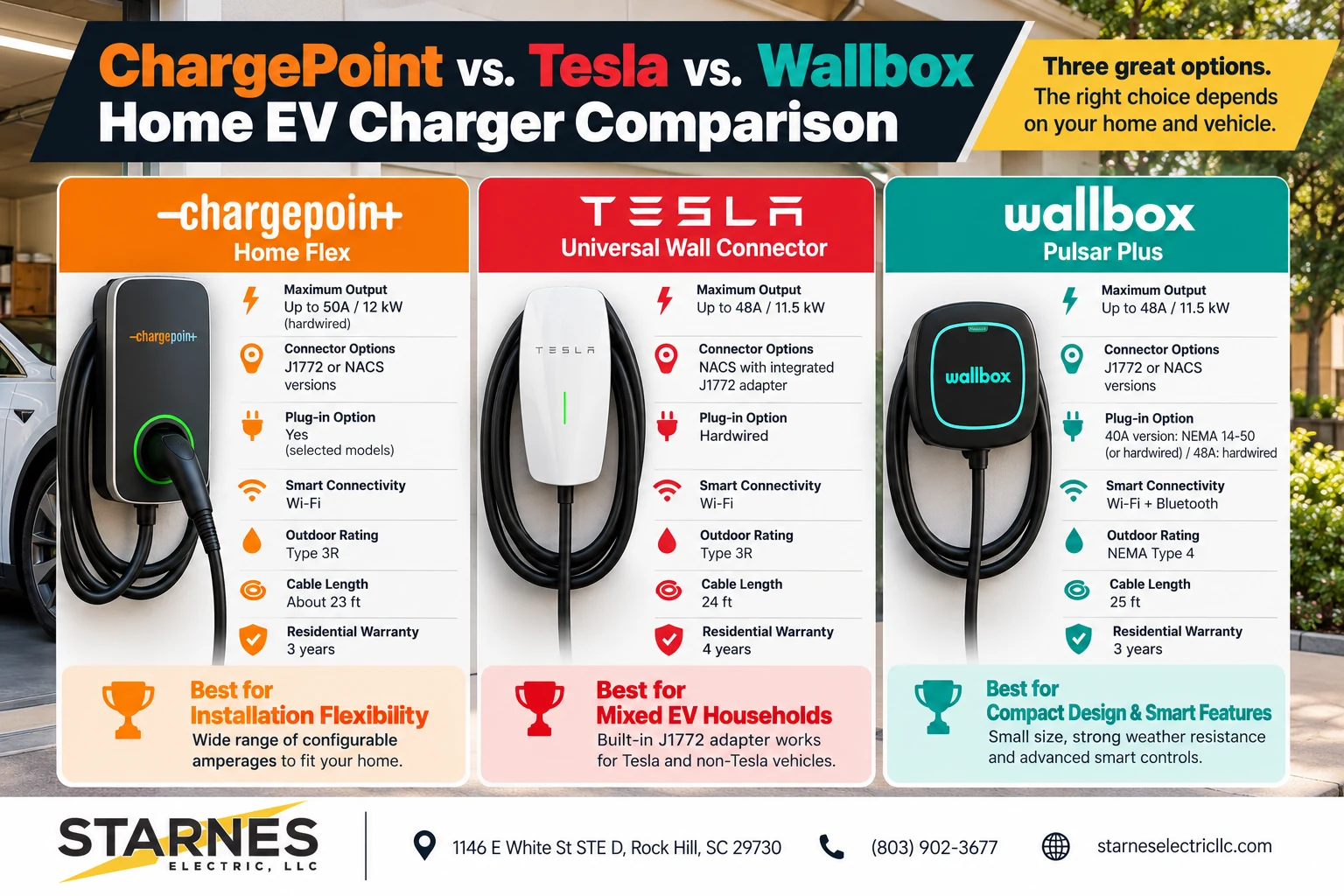
How Do Chargepoint, Tesla, And Wallbox EV Chargers Compare?
Put all three side by side and the differences become easier to understand.
| Feature | ChargePoint Home Flex | Tesla Universal Wall Connector | Wallbox Pulsar Plus |
|---|---|---|---|
| Maximum output | Up to 50A / 12 kW hardwired | Up to 48A / 11.5 kW | Up to 48A / 11.5 kW |
| Connector options | J1772 or NACS versions | NACS with integrated J1772 adapter | J1772 or NACS versions |
| Plug-in option | Yes, selected models/settings | Hardwired | 40A version available with NEMA 14-50 |
| Smart connectivity | Wi-Fi | Wi-Fi | Wi-Fi + Bluetooth |
| Outdoor rating | Type 3R | Type 3R | NEMA Type 4 |
| Cable length | About 23 ft | 24 ft | 25 ft |
| Residential warranty | 3 years | 4 years | 3 years |
| Standout feature | Broad amperage flexibility | Excellent mixed-EV compatibility | Compact design and smart controls |
Specifications are based on current manufacturer information and can vary by configuration.
From our perspective, ChargePoint Home Flex is probably the best choice for homeowners who want maximum installation flexibility. Its wide range of configurable amperages makes it easier to adapt the charger to what the electrical system can realistically support.
Tesla Universal Wall Connector is our favorite for households where vehicle brands may change. The integrated J1772 adapter and NACS connector make it unusually future-friendly for a garage that may see different EVs over the charger’s lifetime.
Wallbox Pulsar Plus is the sleeper pick. It is small, powerful, outdoor capable, and smart without being unnecessarily complicated.
But here is the part that matters more than the logo.
North Carolina and South Carolina have their own adopted electrical-code frameworks, and permitting procedures can also vary by jurisdiction. North Carolina’s Office of State Fire Marshal currently notes that its planned 2023 electrical code remains under an indefinite delay, while South Carolina currently lists the 2020 NEC with state modifications among its adopted codes.
That is why EV charger installation should not be treated like mounting a television.
The electrician may need to consider circuit sizing, panel capacity, conductor sizing, routing, grounding, breaker requirements, outdoor conditions, charger configuration, permits, and the manufacturer’s installation instructions.
The charger is only half the project.
The electrical system feeding it is the other half.
Rock Hill Outdoor Electrical & Conduit Wiring Cost Guide
The average cost of outdoor electrical and conduit work in [...]
Learn More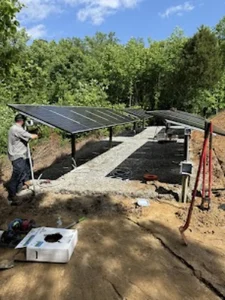
Don’t Buy a 48-Amp Charger Before Checking the Panel With Starnes Electric LLC
There is a strange temptation with EV chargers to shop entirely by maximum amperage.
If one charger delivers 40 amps and another delivers 48, the 48-amp version must be better, right?
Not necessarily.
At Starnes Electric LLC, we believe the best home EV charging setup starts with the house, not the shopping cart.
Before deciding between ChargePoint, Tesla, Wallbox, or another Level 2 charger, it makes sense to look at the vehicle’s charging capability, the electrical panel, available service capacity, parking location, cable route, outdoor exposure, and how your household may use EVs in the future.
Maybe ChargePoint’s adjustable output makes the most sense.
Maybe Tesla’s Universal Wall Connector is ideal because your household has two different EV brands.
Maybe Wallbox fits perfectly beside the garage door where there is barely enough wall space for anything larger.
And sometimes the best answer is installing a charger at a lower amperage because it comfortably handles your daily driving without forcing a costly electrical upgrade.
Starnes Electric LLC can help homeowners plan and install EV charging with the entire electrical system in mind. That includes evaluating existing capacity, determining an appropriate circuit, choosing a sensible charger location, and making sure the installation is approached according to applicable electrical and permitting requirements.
Your home charger should eventually become boring.
You pull into the garage, plug in, go inside, and wake up with the range you need.
No extension cords. No mystery breaker trips. No wondering whether the panel is being pushed beyond what it was designed to handle.
That quiet, dependable routine is what a good EV charging installation is supposed to deliver.
Charge Faster. Drive Ready.
Get a properly installed home EV charger designed for your vehicle and electrical system. Contact Starnes Electric LLC today.
About the Author: Dalton Starnes