
How to Choose an Electrician in Rock Hill, SC: A Homeowner’s Checklist
Table of Contents
Choosing an electrician in Rock Hill, SC should involve more than finding whoever can arrive first or offers the lowest number over the phone. You want someone properly qualified, appropriately licensed, clear about the work, and willing to explain what your home’s electrical system actually needs.
In my opinion, homeowners should approach hiring an electrician the same way they would hire someone to work on the roof or foundation. Much of the finished work disappears behind walls, inside electrical boxes, or within the panel. You need confidence in what you cannot see just as much as what you can.
Call a Rock Hill Electrician Today
Get trusted electrical service without the guesswork. Contact Starnes Electric LLC and schedule your service today.
What Should I Look For When Choosing An Electrician In Rock Hill, SC?
The first thing I would look for is professionalism before a single wire is touched.
That does not mean the electrician needs a spotless truck or a fancy presentation folder. It means they communicate clearly, understand the proposed work, answer reasonable questions, and are willing to follow the permitting and inspection requirements that apply to the project.
For work within the City of Rock Hill, electrical contractors must meet applicable South Carolina licensing requirements, and the City also requires contractors to have a City of Rock Hill business license. The City specifically advises property owners to verify contractor licensing before hiring.
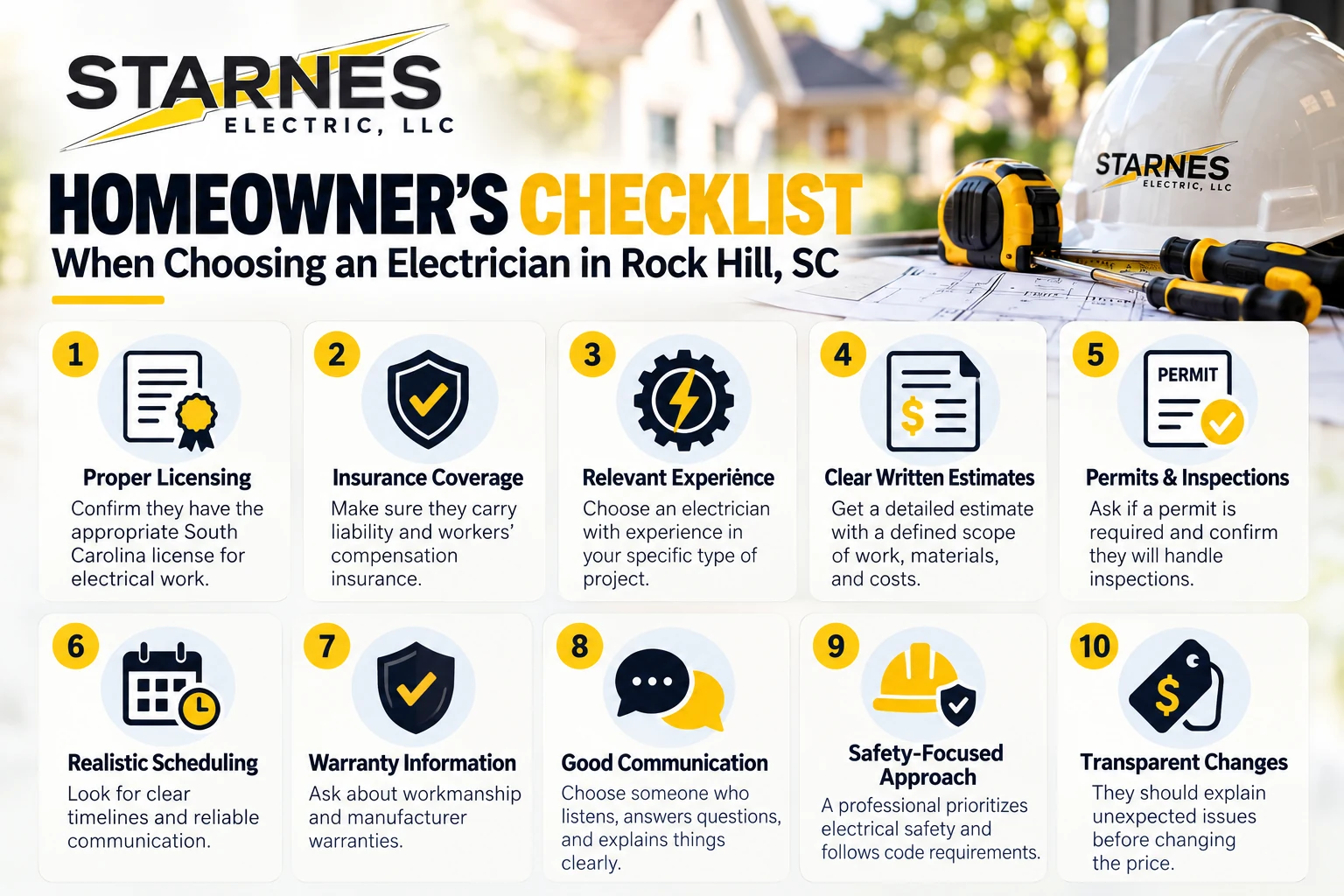
A good homeowner checklist should include:
- Appropriate South Carolina licensing for the work
- Insurance documentation
- Experience with the type of electrical project you need
- Clear written estimates
- A defined scope of work
- An explanation of whether permits are required
- Willingness to arrange required inspections
- Realistic scheduling
- Clear warranty information
- Good communication
- A professional approach to electrical safety
- A willingness to explain unexpected problems before changing the price
Experience matters because electrical work covers a surprisingly wide range of specialties.
Replacing a few switches is very different from troubleshooting recurring voltage problems. Installing recessed lighting is different from replacing an electrical panel. Wiring a detached garage is different from installing an EV charger or correcting outdated electrical work throughout an older home.
You do not necessarily need someone who claims to have done absolutely everything since electricity was invented. You need someone who is comfortable and qualified for your project.
Pay attention to how an electrician talks about permits, too.
The City of Rock Hill lists new or replacement wiring, added outlets, and added lighting among examples of electrical work that can require permitting. Electrical service changes and upgrades have their own permit process as well.
If somebody responds to a legitimate permit question with, “Nobody checks that,” I would consider that useful information.
Just not in the way they intended.
Homeowners should also be cautious about comparing estimates based solely on the number at the bottom.
One quote may include permits, new breakers, proper grounding work, patching considerations, upgraded devices, labeling, cleanup, and testing. Another may cover considerably less.
A $900 estimate and a $1,300 estimate are not really comparable until you know whether both contractors are proposing the same work.
Ask what is included.
A good estimate should make the answer reasonably clear.
What Are The Signs That I Need To Hire A Professional Electrician?
Some electrical jobs begin with a dramatic failure. Others announce themselves through little annoyances that homeowners gradually learn to live with.
The kitchen breaker trips whenever the microwave and toaster run together.
The dining-room light flickers occasionally.
A receptacle feels loose.
There is a faint buzzing near the electrical panel.
The previous homeowner apparently believed electrical tape was a structural material.
Those are not necessarily reasons to panic, but they are reasons to pay attention.
Signs that may justify calling a professional electrician include:
- Breakers that repeatedly trip
- Frequently blown fuses in an older electrical system
- Lights that flicker or dim unexpectedly
- Burning or unusual odors around electrical equipment
- Discolored or scorched outlets and switches
- Warm receptacles or switch plates
- Buzzing, sizzling, or crackling sounds
- Loose or damaged receptacles
- GFCI devices that repeatedly trip or refuse to reset
- Outlets that suddenly stop working
- Electrical shocks or tingling sensations from appliances or fixtures
- Visible damaged wiring
- Electrical problems after water intrusion
- An overloaded collection of extension cords and power strips
- Older wiring that has never been professionally evaluated
Certain renovation projects are also good reasons to involve an electrician even when nothing appears to be broken.
You may need professional electrical work when adding:
- A remodeled kitchen
- A bathroom renovation
- A home office
- A finished basement
- A workshop
- A hot tub or pool
- An EV charger
- New HVAC equipment
- Major appliances
- Outdoor lighting
- Smart-home equipment
- A detached garage or shed with electrical service
These projects can affect circuit capacity, panel space, grounding, GFCI or AFCI protection, wiring methods, and electrical load.
That is why I am not a fan of the phrase, “It’s just one outlet.”
Sometimes it really is a straightforward receptacle installation.
Other times that outlet is for a 240-volt appliance at the opposite end of the house, the electrical panel is already full, and the original wiring dates from an era when having one television was considered extravagant.
Context changes everything.
One particularly important warning sign is repeated breaker tripping.
A breaker that trips is doing its job. Continually resetting it without finding out why is not a repair.
Likewise, installing a larger breaker because the existing one keeps tripping can be dangerous if the wiring was not designed for that higher current.
Professional troubleshooting should identify the cause rather than silence the symptom.
What Should Be Included In An Electrical Safety Checklist For Homeowners?
Homeowners do not need to become amateur electrical inspectors.
In fact, a sensible household electrical safety check should mostly involve looking, listening, and noticing, not removing panel covers or dismantling electrical equipment.
A practical checklist can start with the things you interact with every day.
Check receptacles and switches
Walk through the home occasionally and look for cracked covers, loose receptacles, discoloration, or plugs that no longer fit securely.
A receptacle should not move noticeably when you insert or remove a plug.
If you see scorch marks, melted plastic, or unusual discoloration, stop using the device and have it evaluated.
Pay attention to breaker trips
One random trip caused by an obvious temporary overload may not indicate a major problem.
Repeated trips deserve attention.
Keep track of which circuit trips and what equipment is operating when it happens. That information can be useful when an electrician begins troubleshooting.
Test GFCI devices according to manufacturer instructions
GFCI protection is commonly used in areas where electrical shock hazards are greater, such as bathrooms, kitchens, garages, outdoor locations, and other applicable areas.
Homeowners should use the built-in TEST and RESET functions according to the device manufacturer’s instructions.
If a GFCI will not reset, repeatedly trips, or appears damaged, do not simply replace it with an ordinary receptacle to make the problem disappear.
Look at extension-cord use
Extension cords are useful temporary tools.
They should not become the unofficial wiring system of the house.
If a room permanently depends on extension cords, multi-plug adapters, and interconnected power strips because there are not enough receptacles, it may be worth discussing additional permanent outlets.
Keep electrical equipment accessible
Do not stack boxes, furniture, storage bins, or other belongings directly in front of electrical panels.
An electrician or emergency responder may need to reach that equipment quickly.
Inspect outdoor electrical equipment visually
Look for broken receptacle covers, cracked enclosures, exposed wiring, damage from landscaping equipment, or signs that water is entering electrical components.
Do not disassemble outdoor electrical equipment yourself to investigate.
Know where your electrical panel is
Every adult homeowner should know where the main electrical panel is located.
You should also have a reasonably accurate circuit directory.
A breaker label that says “stuff” is not particularly helpful.
Neither is a 30-year-old handwritten label reading “Tom’s room” when nobody in the family knows who Tom was.
Take unusual smells and sounds seriously
Electrical problems can sometimes produce buzzing, crackling, heat, or burning odors before a complete failure occurs.
If you notice those warning signs, particularly around a panel, outlet, appliance connection, or switch, stop using the affected equipment and seek professional help.
The best homeowner electrical checklist is not complicated.
You are mostly asking yourself one question:
Has anything changed?
New sounds, smells, heat, trips, flickering, damage, or inconsistent performance can all be useful clues.
What Questions Should I Ask An Electrician Before Hiring Them?
You do not need to conduct a 45-minute job interview at the front door, but a few questions can reveal a lot.
I would start with these:
“Are you licensed for this type of work?”
This should be an easy question.
The answer should not require a philosophical discussion about whether licenses really matter.
“Are you insured?”
Ask whether the business carries appropriate insurance and whether documentation can be provided if needed.
Do not assume a license automatically tells you everything about a contractor’s current insurance coverage.
“Have you handled this type of project before?”
This is especially useful for panel replacements, service upgrades, EV chargers, generators, pools, hot tubs, older-home rewiring, major renovations, or complicated troubleshooting.
“Will this project require a permit?”
A professional should be comfortable discussing permitting.
For example, Rock Hill specifically requires a trades permit for electrical service change-outs and upgrades within the City’s jurisdiction.
If a permit is required, ask who will obtain it and schedule inspections.
“What exactly is included in the estimate?”
Ask about:
- Labor
- Materials
- Permit fees
- Cleanup
- Testing
- Disposal of old equipment
- Drywall repair, if applicable
- Panel labeling
- Warranty coverage
- Potential additional costs
The goal is not to interrogate someone over every wire nut.
It is to avoid discovering halfway through the project that you and the electrician had completely different ideas of what “replace the panel” meant.
“What happens if you find another problem?”
Electrical work can reveal surprises, particularly in older homes.
Maybe an electrician opens a box and discovers damaged conductors. Maybe the panel has previous modifications. Maybe grounding needs attention.
Ask how changes to the original scope will be communicated and approved.
“Who will actually perform the work?”
Sometimes the person preparing the estimate is not the electrician who will arrive on installation day.
That is not necessarily a problem.
It is still reasonable to ask who will be performing or supervising the work and whether they are properly qualified.
“What warranty do you provide?”
Ask what is covered and for how long.
Clear warranty terms are much more useful than the phrase, “Don’t worry, we’ll take care of you.”
A handshake is nice.
Written information is nicer.
Security Lighting Installation: Best Places to Add Outdoor Lights Around Your Home
Outdoor security lighting works best when it is strategically placed [...]
Learn More
How Can I Tell If An Electrician Is Licensed, Insured, And Qualified?
This is one of the easiest parts of contractor research, yet homeowners frequently skip it.
For Rock Hill electrical work, start with licensing.
The City advises residents that electrical contractors can be checked through South Carolina’s contractor licensing system and says property owners can also contact the City to verify contractor licensing. The City requires electrical contractors working within City limits to have the applicable South Carolina credentials and a Rock Hill business license.
South Carolina’s Department of Labor, Licensing and Regulation also provides online license-verification and licensee-lookup resources.
When checking a license, confirm:
- The name matches the contractor or business you are considering
- The credential is active
- The classification is appropriate for the work
- You are looking at the correct person or company
- Any information provided by the contractor matches the official record
Insurance should be verified separately.
Ask the electrician for proof of applicable insurance coverage. For a substantial project, homeowners may want current documentation rather than relying on a statement that the contractor is “fully insured.”
Qualification is broader than licenses and insurance, however.
A contractor can satisfy basic credential requirements and still be a poor match for your job.
Look for practical signs of competence:
- Do they listen before recommending a solution?
- Do they inspect enough of the system to understand the problem?
- Can they explain the work in ordinary language?
- Do they discuss permits when applicable?
- Do they identify safety concerns without using scare tactics?
- Does the estimate correspond with what was discussed?
- Are they comfortable answering technical questions?
- Do they avoid shortcuts that conflict with code or manufacturer requirements?
Reviews can help, too, but I would read them for patterns rather than obsessing over whether someone has 4.8 stars instead of 4.9.
Look for repeated comments about communication, reliability, cleanliness, problem-solving, workmanship, and how the company handled problems when something did not go perfectly.
That last category tells you more than people realize.
Almost every contractor eventually encounters a difficult project.
A company’s response when something goes wrong can reveal more than fifty reviews saying, “Great job!”
And finally, trust your reaction to the estimate process.
If someone refuses to put the scope in writing, pressures you to decide immediately, dismisses legitimate questions, recommends suspicious shortcuts, or seems strangely enthusiastic about avoiding permits, keep looking.
Electrical work is too important to hire based on discomfort and hope.
Hire for What You Won’t See After the Drywall Closes With Starnes Electric LLC
The funny thing about good electrical work is that most of it eventually becomes invisible.
The homeowner sees a new outlet, brighter kitchen lighting, a working EV charger, or a clean new electrical panel.
Behind that finished result are conductor sizes, connections, grounding, circuit protection, boxes, wiring methods, calculations, permits, inspections, and dozens of small decisions that determine whether the installation was done properly.
That is why choosing an electrician should never come down to finding the cheapest number on a text message.
At Starnes Electric LLC, we believe homeowners deserve electrical work that is explained clearly and approached with safety, reliability, and the actual needs of the property in mind.
Whether you are dealing with recurring electrical problems, planning a renovation, adding circuits, upgrading a panel, installing new lighting, or simply trying to understand whether an older electrical system needs attention, the right starting point is a proper evaluation.
For homeowners in Rock Hill, SC, that also means working with a contractor who understands local permitting expectations and the importance of completing applicable work through the proper process.
Before hiring any electrician, check the credentials. Ask about insurance. Read the scope. Discuss permits. Understand what is included. And pay attention to how willing the contractor is to answer your questions.
You do not need to become an electrical expert to make a smart hiring decision.
You simply need an electrician who is willing to be one for you.
Starnes Electric LLC is here to help Rock Hill homeowners approach electrical repairs and improvements with fewer surprises, clearer answers, and workmanship that still matters long after the tools have been packed away.
Need a Trusted Electrician?
Choose a licensed Rock Hill electrician you can rely on for safe, professional electrical work. Call Starnes Electric LLC today.
About the Author: Dalton Starnes