
Do You Need a Permit for Electrical Work in York County, SC?
Table of Contents
Yes, many electrical projects in York County, SC require a permit, especially when you are adding circuits, altering permanent wiring, upgrading service equipment, or performing other work regulated by the electrical code. South Carolina does provide exemptions for a limited list of minor homeowner projects, but “I own the house” is not a universal permit-free pass.
In my opinion, permits get an unfair reputation. Nobody wakes up excited to fill out permit paperwork, but electrical inspections exist for a good reason. When the work disappears behind drywall, you want more assurance than, “Well, the lights came on.”
Planning an Electrical Upgrade?
Get the job done safely and according to local requirements. Contact Starnes Electric LLC for dependable electrical service.
Can You Do Your Own Electrical Work In South Carolina?
Yes, South Carolina law can allow a homeowner to perform work on their own residential property, but there are important conditions and distinctions to understand.
South Carolina’s owner-builder exemption applies in certain situations where the owner is improving residential property for their own or their family’s occupancy rather than for sale or rent. The law says the owner may do the work personally, use their own employees, or use properly licensed or registered contractors. It also places conditions on the use and occupancy of the property.
That does not mean every electrical project becomes exempt from permitting just because you own a screwdriver and watched three wiring videos on Saturday morning.
South Carolina separately identifies a limited group of homeowner improvements that are exempt from building-permit and licensure requirements. For electrical work, those exemptions include specific minor activities such as:
- Listed cord-and-plug temporary decorative lighting
- Reinstallation of attachment-plug receptacles, but not the outlets themselves
- Replacing branch-circuit overcurrent devices with the required capacity in the same location
- Certain wiring and equipment operating below 25 volts and limited to 50 watts
- Minor repairs such as replacing lamps
- Connecting approved portable electrical equipment to approved permanent receptacles
Those exemptions are narrower than many homeowners expect.
If you are installing new permanent wiring, adding circuits, moving electrical outlets, replacing major equipment, modifying a service, or performing a substantial renovation, you should not simply assume the work fits one of those exemptions.
The owner-builder route also comes with responsibility. For projects requiring the owner-builder exemption, state law requires the owner to personally participate in the permitting process and imposes restrictions regarding occupancy and sale or rental of the property. York County’s residential permit paperwork similarly warns owner-builders that the property generally must be occupied by the owner or immediate family and that properly licensed contractors must be used when contractors are brought into the project.
My opinion? Being legally allowed to perform electrical work and being well-equipped to perform it safely are two different questions.
Changing a simple device under the right conditions is one thing. Troubleshooting a panel, sizing conductors, modifying grounding and bonding, or adding circuits is another.
Electricity does not care how confident you felt after watching the tutorial.
What Electrical Work Requires A Permit In York County, SC?
For residential properties under York County’s permitting jurisdiction, electrical work that goes beyond the state’s narrow permit exemptions should generally be treated as potentially permit-required work.
York County’s online permitting system specifically provides for residential electric, HVAC, gas, and plumbing permits, and notes that County permits are all-inclusive rather than issuing separate subcontractor permits for every trade. Contractors and subcontractors are identified on the applicable permit.
Common projects that should prompt a permit check include:
- Installing new branch circuits
- Adding permanent receptacles or lighting circuits
- Significant rewiring during a renovation
- Installing or replacing electrical panels
- Service upgrades
- Adding circuits for major appliances
- Wiring additions or finished spaces
- Adding electrical wiring to detached garages or workshops
- Installing electrical systems for substantial remodeling projects
- Moving or materially altering existing permanent wiring
- Electrical work associated with new construction
The exact permit requirement depends on the scope of work and which authority has jurisdiction over the property. That last part is important because York County contains incorporated municipalities as well as unincorporated areas. A property inside a city or town may fall under a municipal permitting authority rather than York County Planning & Development Services.
So, before buying materials, determine who actually issues permits for your address.
That five-minute question can prevent an impressive amount of paperwork later.
There is another common misunderstanding worth clearing up. A project does not necessarily become permit-free simply because no walls are being added.
Electrical permits are about electrical work, not just construction.
You could leave every stud, cabinet, floorboard, and roof shingle exactly where it is and still perform electrical work significant enough to require approval.
Think about a kitchen remodel. Maybe the cabinets are being replaced in the same footprint, but you are also:
- Moving receptacles
- Adding appliance circuits
- Changing lighting
- Adding an island
- Installing under-cabinet power
- Changing major appliances
The kitchen may look like a cosmetic remodel on Pinterest, but electrically, quite a lot may be happening behind the backsplash.
The safest approach is to describe the planned electrical work accurately to the permitting authority or electrician rather than trying to decide based on whether the project “feels big.”
What Requires A Building Permit In South Carolina?
South Carolina uses state-adopted building codes that local jurisdictions enforce. As a general principle, permits apply when regulated construction or building systems are constructed, enlarged, altered, repaired, moved, demolished, converted, or replaced, subject to specific exemptions.
That covers considerably more than building a house from scratch.
Depending on the project, permits may be involved when you:
- Construct a new building
- Build an addition
- Make significant structural alterations
- Convert or change the use of a space
- Perform major electrical work
- Make regulated plumbing changes
- Install or alter mechanical systems
- Perform certain gas work
- Build larger accessory structures
- Complete substantial renovations
South Carolina law, however, includes specific homeowner exemptions for certain smaller projects.
For example, the state statute lists one-story detached accessory structures of no more than 200 square feet, certain fences, qualifying small retaining walls, sidewalks, driveways, finish work, and several other limited projects among the residential-owner improvements exempted from building permit requirements.
Here’s where things get interesting.
A state building-permit exemption does not necessarily mean you can place whatever you want wherever you want.
Zoning, setbacks, easements, environmental rules, HOA restrictions, utility clearances, and other requirements may still apply.
York County demonstrates this nicely with its accessory-building rules. Its current detached accessory structure checklist says structures greater than 200 square feet require a residential building permit application and supporting information such as a site plan showing setbacks and easements. Structures of 200 square feet or less use a different process and require a Zoning Compliance Application and Checklist.
That distinction matters.
“No building permit required” does not translate to “no rules exist.”
That phrase may be the most useful sentence in this entire discussion.
What Are The Rules For Getting A Permit In South Carolina?
Permit procedures are administered locally, so the exact application depends on where the property is located and what you are doing.
For a York County project, the process typically begins by identifying the project type and submitting the appropriate application and supporting documentation through the County’s permitting system when York County is the authority having jurisdiction. York County provides online applications for residential electrical and other trade work.
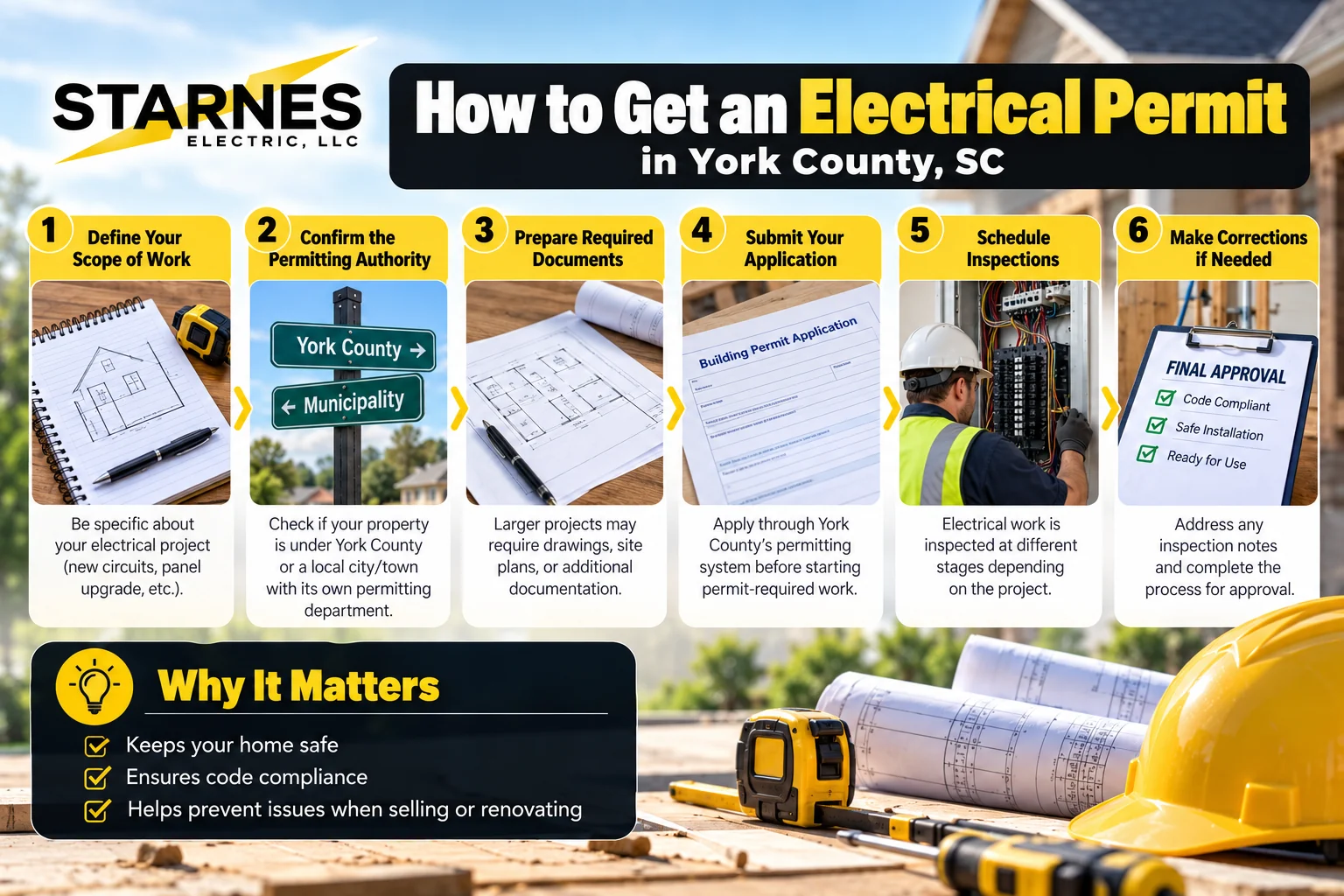
For larger residential projects, the process may look something like this:
- Define the entire scope of work.
Do not describe a complete rewiring project as “changing some outlets.” Accurate scope helps determine what permits and inspections are actually required. - Confirm the permitting authority.
Check whether the property is under York County or a municipality with its own permitting department. - Determine whether plans are required.
New construction, additions, accessory structures, and substantial renovations may require drawings or other documentation. - Identify the contractor or owner-builder.
York County’s residential applications request contractor and South Carolina licensing information. Homeowners acting as their own contractor must meet applicable owner-builder requirements. - Submit the application before beginning permit-required work.
The whole point of obtaining a permit is to have the work reviewed through the proper process, not to request approval after everything has been covered with drywall. - Schedule required inspections.
Depending on the project, electrical work may be inspected at different stages before final approval. - Correct deficiencies if necessary.
An inspection correction is not the end of civilization. It simply means something needs to be addressed before approval.
York County notes that residential plan review for detached accessory structures can take up to five business days, although processing time naturally depends on the application and project involved. The County also states that incomplete submissions will not be processed until deficiencies are addressed.
That last part deserves emphasis.
Permit delays are not always caused by some mysterious government machine turning slowly in a basement. Sometimes the submitted plans simply forgot the dimensions, property lines, contractor information, or half the project.
A clean application helps.
So does deciding on your electrical plan before rough-in begins.
Changing your mind from “one ceiling light” to “twelve recessed lights, two pendants, a smart lighting system, and while we’re here can we add an EV charger?” after work starts tends to make everyone’s afternoon more interesting.
Copper vs. Aluminum Wiring: A 2026 Safety and Conductivity Showdown
The copper-versus-aluminum debate sounds simple until someone opens an electrical [...]
Learn More
Do You Need A Permit To Build A Shed In York County, SC?
Sometimes yes, but size makes an important difference.
Under South Carolina law, an owner improving their own residential property can qualify for a building-permit exemption for a one-story detached accessory structure not exceeding 200 square feet.
York County’s current accessory structure guidance follows that 200-square-foot threshold in its permitting process.
For a detached accessory structure greater than 200 square feet, York County lists several plan-review items, including:
- Residential building permit application
- Residential land-disturbance questionnaire
- Site plan or plat
- Property-line setbacks
- Easements and rights-of-way
- Construction plans
- Accessory-building acknowledgement
- Applicable garage, storage, or workshop details
- HOA approval when applicable
- Owner-builder documentation when applicable
Structures 200 square feet or smaller use York County’s Zoning Compliance Application and Checklist rather than simply disappearing from local oversight.
And now we arrive at the part people often overlook.
The shed and the electricity going into the shed are separate questions.
Suppose you install a small storage shed that qualifies for the building-permit exemption. If it remains a simple storage building with no electricity, that is one situation.
But then you decide it would be nice to have:
- Interior lights
- Exterior floodlights
- Several receptacles
- A mini refrigerator
- Workshop equipment
- An air conditioner
- A buried feeder from the house
You have now moved well beyond the question, “Do I need a building permit for this little shed?”
You also need to consider the electrical installation.
Running permanent power to a detached structure can involve conductor sizing, burial requirements, grounding, overcurrent protection, disconnecting means, GFCI protection, load calculations, wiring methods, and other code considerations depending on the installation.
A 150-square-foot shed does not magically shrink electrical code requirements to 150 square feet too.
This is one of the easiest home projects to underestimate. The homeowner sees a wooden box in the backyard. The electrician sees a detached structure 70 feet away from the panel with power tools, outdoor exposure, trenching, grounding, and future loads to consider.
Both people are technically looking at the same shed. They are just seeing very different projects.
Get the Permit Question Answered Before the Wire Goes In With Starnes Electric LLC
Electrical permits are not the glamorous part of a renovation. Nobody posts a photo of an approved permit on social media next to the caption, “Finally, the dream kitchen is coming together!”
But correct permitting matters.
It helps ensure permit-required electrical work is reviewed, inspected, and completed with applicable safety requirements in mind. It can also prevent unpleasant questions later when a property is renovated again, sold, inspected, or evaluated after an electrical problem.
At Starnes Electric LLC, we would rather help homeowners think through electrical requirements before work begins than arrive after somebody has installed a questionable circuit and covered it with brand-new drywall.
If you are planning a panel upgrade, renovation, new circuit, detached garage, workshop, shed electrical installation, or other project in York County, SC, our team can help you determine the electrical scope and approach the work correctly from the beginning.
And remember, permitting requirements depend on the project and the authority with jurisdiction over the property. South Carolina provides specific exemptions for certain homeowner improvements, while York County and municipalities administer local permitting, zoning, and inspection processes. When in doubt, confirm the requirements before starting.
That may feel like one extra step.
It is still considerably easier than hearing, “We need to open that wall again.”
Starnes Electric LLC is here to help homeowners handle electrical projects with safety, proper planning, and code compliance in mind, so the finished project works the way it should without leaving permit questions hanging over it.
Need Electrical Work in York County?
Make sure your project is permitted and completed safely. Call Starnes Electric LLC for professional electrical service today.
About the Author: Dalton Starnes