
Pool and Spa Electrical Wiring Requirements & Safety
Table of Contents
Pools and spas are supposed to be where you relax, not where you start wondering whether the pump, lights, outlets, and hot tub disconnect were wired correctly. Because electricity and water make such an unforgiving combination, pool and spa electrical systems have stricter requirements than ordinary backyard wiring.
In our view, this is one area where “close enough” should never enter the conversation. Correct GFCI protection, bonding, grounding, equipment placement, and wiring methods are all part of creating a safer swimming or soaking area.
For South Carolina homeowners, it is also worth knowing that, as of September 2026, the state is using the 2020 National Electrical Code with South Carolina modifications, implemented statewide on January 1, 2023.
Need Pool Electrical Wiring?
Make sure your pool or spa wiring meets safety requirements. Call Starnes Electric LLC for expert electrical service.
What Are The Electrical Wiring Requirements For A Hot Tub?
Hot tub wiring depends heavily on the specific unit.
Some smaller portable spas plug into a suitable receptacle. Larger hot tubs often use a permanently connected 240-volt electrical supply and can require a substantial dedicated circuit. The manufacturer’s nameplate and installation instructions matter because voltage, current, conductor sizes, and circuit requirements vary considerably from one model to another.
This is why buying the hot tub first and telling the electrician, “It needs power somewhere over there,” is not exactly ideal project planning.
For a typical permanently installed spa or hot tub, an electrician may need to consider:
- The manufacturer’s required voltage and amperage
- A properly sized dedicated branch circuit
- GFCI protection
- An equipment grounding conductor
- Approved wiring methods for wet, outdoor, or corrosive environments
- A properly located maintenance disconnect
- Bonding requirements
- Receptacle and switch placement
- Local permitting and inspection requirements
- Whether the home’s existing electrical service has enough capacity
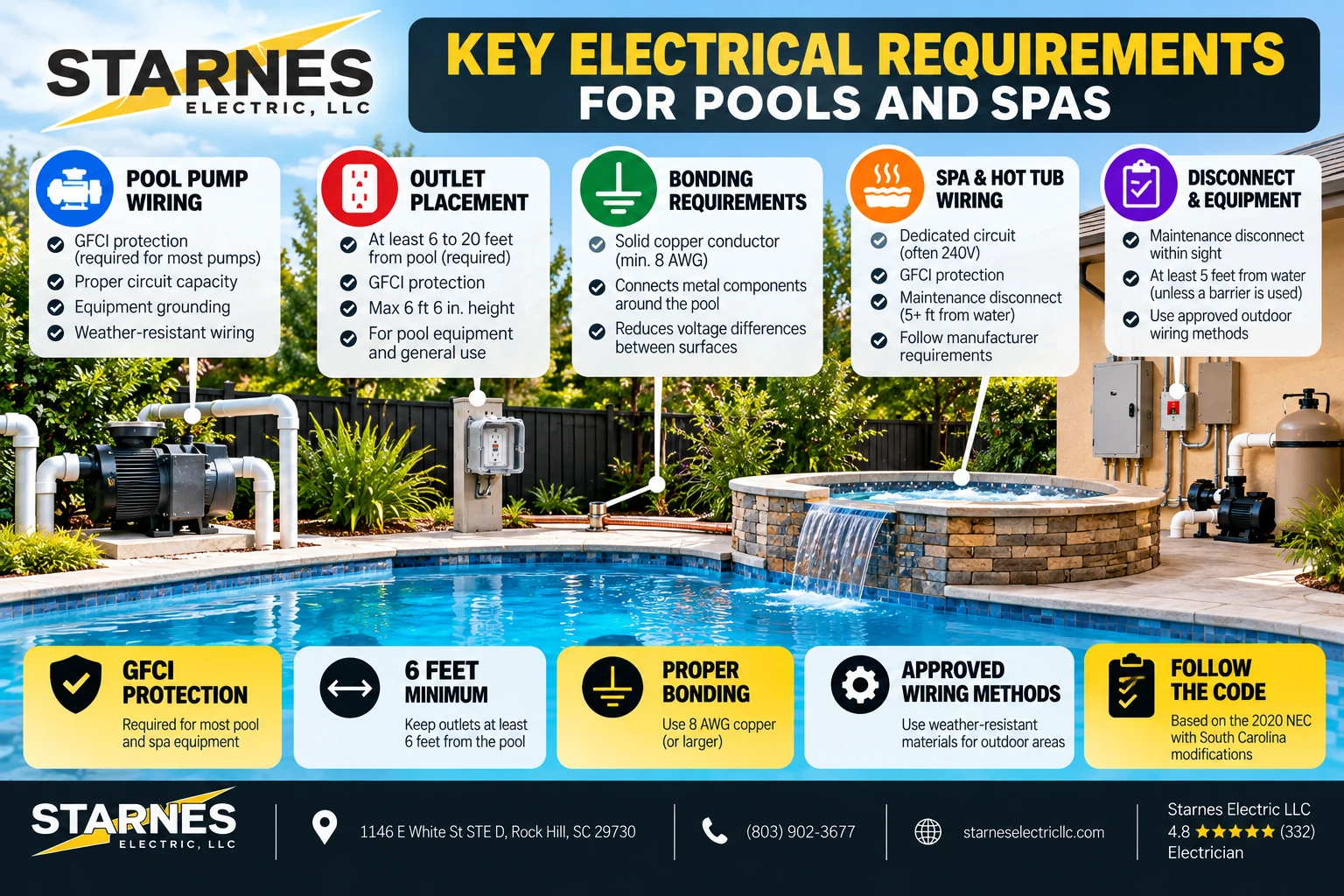
Under the 2020 NEC, a maintenance disconnect is required for pool, spa, and hot tub equipment other than lighting. It must generally be readily accessible, within sight of the equipment, and at least 5 feet from the water unless a permanent barrier provides the required separation.
That distance is important.
You do not want someone standing in a hot tub while casually reaching over to operate electrical switching equipment. Electrical codes have an understandable habit of becoming rather suspicious whenever people, water, and reachable electrical controls appear in the same sentence.
GFCI protection is another major part of hot tub wiring. Under the 2020 NEC, outlets supplying self-contained or packaged spas and hot tubs generally require GFCI protection, although certain listed equipment with integral GFCI protection may qualify for specific exceptions.
Outdoor installations introduce another issue: the wiring method itself.
Conduit, conductors, fittings, disconnects, and enclosures need to be appropriate for their environment. Pool and spa equipment areas can be wet, humid, chemically aggressive, and exposed to weather. The electrical installation needs to account for those conditions rather than treating the hot tub like an oversized living-room appliance.
One mistake homeowners sometimes make is assuming the hot tub company’s job automatically includes every electrical requirement. Sometimes it does. Sometimes the electrical connection is specifically excluded.
Before delivery day, find out who is responsible for the electrical work.
Watching four delivery workers lower a 900-pound spa into position and then discovering there is no suitable power supply nearby is a memorable experience, but not the fun kind.
What Electrical Requirements Are Needed For A Pool Pump?
A pool pump needs more than a convenient source of electricity. The circuit, wiring method, grounding, GFCI protection, receptacle or direct connection, and equipment location all need to work together.
The starting point is the pump itself.
Its nameplate tells the electrician important information such as operating voltage and current. That information helps determine the appropriate branch circuit and overcurrent protection.
Under the 2020 NEC, pool-associated motors rated 60 amperes or less and not over 150 volts to ground require GFCI protection, whether they are connected through a receptacle or directly wired. Replacement pool pump motors also require GFCI protection under these provisions.
For pool-associated motors installed in corrosive locations, the NEC also specifies acceptable wiring methods and requires an insulated copper equipment grounding conductor sized under the applicable rules, but not smaller than 12 AWG.
In practical terms, pool pump electrical planning should consider:
- Pump voltage and amperage
- Circuit capacity
- GFCI protection
- Proper equipment grounding
- Approved conduit and wiring methods
- Weather-resistant equipment where applicable
- Disconnecting means
- Bonding connections
- Distance from the pool
- Timer, automation, or control equipment
- Future additions such as heaters, lights, or additional pumps
That final point is worth thinking about before installation.
Today’s pool equipment pad may contain one pump.
Next year it could have a variable-speed pump, heater, saltwater chlorine generator, landscape lighting controller, automation panel, water feature pump, and enough technology to look like the engine room of a small yacht.
Planning ahead can save quite a bit of reworking.
A pool pump that repeatedly trips a breaker or GFCI should also be investigated rather than “fixed” by replacing the protective device with something less sensitive.
Frequent tripping can indicate problems involving the motor, wiring, moisture, insulation, connections, or other equipment. Protective devices are sometimes annoying precisely because they are telling you something you would rather not hear.
The appropriate response is to find the reason.
How Close Can An Electrical Outlet Be To A Pool?
For permanently installed pools, the magic number homeowners should remember is 6 feet, but the complete rule is a little more interesting.
Under the 2020 NEC, at least one 125-volt, 15- or 20-amp general-purpose receptacle is required between 6 feet and 20 feet from the inside wall of a permanently installed pool. It also cannot be more than 6 feet 6 inches above the floor, platform, or grade serving the pool.
Other receptacles generally must also remain at least 6 feet from the inside walls of the pool. Receptacles supplying permanently installed pool motors or circulation-related loads must be at least 6 feet away and GFCI protected.
Why have a receptacle near the pool at all?
Because people need electricity outdoors.
Someone will eventually want to plug in a cleaning device, radio, charger, maintenance tool, or some other piece of equipment. Providing a properly located receptacle is much safer than encouraging someone to run a 75-foot extension cord from the kitchen window.
Extension cords have a remarkable ability to appear whenever permanent receptacles were poorly planned.
Unfortunately, they also create exactly the sort of trip, moisture, and electrical hazards you do not want beside a swimming pool.
GFCI protection plays a big role too. Pool-area receptacle requirements include GFCI protection for applicable receptacles within 20 feet of the inside wall of the pool.
Distance is not simply measured however someone finds convenient.
NEC measurement rules consider the shortest path a flexible appliance cord could follow without passing through a wall, doorway, window, or another effective permanent barrier.
So, no, placing a flowerpot between the outlet and swimming pool does not create a code-approved electrical barrier.
It does create a flowerpot.
Hot tubs and spas have their own receptacle requirements depending on whether they are indoor, outdoor, permanent, or storable installations. For example, under the 2020 NEC, receptacles for storable pools, spas, and hot tubs must be at least 6 feet from the inside walls, with applicable receptacles within 20 feet requiring GFCI protection.
This is why pool-area electrical layout should be decided before the deck, patio, landscaping, and equipment locations are finalized whenever possible.
Moving an electrical plan on paper is easy.
Moving finished concrete is less charming.
What Are The Minimum Requirements For Pool Bonding Wire?
This question leads to one of the most misunderstood parts of swimming pool electrical safety: bonding is not the same thing as grounding.
Grounding provides a path associated with the electrical system and fault-current operation.
Equipotential bonding has a different job. Around a swimming pool, conductive components are bonded together to reduce voltage differences between surfaces and metal parts that a person could contact.
Imagine someone climbing out of the water while touching a metal ladder and standing barefoot on the pool deck. The goal is to minimize dangerous voltage differences between conductive objects and surfaces around that person.
That is why pool bonding is much bigger than simply connecting a green wire to the pump.
Under the 2020 NEC, listed pool components subject to equipotential bonding are generally bonded together using a solid insulated or bare copper conductor not smaller than 8 AWG.
Depending on pool construction, the bonding system can involve components such as:
- Conductive pool shells
- Perimeter surfaces
- Metal ladders and handrails
- Certain metal fittings
- Underwater lighting components
- Pump and other electrical equipment
- Certain fixed metal parts near the pool
- Structural reinforcing steel where applicable
The rules become more detailed when dealing with perimeter bonding.
Where the NEC’s copper ring method is applicable, the 2020 requirements include a bare solid copper conductor of at least 8 AWG following the pool perimeter. The ring is placed approximately 18 to 24 inches from the inside wall of the pool and typically 4 to 6 inches below the subgrade.
That does not mean every swimming pool gets an identical loop of copper installed in exactly the same way. Pool construction varies. Concrete, vinyl-lined, fiberglass, above-ground, and other installations can involve different details and exceptions.
It does mean bonding needs to be deliberately planned.
This is also why bonding should happen at the correct stage of construction.
Once concrete has been poured and decking completed, fixing a missing bonding connection becomes dramatically less entertaining.
Pool bonding is one of those systems homeowners rarely notice when everything is installed correctly. There is no smartphone app for it, no colorful LED telling you it is working, and no impressive button to press at the neighborhood barbecue.
It simply sits there doing an extremely important job.
Frankly, that is exactly how we like electrical safety systems to behave.
Does A Pool Or SPA Require GFCI Protection For Electrical Equipment?
Yes, GFCI protection is a major requirement for many pool and spa electrical loads, although the exact rules depend on the equipment and type of installation.
A GFCI monitors the electrical current leaving and returning through a circuit. If it detects an imbalance consistent with electricity escaping through an unintended path, it can disconnect power rapidly.
Around a pool or spa, that protection is particularly important.
Under the 2020 NEC, GFCI protection applies to numerous installations, including pool motors rated within the scope of Article 680, applicable pool-area receptacles, spa and hot tub supply outlets, and other specified electrical equipment.
Examples can include:
- Pool pump motors
- Replacement pool pump motors
- Receptacles near swimming pools
- Receptacles supplying circulation equipment
- Certain pool equipment-room receptacles
- Spa and hot tub equipment
- Applicable outlets supplying packaged or self-contained spas
- Electrical equipment associated with storable pools
It is important not to interpret that list as saying one GFCI receptacle beside the equipment pad automatically takes care of everything.
Different loads may be hardwired or receptacle-connected. Equipment ratings differ. Breakers and receptacles have different applications. Listed equipment may contain built-in protection. The electrical design needs to determine where GFCI protection belongs and what type is appropriate.
There is also a dangerous misconception that bonding eliminates the need for GFCI protection.
It does not.
Bonding, grounding, and GFCI protection perform different jobs. Pool electrical safety relies on those protections working together.
Think of them as members of the same safety team rather than interchangeable players.
And if a pool GFCI starts tripping repeatedly, do not bypass it because everyone wants to swim.
That is roughly the electrical equivalent of covering the check-engine light with tape and declaring the car repaired.
A trip deserves investigation.
Moisture intrusion, damaged wiring, failing pumps, deteriorating insulation, faulty equipment, and improperly installed components are only some of the issues that can produce electrical problems around pools and spas.
The combination of electricity, people, and water simply leaves very little room for creative troubleshooting.
Financing Your Electrical Project: Breaking Down Monthly Payments for Major Upgrades
Major electrical work has an annoying habit of becoming necessary [...]
Learn More
Keep the Water Relaxing and the Electrical System Boring With Starnes Electric LLC
A swimming pool should be exciting because the kids are doing cannonballs, not because touching the handrail suddenly becomes an electrical experiment.
That is why we believe pool and spa electrical work deserves more planning than almost any ordinary outdoor electrical project.
At Starnes Electric LLC, we can help homeowners evaluate and plan electrical systems for pools, spas, hot tubs, pumps, lighting, controls, and related equipment. That includes looking at appropriate circuit capacity, GFCI protection, equipment grounding, bonding, disconnect locations, receptacle placement, and the wiring methods required for the environment.
This is particularly important when adding a new pool or hot tub to an existing home. The electrical panel and service were not necessarily designed with another large electrical load in mind. Planning the project early gives an electrician the opportunity to evaluate available capacity and identify necessary upgrades before the equipment arrives.
The same applies to older pools.
Electrical standards have evolved, equipment ages, connections corrode, pumps get replaced, decks get remodeled, and previous owners sometimes leave behind electrical work that raises more questions than answers.
If you are installing a new pool or spa, replacing pool equipment, experiencing GFCI trips, upgrading a pump, adding pool lighting, or wondering whether existing bonding and electrical protection are adequate, Starnes Electric LLC can help evaluate the installation and determine the right next step.
Pool electrical work should not be judged by whether the pump starts when somebody flips the switch.
It should be planned so that the wiring, protection, bonding, grounding, equipment, and surrounding environment all work safely together.
Because the best electrical system around a pool is the one nobody thinks about once it is finished. The water stays refreshing, the pump keeps running, the lights work, and the electricity stays exactly where it belongs.
Keep Your Pool Wiring Safe
Get professional pool and spa electrical wiring from Starnes Electric LLC. Call now for safe, code-compliant service.
About the Author: Dalton Starnes