Is Your Electrical Panel a “Fire Trap”? The Federal Pacific and Zinsco Warning
Table of Contents
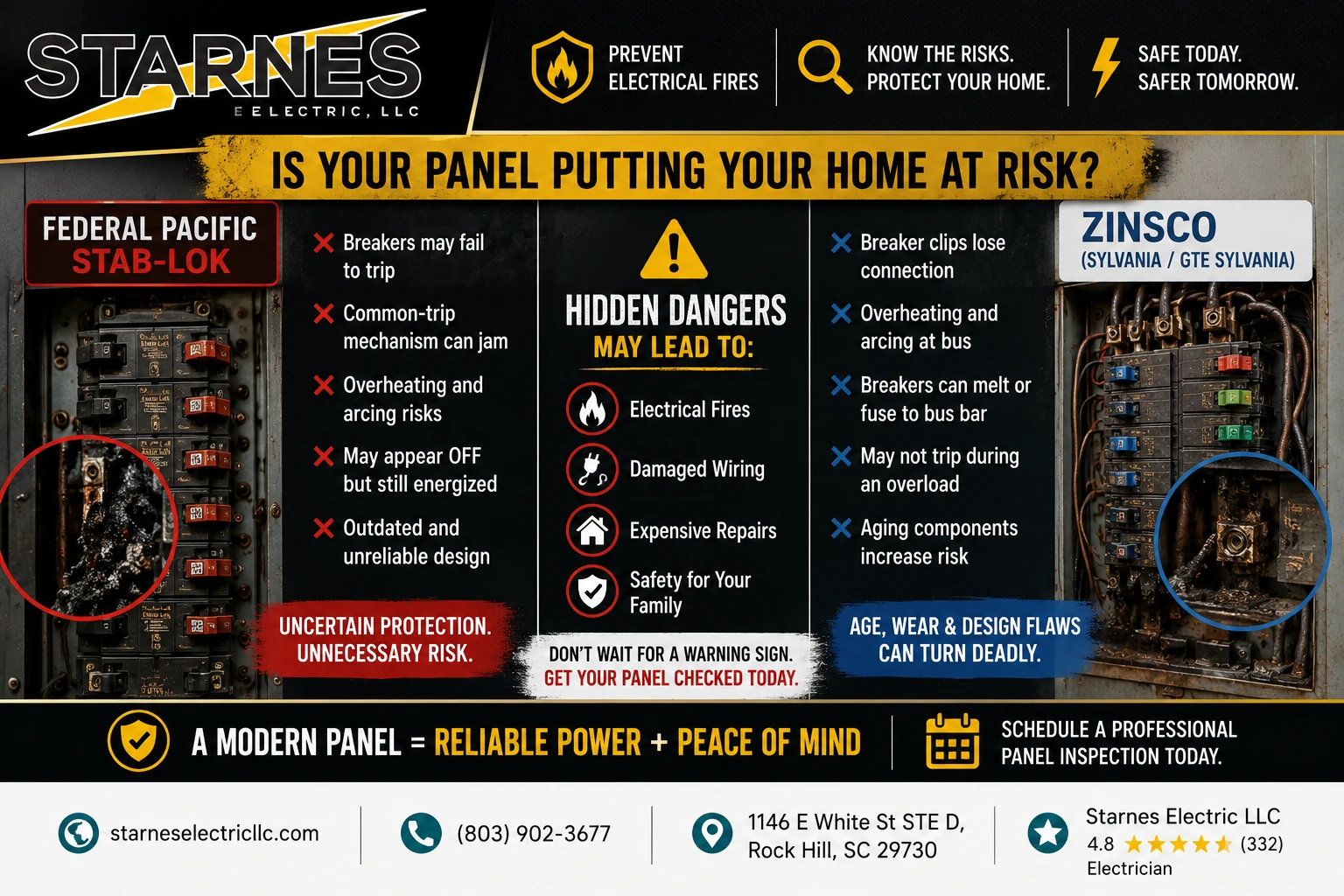
Calling an electrical panel a “fire trap” is dramatic, but Federal Pacific Stab-Lok panels and Zinsco panels have earned serious concern from electricians, inspectors, engineers, and insurers. Both panel types are associated with reports of overheating, damaged bus connections, and breakers that may fail to interrupt dangerous electrical current.
That does not mean every home containing one of these panels is moments away from catching fire. Electrical safety deserves more precision than that. It does mean homeowners should not treat the panel as harmless simply because the lights work and the breakers have not tripped recently.
Circuit breakers are supposed to act as the electrical system’s emergency brakes. When a circuit becomes overloaded or develops a serious electrical fault, the breaker should open and stop the current before wiring overheats. If the breaker does not trip when required, the wires inside the walls may continue heating while the panel appears to be operating normally.
That is the uncomfortable part. A defective breaker may not announce itself during ordinary use. The failure can remain hidden until the circuit is placed under dangerous stress.
In our opinion at Starnes Electric, Federal Pacific and Zinsco panels should be professionally evaluated and usually considered for replacement. Homeowners do not need panic, but they do need an honest assessment. Ignoring known concerns because the panel has “worked fine for decades” is not a strong electrical safety plan.
Don't Ignore a Dangerous Electrical Panel
Federal Pacific and Zinsco panels have known safety concerns. Schedule an expert inspection today for peace of mind.
Are Zinsco Electrical Panels A Fire Hazard?
Zinsco electrical panels are widely regarded as a potential fire and electrical safety hazard because of reported problems involving breaker connections, overheating, arcing, and failures to trip.
The central concern is the relationship between the circuit breaker and the panel’s bus bars. Bus bars are the energized metal components that distribute electricity to the breakers. In a sound panel, each breaker must maintain a secure electrical connection to the bus.
Reports involving Zinsco equipment describe breaker clips losing reliable contact with the bus bar. A weak connection creates resistance, and resistance creates heat. Continued heating can damage the breaker, discolor the bus, melt surrounding components, or cause the breaker to become fused to the bus bar.
Testing summarized in a technical Zinsco failure report found high failure rates among the breakers examined, although the sample was limited and should not be treated as a complete measurement of every Zinsco panel still in service. The same report documents arcing and burn damage at breaker-to-bus connections.
Possible Hazards Associated With a Deteriorated Zinsco Panel
- Breakers overheating at the bus connection
- Arcing between the breaker and bus bar
- Breakers melting or becoming stuck to the bus
- Internal damage hidden behind installed breakers
- Breakers remaining energized when their handles appear off
- Breakers failing to open during an overload
- Heat damage spreading to nearby wiring and insulation
One reason the issue is easy to overlook is that the front of the panel may appear normal. A breaker handle can move from ON to OFF even when the internal mechanism or bus connection has been damaged.
Homeowners should never remove breakers or the dead-front cover to investigate. Parts inside the panel may remain energized even when the main breaker is turned off. Inspection belongs to a licensed electrician with the training and protective equipment to work around service equipment.
We would not tell a homeowner that every Zinsco panel is actively burning. We would say that the design and age create enough concern that leaving one unexamined is an unnecessary gamble.
What Is A Zinsco Electrical Panel?
A Zinsco electrical panel is an older brand and design of electrical distribution equipment commonly installed in homes during the middle decades of the twentieth century. Related equipment may also carry names such as Sylvania, GTE Sylvania, or Zinsco-Sylvania.
The panel receives electricity from the utility and distributes it through individual circuit breakers to lighting, receptacles, appliances, air conditioners, and other loads throughout the home.
Zinsco panels are often recognizable by their distinctive narrow breakers and colored breaker handles. Common handle colors include red, green, blue, or combinations of colors. Some panels have the Zinsco name clearly visible on the label, while others may show Sylvania or GTE Sylvania branding.
Brand identification is not always simple because labels can be damaged, painted over, missing, or hidden inside the panel cover. Equipment ownership and product lines also changed over time, so a panel may use a related brand name while still containing the same basic breaker design.
Clues That a Panel May Be a Zinsco Design
- The name Zinsco on the panel label
- The names Sylvania or GTE Sylvania
- Tall, narrow breakers
- Brightly colored breaker handles
- Breakers spanning both bus bars in an unusual arrangement
- A panel installed during the 1950s through the 1970s
- Replacement breakers labeled for Zinsco-style equipment
Homeowners should not identify a panel based only on handle color. Several manufacturers have produced breakers in different colors, and electrical panels are frequently altered over their lifetime.
A qualified electrician can inspect the label, breaker design, bus configuration, and equipment history. Identification is worth doing because the correct response to a Zinsco panel is different from the response to an ordinary modern panel with one worn breaker.
What Makes Zinsco Panels Unsafe In Older Homes?
The combination of design concerns, decades of wear, increasing household electrical demand, and limited replacement options makes Zinsco panels especially concerning in older homes.
These panels were often installed when homes used fewer electrical devices. A household might have had one television, a basic refrigerator, several lamps, and a modest air-conditioning system. Today, the same house may have multiple televisions, computers, chargers, kitchen appliances, smart devices, upgraded HVAC equipment, and outdoor electrical loads.
The panel may now be doing a much harder job than its original installers ever expected.
Age also affects electrical equipment. Repeated heating and cooling can weaken connections. Corrosion can develop. Breaker mechanisms can become stiff. Previous homeowners may have added circuits, installed incompatible parts, or made questionable repairs.
Zinsco’s breaker-to-bus problems make these normal aging concerns more serious. If the breaker connection is already vulnerable to arcing or overheating, years of heavy electrical use may accelerate deterioration.
A Professional Inspection May Reveal
- Burn marks behind breakers
- Pitted or damaged bus bars
- Melted breaker housings
- Loose breakers
- Corroded terminals
- Improperly sized breakers
- Double-tapped connections
- Aluminum branch-circuit wiring
- Missing filler plates
- Improvised replacement parts
- Evidence of past overheating
A major problem is that replacing one breaker may not correct damage to the bus bar. If the metal bus has been burned or pitted, a new breaker may connect to an already compromised surface.
Some third-party replacement breakers remain available, but installing replacement parts does not automatically make the original panel design equivalent to a new modern system. Replacement decisions must account for the bus condition, panel listing, available components, and the reliability of the entire assembly.
In our view, repeatedly repairing an obsolete panel can become the electrical version of keeping an aging car alive by replacing one smoking part at a time. Eventually, a complete panel upgrade becomes the safer and more practical choice.
Are Federal Pacific Electrical Panels A Fire Hazard?
Federal Pacific Electric panels equipped with Stab-Lok breakers are considered a significant electrical safety concern because some breakers have reportedly failed to trip under overload and short-circuit conditions.
The U.S. Consumer Product Safety Commission (CPSC) investigated Federal Pacific Stab-Lok breakers during the early 1980s after the manufacturer’s parent company reported that many breakers did not fully comply with Underwriters Laboratories (UL) requirements. The CPSC closed the investigation in 1983 because the available data did not establish a serious risk of injury. Importantly, the agency stated that it had not made a determination that the breakers were safe.
That nuance matters.
It is inaccurate to say the CPSC officially declared every Federal Pacific panel unsafe. It is equally inaccurate to use the closed investigation as proof that the panels were cleared of all safety concerns. The commission did not issue a final safety endorsement.
Later independent testing, engineering analysis, field reports, and insurance-industry guidance continued to raise concerns about Stab-Lok performance. An insurance safety bulletin discussing testing by electrical engineer Jesse Aronstein describes breakers failing to open during dangerous overcurrent conditions, which can allow wiring to overheat.
Federal Pacific panels can remain in service without obvious symptoms. The breakers may turn lights on and off normally. They may even trip under some conditions while failing under others.
That unpredictability is exactly why electricians take them seriously. A safety device does not earn much confidence by working only when it feels like it.
When an overload occurs, the breaker is supposed to respond before the branch-circuit wiring reaches a dangerous temperature. If the breaker jams or fails to open, the wire can remain overloaded. Insulation may soften, nearby materials may heat, and the risk of arcing or fire can increase.
Rethinking Safety: The Overlooked Importance of Electrical Panel Clearance
When it comes to home safety, the electrical panel is [...]
Learn More
What Is The Issue With Federal Pacific Stab-Lok Breakers?
The main issue with Federal Pacific Stab-Lok breakers is that some units may fail to trip when an overload or short circuit requires them to disconnect power.
The name Stab-Lok refers to the way the breaker attaches to the energized bus within the panel. The design differs from many modern breakers that clip onto bus stabs in a more conventional arrangement.
Testing and Field Investigations Have Identified Several Possible Failure Modes
- A breaker may not trip under overcurrent conditions
- A double-pole breaker’s common-trip mechanism may jam
- Breaker contacts may remain closed
- Breakers may fit loosely or make poor bus contact
- Arcing or heat damage may develop inside the panel
- A breaker may appear switched off while parts remain energized
- Internal damage may not be visible from the front
Technical material describing Stab-Lok performance reports that double-pole breakers can experience jamming associated with friction in the common-trip mechanism. Double-pole breakers commonly supply larger 240-volt loads such as air conditioners, water heaters, ranges, dryers, and other high-demand equipment.
The danger is not that every Federal Pacific breaker fails. The concern is that homeowners cannot reliably predict which breaker will work properly during the next electrical fault.
Pressing the test button on a GFCI breaker, flipping the breaker handle, or seeing that the circuit currently works does not prove that the breaker will trip at the correct current level. Proper performance testing would require specialized equipment and controlled conditions.
Even testing individual breakers may not be the most practical answer. A home can contain dozens of aging breakers, and panel components can continue deteriorating after testing. Replacing the complete electrical panel is often more sensible than trying to certify each obsolete component individually.
Some homeowners ask whether replacement Stab-Lok breakers solve the problem. They may replace a visibly damaged breaker, but they do not replace an aged bus assembly, correct hidden heat damage, or modernize the panel’s overall design.
A Panel Replacement Also Creates an Opportunity to Correct Other Concerns
- Insufficient panel capacity
- Overcrowded circuits
- Improper grounding or bonding
- Missing surge protection
- Damaged service conductors
- Obsolete breakers
- Poor circuit labeling
- Code issues from previous renovations
We see this as more than replacing a metal box. It is an opportunity to give the electrical system a reliable control center again.
How Do I Know If My Home Has A Federal Pacific Or Zinsco Panel?
Homeowners can begin by looking at the outside of the electrical panel without removing any screws or covers.
Federal Pacific Panels Often Display
- Federal Pacific Electric
- FPE
- Stab-Lok
- Red markings on breaker handles
- A Stab-Lok label inside the panel door
- Breakers with the Federal Pacific name
Zinsco-Style Panels May Display
- Zinsco
- Sylvania
- GTE Sylvania
- Narrow breakers with colored handles
- Breakers arranged in a distinctive vertical design
- Labels referring to Zinsco-compatible equipment
The main electrical panel is often located in a garage, basement, utility room, hallway, closet, or on an exterior wall. Some homes also have subpanels in additions, workshops, detached garages, or near HVAC equipment.
Check every panel, not just the main service panel. A previous owner may have replaced the main panel while leaving an older Zinsco or Federal Pacific subpanel elsewhere.
Signs That Any Electrical Panel Needs Immediate Professional Attention
- A burning or hot-plastic odor
- Buzzing, sizzling, or crackling
- Breakers or the panel cover feeling warm
- Rust or water stains
- Melted plastic
- Scorch marks
- Frequently tripping breakers
- Flickering lights
- Breakers that will not reset
- Breakers that feel loose
- Smoke or visible sparks
If the panel is hot, smoking, or producing a burning smell, move away from it and contact emergency services when appropriate. Do not remove the cover, spray water on the panel, or try to repair it.
If the panel appears normal but the label says Federal Pacific, FPE, Stab-Lok, Zinsco, Sylvania, or GTE Sylvania, schedule an inspection with a licensed electrician. The electrician can verify the equipment, evaluate its condition, check the service capacity, and explain replacement options.
Homeowners may also discover that an insurer has concerns about these panels. Insurance underwriting requirements vary, but some carriers may request inspection, replacement, or documentation before issuing or renewing coverage. An industry risk bulletin from Ohio Mutual recommends complete replacement of FPE and Zinsco equipment by a qualified electrician.
A home inspection report may mention the panel as well, particularly during a property sale. However, a general home inspection is not the same as an electrical evaluation. A licensed electrician can provide a more detailed assessment and develop the actual scope of work.
Retire the Panel Before It Fails Its Only Test
Federal Pacific and Zinsco panels are not dangerous merely because they are old or unpopular. The concern comes from documented performance problems, obsolete components, hidden heat damage, and breakers that may not provide dependable overcurrent protection.
At Starnes Electric, we do not believe homeowners should live in fear of their electrical panel. We do believe they should know what equipment is installed and whether it can still perform the job it was designed to do.
Our electricians can identify Federal Pacific Stab-Lok and Zinsco equipment, inspect the service, review the panel’s condition, evaluate electrical demand, and explain the safest replacement options. We also check related concerns such as grounding, bonding, surge protection, breaker sizing, service capacity, and previous electrical modifications.
A modern electrical panel cannot prevent every electrical problem, but it gives the home properly listed equipment, dependable breaker options, improved capacity, and a safer foundation for future upgrades.
Contact Starnes Electric to schedule a professional panel evaluation. We will help you determine whether that older electrical panel is simply outdated or whether it has become a risk your home should no longer carry.
Could Your Electrical Panel Be a Hidden Fire Hazard?
Protect your home with a professional electrical panel inspection. Call Starnes Electric LLC before a small problem becomes a major emergency.
About the Author: Starnes Electric