
Why “Piedmont Humidity” Is a Hidden Threat to Outdoor Electrical Boxes
Table of Contents
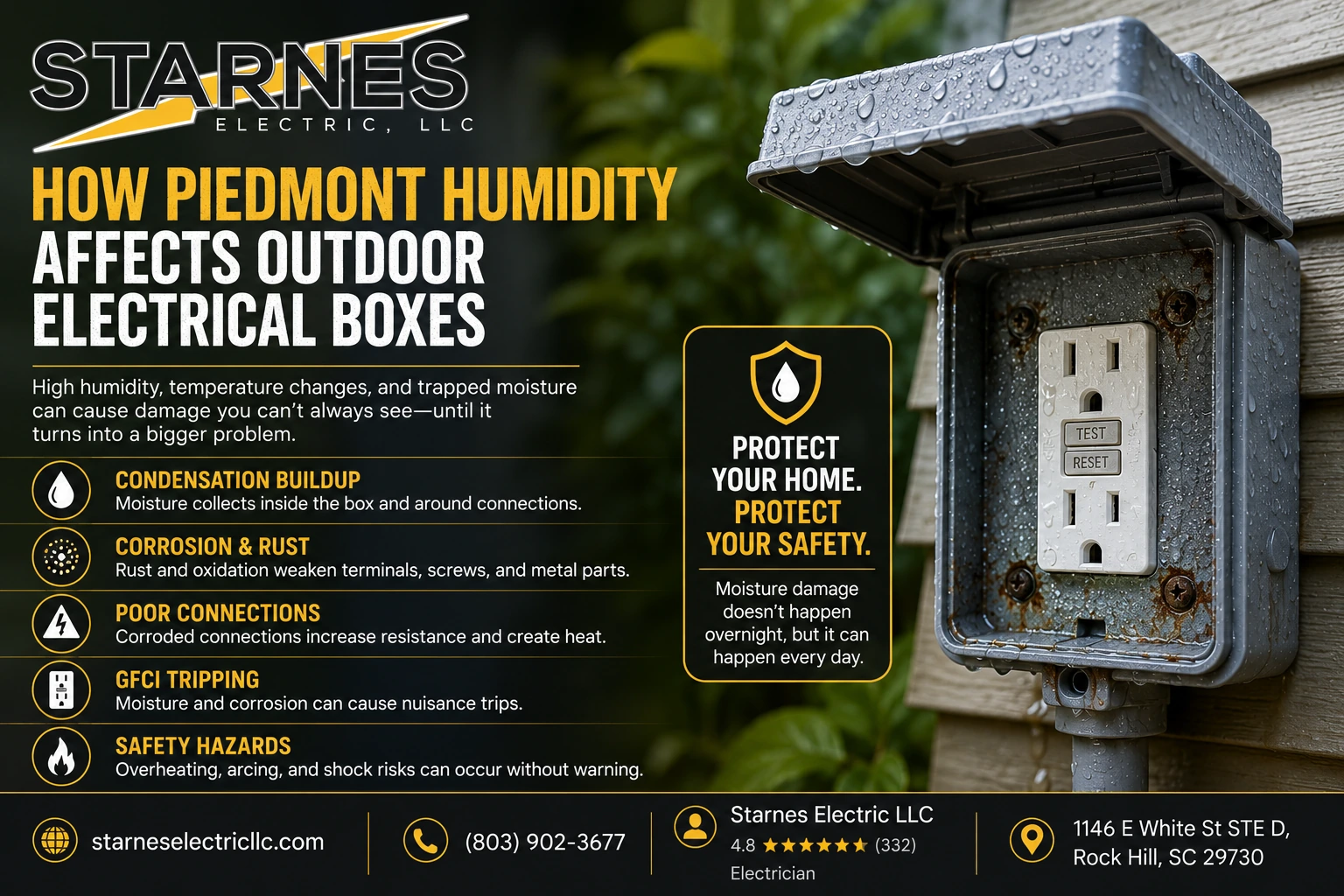
Piedmont humidity can quietly damage outdoor electrical boxes by encouraging condensation, corrosion, and deterioration around wiring connections. Unlike a dramatic lightning strike or a visibly broken outlet, humidity often works slowly, giving homeowners little warning until a receptacle stops working, a breaker trips, or a connection begins overheating.
That is what makes moisture around outdoor electricity so frustrating. Rain is easy to understand. You see the storm, notice the water, and know something may need attention. Humidity is different. It can enter through tiny gaps, collect inside an electrical enclosure, and remain trapped long after the yard looks dry.
Rock Hill and the surrounding Piedmont region regularly experience warm temperatures, high dew points, thunderstorms, and humid summer mornings. Recent National Weather Service observations for Rock Hill have shown relative humidity reaching the mid-90% range, illustrating how moisture-heavy local air can become.
In our opinion at Starnes Electric, outdoor electrical boxes deserve far more attention than they receive. Homeowners routinely inspect roofs, gutters, decks, and air conditioners, yet the outlet beside the patio may sit untouched for years. It is expected to survive heat, rain, insects, pressure washing, lawn equipment, irrigation spray, and constant seasonal changes while quietly powering everything from string lights to electric grills.
That little box has a demanding job.
Humidity Damaging Your Outdoor Electrical Boxes?
Stop hidden moisture before it causes corrosion, tripped outlets, or electrical hazards. Call Starnes Electric LLC today.
Can Humidity Cause Electrical Problems in Outdoor Electrical Boxes?
Yes, humidity can cause electrical problems in outdoor electrical boxes, especially when moist air enters an enclosure and condenses on cooler internal surfaces.
Humidity itself is water vapor suspended in the air. The problem begins when that vapor turns into liquid moisture. This can happen when warm, humid outdoor air reaches metal components that are cooler than the surrounding air. Small droplets may then form inside the box, around terminals, or on the back of a receptacle.
One humid morning is unlikely to destroy a properly installed outdoor outlet. The greater concern is repeated exposure. Electrical boxes go through daily heating and cooling cycles. Sunlight warms the enclosure during the day, while evening temperatures cause it to cool. Those changes can pull moist air in and encourage condensation.
Over time, repeated moisture exposure may contribute to:
- Corrosion on screws and terminals
- Rust on metal boxes and covers
- Oxidation on conductor surfaces
- Deterioration of seals and gaskets
- Mineral deposits from evaporated water
- Ground-fault circuit interrupter (GFCI) failure
- Loose or unreliable electrical connections
- Nuisance tripping
- Electrical arcing or overheating
Outdoor equipment should be designed and installed for its environment. OSHA’s electrical requirements state that equipment not identified for damp or wet locations should not be placed where moisture, liquids, vapors, or other deteriorating agents can affect it. The same guidance recognizes corrosion and environmental deterioration as conditions that can compromise electrical equipment.
The important phrase is “designed and installed.” A weather-resistant receptacle can still develop trouble if it is placed in a damaged box, paired with the wrong cover, poorly sealed, or connected using weak workmanship.
Outdoor-rated does not mean immortal.
How Does Piedmont Humidity Affect Outdoor Electrical Boxes?
Piedmont humidity affects outdoor electrical boxes by creating a nearly constant moisture challenge during warmer months. The combination of hot afternoons, cool overnight surfaces, heavy air, rainstorms, irrigation, and shaded walls can keep exterior equipment damp much longer than homeowners realize.
Imagine an outdoor outlet mounted on the north side of a house. It receives little direct sunlight, sits behind thick shrubs, and stays shaded most of the day. After an evening thunderstorm, the wall and box may remain cool and damp through the following morning. Humid air keeps moisture from evaporating quickly, while restricted airflow around the shrubs makes the situation worse.
Now repeat that pattern throughout summer.
The box does not need to fill with water like a tiny swimming pool. A thin film of moisture is enough to encourage corrosion on metal parts, especially when the process happens repeatedly.
Piedmont weather also tends to create several moisture sources at once:
- High outdoor humidity
- Afternoon thunderstorms
- Wind-driven rain
- Lawn irrigation
- Morning dew
- Condensation from temperature changes
- Water splashed during pressure washing
- Moist soil near low-mounted boxes
- Vegetation holding moisture against exterior walls
This is why a box can develop humidity-related damage even when its cover looks acceptable from a distance.
Location makes a major difference. An outlet beneath a deep porch roof is less exposed than one mounted on an open wall near a sprinkler head. A box facing wind-driven rain faces a different challenge than one sheltered beneath an overhang. Homes near wooded lots, shaded yards, drainage areas, or dense landscaping may also experience slower drying.
Our view is that Piedmont humidity should be treated as an environmental load, much like summer heat. Homeowners understand that an attic becomes extremely hot and that equipment installed there must be chosen accordingly. Outdoor electrical equipment deserves the same thinking. The local air is part of the installation environment, even when no rain is falling.
Why Is Moisture a Hidden Electrical Safety Risk Outside?
Moisture is a hidden electrical safety risk because it can create dangerous conditions before the outlet looks obviously damaged.
Water can lower electrical resistance and provide an unintended path for current. When electricity leaves its intended circuit path, it may energize metal parts, travel through moisture, or create a shock hazard for someone touching connected equipment.
That is why ground-fault circuit interrupters (GFCIs) are so important outdoors. A GFCI monitors the current leaving and returning to the circuit. If it detects an imbalance suggesting current is escaping, it shuts off power quickly. ESFI recommends GFCI protection for outdoor areas where electrical products may come into contact with water and advises using weatherproof electrical boxes or covers.
Still, a GFCI is not permission to ignore moisture damage. It is a protective device, not a substitute for a secure box, suitable cover, sound wiring, and proper installation.
Moisture can create several different hazards.
First, it can cause corrosion. Corrosion changes the surface of terminals, screws, and conductor connections. A corroded connection may not conduct electricity as effectively as it once did.
Second, poor contact can create resistance. Electrical resistance produces heat. If the connection continues carrying current, it may become hot enough to damage insulation, discolor the receptacle, or contribute to arcing.
Third, moisture can lead to intermittent operation. An outlet may work in dry weather and trip after rain or heavy humidity. This can tempt homeowners to keep resetting the GFCI without addressing the underlying condition.
Fourth, water may reach an extension cord, appliance cord, landscape light, or power tool connected to the outlet. The hazard is no longer contained inside the box.
The tricky part is that these problems may come and go. An outlet that trips during a wet week might appear perfectly normal after several sunny days. That does not necessarily mean the problem repaired itself. It may simply be waiting for the next humid cycle.
Electrical problems are not known for healing through optimism.
What Happens When Humidity Is Too High Around Outdoor Outlets?
When humidity remains high around outdoor outlets, moisture can accumulate in places that are difficult to see. Connections may corrode, the GFCI may begin tripping, and internal parts may slowly deteriorate.
Some symptoms are minor at first. The outlet may feel loose. A cover may become difficult to close. The GFCI test button may stick. Plug blades may show discoloration. Outdoor lights may flicker during damp weather.
Other symptoms deserve immediate attention:
- A burning smell
- Crackling or buzzing noises
- Heat around the outlet or cover
- Black or brown discoloration
- Melted plastic
- Visible sparks
- Repeated breaker or GFCI trips
- A mild shock or tingling sensation
- Water visibly draining from the box
If an outlet feels warm, smells burned, sparks, or gives someone a shock, it should not be used. The circuit may need to be turned off until a licensed electrician can inspect it.
Humidity can also affect outdoor receptacles that appear protected by a cover. Traditional flat covers are generally closed when the outlet is not being used. Once a cord is plugged in, however, the cover may no longer shield the receptacle adequately.
In-use covers are designed to protect the receptacle while a cord remains plugged in. These are particularly helpful for holiday lighting, landscape equipment, outdoor refrigerators, fountains, and other devices that stay connected for extended periods.
A cover must also close correctly. Cracks, broken hinges, missing gaskets, loose screws, and cords pinched through the wrong opening can all allow moisture inside.
Another common issue is landscaping. Vines, shrubs, mulch, and leaf debris may hold moisture against the outlet. They can also hide damage and make inspection difficult. An outdoor box should not be buried behind a miniature rainforest.
Homeowners should keep the area reasonably clear so the cover can open, close, and dry properly.
Tripped Breakers: Common Electrical Issues
Are you tired of having to constantly reset tripped breakers [...]
Learn More
How Does Moisture Affect Electrical Wiring and Connections?
Moisture affects electrical wiring and connections by attacking the points where current moves from one component to another.
The insulated portion of a wire may look fine, but the exposed conductor at a terminal is more vulnerable. If moisture reaches that area, oxidation or corrosion may develop. This can weaken the connection and increase resistance.
Electrical connections need firm, clean contact. When corrosion develops between conducting surfaces, current may be forced through a smaller effective contact area. That concentrated current can create localized heating.
The process can become self-reinforcing:
- Moisture reaches the connection.
- Corrosion or oxidation develops.
- Electrical resistance increases.
- The connection creates more heat under load.
- Heating and cooling cause expansion and contraction.
- The connection becomes looser or more damaged.
- Arcing or failure becomes more likely.
OSHA guidance states that internal electrical components, including wiring terminals and bus surfaces, should not be damaged or contaminated by corrosive residues. It also identifies corrosion, chemical action, and overheating as conditions that can adversely affect safe equipment operation.
Moisture can also enter through the cable or conduit path. A box may have a good cover but still receive moisture through an improperly sealed opening, damaged conduit fitting, loose connector, or gap around the mounting surface.
Unused openings are another concern. Every knockout or entry point should be properly closed. An open hole gives insects, humid air, and water an easy route into the enclosure.
Once insects move in, the box may contain nests, debris, or organic material that holds moisture. Ants seem especially attracted to electrical equipment, apparently because ordinary places were not inconvenient enough.
The type of box matters as well. Metal boxes may rust when protective finishes fail. Nonmetallic boxes do not rust, but they can crack, warp, loosen, or allow water entry around fittings. Neither type is maintenance-free.
Correct material selection, rated components, secure fittings, sound seals, proper covers, and professional installation all work together to keep moisture away from electrical connections.
How Can Homeowners Tell if an Outdoor Electrical Box Has Humidity Damage?
Homeowners can often spot humidity damage by inspecting the exterior of the box and watching for changes in outlet performance. The safest inspection is visual. There is no need to remove the cover plate or touch wiring.
Look for:
- Rust streaks around the box or mounting screws
- Green, white, or chalky deposits on metal parts
- Cracks in the cover or enclosure
- Missing, brittle, or flattened gaskets
- A cover that no longer closes tightly
- Water droplets behind a clear cover
- Dirt or insect debris inside the enclosure
- Discoloration around plug openings
- A receptacle that feels loose
- GFCI TEST or RESET buttons that do not work
- Tripping that occurs after rain or humid weather
- Outdoor equipment that operates intermittently
NFPA maintenance guidance recommends watching electrical enclosures for rust, corrosion, water entry, missing covers, and physical damage. ESFI also advises homeowners to use weatherproof boxes and covers and to protect outdoor outlets with GFCIs.
Homeowners should test outdoor GFCIs regularly using the TEST and RESET buttons. ESFI recommends monthly GFCI testing. If the device does not trip, reset, or restore power correctly, it should be replaced by a qualified electrician.
A visual inspection is especially worthwhile:
- Before summer storm season
- After severe wind-driven rain
- Before installing holiday lights
- After pressure washing
- When purchasing an older home
- When an outlet begins tripping
- After landscaping work near exterior walls
- When a cover has been struck or damaged
Do not try to dry a wet electrical box with a hair dryer, heat gun, or improvised tool. Do not spray lubricant or household cleaner into the receptacle. Do not keep resetting a GFCI that repeatedly trips.
If water is visibly present, stop using the outlet and contact a licensed electrician.
Stop Letting Humidity Work Behind the Cover
Piedmont humidity is easy to ignore because it does not arrive with the drama of a lightning strike or fallen tree. It works quietly through condensation, trapped moisture, corrosion, and repeated heating and cooling. By the time an outdoor outlet stops working, the problem may have been developing for months or years.
At Starnes Electric, we inspect outdoor electrical boxes, receptacles, covers, GFCI protection, wiring connections, grounding, and weather exposure as one complete system. We look beyond the face of the outlet to determine how moisture is entering, what it has affected, and what should be repaired or replaced.
Sometimes the solution is a new weather-resistant receptacle and an in-use cover. Other situations require replacing a corroded box, repairing damaged wiring, improving seals, correcting conduit entries, or installing proper GFCI protection.
Our opinion is simple: outdoor electrical equipment should be inspected before it gives you a reason to notice it. A small moisture problem is usually easier to address than an overheated connection, failed circuit, or shock hazard.
Contact Starnes Electric to schedule an outdoor electrical safety inspection. We will help protect your exterior outlets and electrical boxes from the heat, storms, and stubborn Piedmont humidity that come with life in the Piedmont.
Keep Moisture Away From Your Electrical Boxes
If humidity is affecting your outdoor electrical equipment, our licensed electricians are ready to help. Call today.
About the Author: Starnes Electric