The Rock Hill Homeowner’s Guide to the 2026 Federal Energy Rebates
Table of Contents
Federal energy rebates in 2026 can still help Rock Hill homeowners lower the cost of certain energy efficiency upgrades, but the rules have changed. Many federal tax credits for residential energy improvements ended after 2025, while South Carolina’s federally funded Home Energy Rebates are still expected to support qualifying upgrades once the state program becomes available.
That means homeowners should be careful with outdated information. A rebate is not the same as a tax credit. A federal tax credit reduces what you owe when filing taxes. A rebate usually reduces the project cost through a program, either before or after installation, depending on the rules.
At Starnes Electric LLC, we help homeowners look at energy upgrades from a practical electrical standpoint. Rebates can be helpful, but the project still needs to make sense for your home. Electrical panels, EV chargers, heat pumps, backup power planning, insulation, and appliance upgrades all depend on safe installation, proper load calculations, and a clear plan.
Planning an Energy-Efficient Upgrade?
From panel upgrades to EV chargers, Starnes Electric LLC is here to help. Call today to get started.
What Federal Energy Rebates Are Available for Rock Hill Homeowners in 2026?
The main federal rebate programs Rock Hill homeowners should watch in 2026 are the Home Electrification and Appliance Rebates (HEAR) program and the Home Efficiency Rebates (HOMES) program.
These rebate programs were funded through federal legislation, but they are managed at the state level. In South Carolina, the South Carolina Energy Office says the programs will include two separate paths: HEAR for high-efficiency electric appliances and HOMES for whole-home energy improvements. As of the latest South Carolina Energy Office update, these rebates are not yet available, and the state website is being used as the central place for future program updates, eligibility details, and application information.
That “not yet available” detail is important. Homeowners should not assume they can complete a project today and automatically receive a rebate later. Some programs require pre-approval, a participating contractor, income verification, energy modeling, or specific equipment standards.
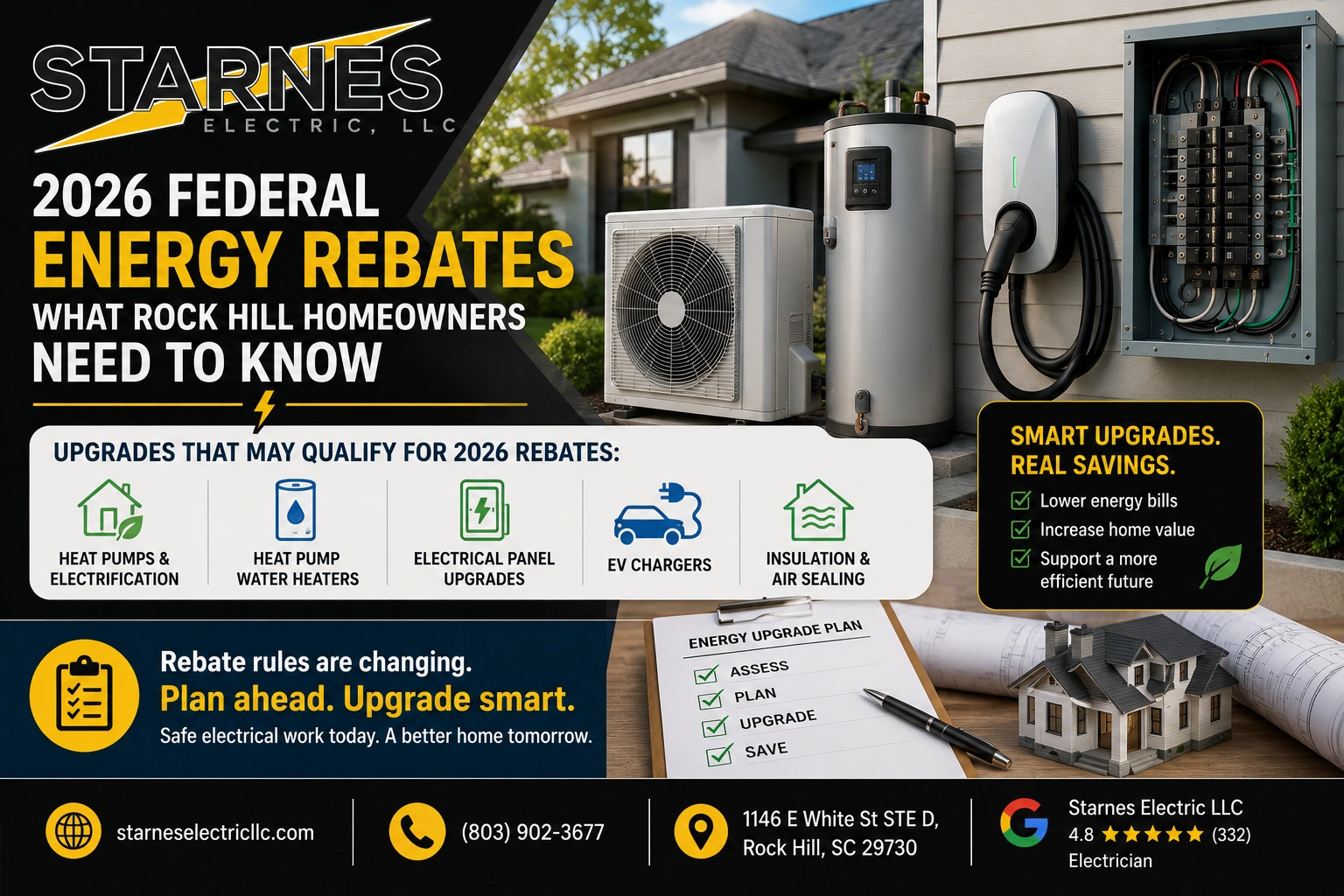
HEAR is generally designed to help eligible households with electrification upgrades. These may include qualified heat pump systems, heat pump water heaters, electric cooking equipment, electric wiring, insulation, air sealing, ventilation, and electrical panel upgrades when needed to support eligible electrification work.
HOMES is generally focused on whole-home efficiency improvements. Instead of paying for one specific appliance only, HOMES rewards upgrades that reduce the home’s total energy use. That may include a combination of insulation, air sealing, HVAC improvements, electrical planning, and other efficiency measures.
For Rock Hill homeowners, these programs may become especially useful when an older home needs electrical upgrades before adding newer equipment. A heat pump, EV charger, or energy-efficient appliance may require dedicated circuits, panel space, or a service evaluation before installation.
Do Rock Hill Homeowners Still Qualify for Federal Energy Tax Credits in 2026?
For most residential energy efficiency improvements placed in service in 2026, homeowners should not assume the older federal tax credits still apply.
The IRS instructions for Form 5695 state that residential clean energy credits cannot be claimed for expenditures made after December 31, 2025, and energy-efficient home improvement credits cannot be claimed for expenditures or property placed in service after December 31, 2025. The IRS also says the energy-efficient home improvement credit is allowed for property placed in service through December 31, 2025.
This matters because many homeowners remember previous credit amounts. For example, prior rules helped offset certain heat pumps, electrical panel upgrades, insulation, windows, doors, solar, battery storage, and other qualifying improvements. Those credits were valuable, but the deadline changed.
If your project was completed and placed in service before January 1, 2026, you may still need to talk with a tax professional about whether it can be claimed on the correct tax return. If your project is installed in 2026, the older residential credits generally should not be treated as available unless your tax professional confirms otherwise.
There is one area Rock Hill homeowners may still need to watch closely in 2026: EV charger equipment. The IRS instructions for Form 8911 state that the Alternative Fuel Vehicle Refueling Property Credit cannot be claimed for qualifying refueling or recharging property placed in service after June 30, 2026. For personal-use property installed at a main home, the credit can be 30% of the cost, limited to $1,000 for each single item of qualified property, subject to eligibility rules.
Because these rules are technical, Starnes Electric LLC recommends treating tax questions separately from electrical installation questions. We can help with the electrical side of the work. A qualified tax professional can confirm whether your specific project qualifies for a credit, rebate, or deduction.
What Home Upgrades May Qualify for Energy Rebates in 2026?
The upgrades most likely to matter for Rock Hill homeowners in 2026 fall into a few practical categories: electrification, efficiency, load management, and backup readiness.
Heat Pump Systems
Heat pump systems are one of the most common rebate-related upgrades. A heat pump can provide heating and cooling in one system, and it can be especially useful in South Carolina’s climate when properly sized and installed. If a home is replacing older heating and cooling equipment, the electrical system may need to be reviewed first.
Heat Pump Water Heaters
Heat pump water heaters may also be included in rebate conversations. These systems can reduce energy use compared with older electric water heaters, but they may require proper placement, electrical capacity, and installation planning.
Electrical Panel Upgrades
Electrical panel upgrades are especially important. Many older homes were not built for today’s electrical demand. EV chargers, heat pumps, induction ranges, hot tubs, workshop circuits, home offices, and backup systems can all place added demand on the panel. If an electrical panel upgrade is needed to support a qualifying electrification project, it may be part of a rebate pathway once South Carolina’s program details are active.
Wiring Upgrades
Wiring upgrades may also matter. Some electrification projects require new dedicated circuits. This can include EV charging equipment, heat pump equipment, electric cooking appliances, or other high-demand systems.
Insulation and Air Sealing
Insulation and air sealing can also qualify under many energy efficiency programs because they reduce heating and cooling waste. These improvements are not electrical work by themselves, but they affect how hard HVAC equipment has to run.
Smart Panels and Load Management
Smart panels and load management equipment may also become more important in 2026. Even when rebates do not cover every part of a project, smarter electrical planning can help homeowners avoid unnecessary service upgrades or prepare for future power needs.
The key point is simple: do not choose upgrades based only on rebate headlines. Choose upgrades based on your home’s real needs, then check which incentives may apply.
From Power Outages to Perfect Lights: What It Really Takes to Hire an Expert Christmas Lighting Electrician
The holiday season isn’t complete without the magical glow of [...]
Learn More
How Much Can Homeowners Save With 2026 Federal Energy Rebates?
The savings can vary widely because rebate amounts depend on the final South Carolina program rules, household income, project type, equipment requirements, and measured or modeled energy savings.
HOMES rebates are generally tied to whole-home energy reduction. A project that produces higher energy savings may qualify for a larger rebate. HEAR rebates are generally tied to specific electrification upgrades and income eligibility.
Federal program summaries commonly describe HEAR as an income-qualified program and HOMES as a performance-based program. South Carolina has confirmed that both types of programs are planned, but the state has also stated that the rebates are not yet available.
For homeowners, that means the smartest move is to prepare before spending money.
Start by identifying your goals:
- Lower monthly energy bills
- Add an EV charger
- Replace aging equipment
- Prepare for solar
- Improve backup power options
- Upgrade an old electrical panel
Once the goal is clear, the next step is to check the electrical system. A home with limited panel space, outdated wiring, or insufficient service capacity may need electrical work before the energy upgrade can happen safely.
Savings should also be measured in more than rebate dollars. A better electrical plan can reduce nuisance tripping, improve safety, support future upgrades, and help the home handle modern loads. A more efficient system can also reduce energy waste over time.
Still, homeowners should be realistic. A rebate rarely makes a poor project a good project. The best savings come when the rebate supports an upgrade the home already needs.
Who Is Eligible for Home Energy Rebates in Rock Hill, SC?
Eligibility for home energy rebates in Rock Hill will depend on the program, the home, household income, and the type of work being completed.
HEAR is expected to focus more heavily on low- and moderate-income households. These programs often use area median income, household size, and location to determine eligibility. A homeowner may qualify for a higher rebate level, a lower rebate level, or no rebate depending on income.
HOMES is different because it is generally based on energy savings. A homeowner may need an energy assessment, energy modeling, or documented performance improvement to qualify. The more energy the project is expected to save, the stronger the rebate opportunity may be.
Property type can also matter. Primary residences, rental properties, multifamily homes, and manufactured homes may have different rules. Equipment standards may also matter. Not every product qualifies simply because it is new or energy efficient.
Contractor requirements may matter too. Some rebate programs require work to be completed by approved or participating contractors. Some require paperwork before the project starts. Others require inspections, documentation, invoices, model numbers, or proof that the equipment meets specific standards.
This is why homeowners should avoid rushing into a project based on a social media post or a general rebate article. Program details can change, and the South Carolina Energy Office should be treated as the main source for state rollout information.
For electrical work, Starnes Electric LLC can help Rock Hill homeowners understand whether their panel, wiring, or service is ready for the upgrade they are considering. That is often the first step before applying for incentives or scheduling installation.
How Do Energy Incentives Promote Greener, More Efficient Homes?
Energy incentives promote greener homes by lowering the upfront cost of improvements that reduce energy waste and support more efficient equipment.
Many homeowners want a more efficient home but delay upgrades because of cost. Rebates can make those projects easier to start. When a homeowner upgrades inefficient equipment, improves insulation, seals air leaks, or modernizes electrical systems, the home may use less energy and operate more consistently.
Energy incentives also encourage better planning. Instead of replacing one appliance at a time without thinking ahead, homeowners are pushed to consider how the whole home works. HVAC, insulation, electrical capacity, water heating, ventilation, and appliance loads are all connected.
For Rock Hill homeowners, this matters because energy demand is changing. More families are adding EV chargers, larger appliances, home offices, smart technology, generators, and battery systems. Older electrical systems were not always designed for that level of use.
A greener home is not just about one piece of equipment. It is about reducing waste, improving safety, and making sure the home can support modern electrical needs without strain.
That is where electrical planning becomes valuable. A panel upgrade, dedicated circuit, smart load management system, or EV charger installation may be part of a broader efficiency plan. When done correctly, these upgrades can support cleaner energy use while making the home more practical for everyday life.
Energy Upgrade Planning From Starnes Electric LLC
The 2026 federal energy rebate landscape is different from what many homeowners expected. Some older federal tax credits ended after 2025, while South Carolina’s federally funded rebate programs are still developing. The opportunity is real, but the details matter.
Before starting an energy upgrade, Rock Hill homeowners should confirm current rebate rules, check eligibility, and make sure the home’s electrical system is ready.
Starnes Electric LLC can help with the electrical side of energy planning, including panel evaluations, dedicated circuits, EV charger preparation, smart panel options, and electrical upgrades tied to modern home efficiency projects.
A rebate can help reduce cost, but safe electrical work protects the home. If you are planning an energy upgrade in Rock Hill, start with a clear electrical assessment and a plan that supports your home now and in the years ahead.
Ready to Save with Energy Rebates?
Find out which upgrades qualify. Call Starnes Electric LLC today for expert guidance and professional installation.
About the Author: Starnes Electric