
The Cost of a Whole-Home Rewire: What Homeowners Should Know
Table of Contents
Quick Answer: How Much Does a Whole-Home Rewire Cost?
A whole-home rewire commonly costs anywhere from several thousand dollars to tens of thousands of dollars. Many homeowners can use a broad planning range of around $8,000 to $30,000, but the actual cost depends on the home’s size, age, access, wiring condition, panel condition, code requirements, and the amount of finish repair needed afterward.
The only way to get an accurate price is to have a licensed electrician inspect the home. A small one-story house with open attic access may cost much less than a larger two-story home with finished walls, limited crawl space access, outdated wiring, and an undersized electrical panel.
At Starnes Electric LLC, we know homeowners want straight answers before committing to a major electrical project. No two rewires are exactly the same, but understanding the main cost factors can help you plan with confidence.
Planning a Whole-Home Rewire?
Know your options before the project begins. Speak with a trusted electrician for accurate pricing.
What Is a Whole-House Rewire?
A whole-house rewire is the process of replacing outdated, unsafe, damaged, or insufficient electrical wiring throughout the home. In many cases, it also includes updating outlets, switches, junction boxes, grounding, dedicated circuits, and sometimes the electrical panel.
The goal is to make the home’s electrical system safer, more reliable, and better suited for modern electrical use. Older homes were not built for today’s electrical demand. Decades ago, families had fewer appliances, fewer electronics, fewer chargers, fewer HVAC demands, and fewer high-power devices. Today, the average home may need to support computers, televisions, kitchen appliances, smart devices, EV chargers, security systems, home offices, modern HVAC equipment, and more.
A full rewire may involve running new cable through walls, ceilings, attic spaces, basements, or crawl spaces. It may also involve replacing two-prong outlets with grounded outlets, adding GFCI protection where required, updating AFCI protection where required, separating overloaded circuits, and improving electrical safety throughout the home.
A whole-home rewire is different from a small repair. Replacing one damaged outlet or adding one new circuit is limited work. Rewiring the home addresses the larger electrical system and helps make sure the house can safely handle everyday use.
How Much Does a Full House Rewire Cost?
A full house rewire can cost anywhere from several thousand dollars to tens of thousands of dollars. For many homes, a broad planning range may fall between $8,000 and $30,000, but the actual cost depends on the size, age, layout, accessibility, wiring condition, panel condition, and project scope.
Some homeowners see online numbers that look much lower, but those figures may not include panel upgrades, drywall repair, permit costs, complex access, code-required safety devices, dedicated appliance circuits, or higher local labor rates. That is why it is important to compare complete project scopes, not just headline prices.
A proper rewire estimate should account for:
- New wiring materials
- Labor
- Circuit layout
- Outlet and switch replacement
- Grounding needs
- Panel condition
- Permits and inspections
- Access through attic, crawl space, basement, or walls
- Code-required protection
- Cleanup
- Project complexity
If walls and ceilings need to be opened, the total project cost may also include drywall, paint, or finish repairs. Some electricians handle limited access work, while other finish repairs may need to be completed by a separate contractor.
At Starnes Electric LLC, we recommend having a professional electrician inspect the home before relying on any general cost range. A real estimate should be based on the home’s age, layout, existing wiring, electrical panel, and the homeowner’s current and future needs.
What Factors Affect the Cost of a Whole-Home Rewire?
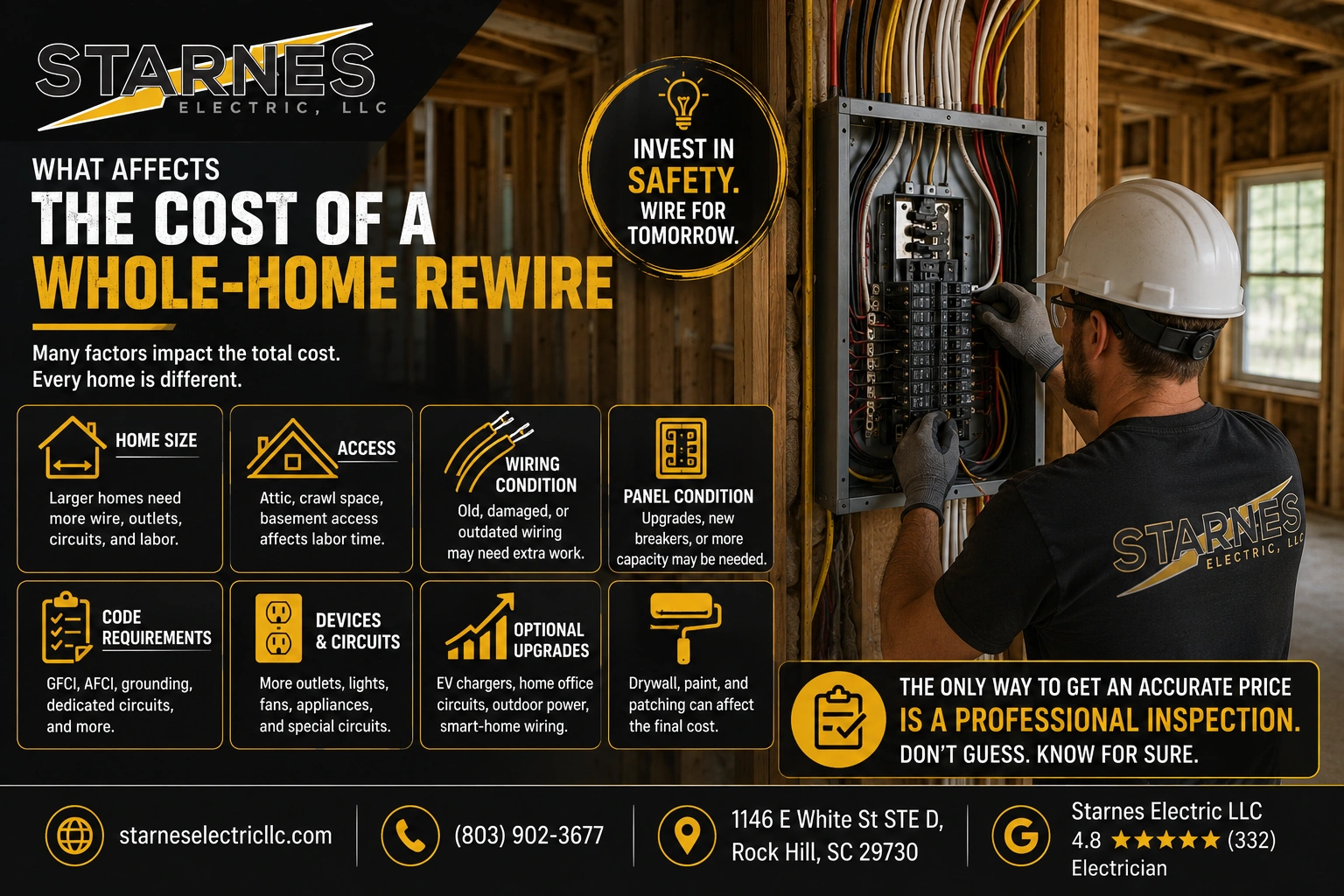
Several factors can raise or lower the cost of a whole-home rewire, including:
- Home size: Larger homes usually require more wire, more outlets, more switches, more circuits, and more labor. A 1,200-square-foot home will generally cost less to rewire than a 3,000-square-foot home.
- Access: Open attic, basement, or crawl space access can make the work more efficient. Finished walls, tight crawl spaces, plaster walls, and multiple stories can increase labor.
- Existing wiring condition: Knob-and-tube wiring, cloth-insulated wiring, aluminum branch wiring, ungrounded systems, and previous DIY work may require extra care.
- Electrical panel condition: Some homes need more than new wiring. They may also need a panel upgrade, service upgrade, new breakers, or better circuit organization.
- Code requirements: Modern electrical work may require GFCI protection, AFCI protection, tamper-resistant receptacles, dedicated circuits, proper grounding, smoke detector wiring, and other updates depending on the project and local code enforcement.
- Number of devices: More outlets, switches, recessed lights, ceiling fans, exterior outlets, appliance circuits, garage circuits, and special equipment can increase the scope.
- Optional upgrades: A rewire is often a good time to add home office circuits, EV charger preparation, outdoor power, better kitchen circuits, improved lighting layouts, or smart-home-ready wiring.
A whole-home rewire is not priced by square footage alone. The final cost depends on how much work is needed to make the home safe, functional, and ready for modern electrical use.
How Much Does It Cost to Rewire a 2,000-Square-Foot House?
A 2,000-square-foot house often falls near the middle of the whole-home rewire cost range, depending on access and complexity. As a general planning number, many 2,000-square-foot rewires may land between $10,000 and $20,000. Some may be lower if access is easy and the electrical system is simple. Others may be higher if the home is older, multi-story, difficult to access, or needs a panel upgrade.
For example, a single-story 2,000-square-foot home with attic access may be easier to rewire than a two-story home with finished ceilings, limited wall access, and older electrical components. The square footage may be the same, but the labor can be very different.
A 2,000-square-foot rewire may include new branch wiring, updated outlets and switches, dedicated kitchen circuits, bathroom GFCI circuits, laundry circuits, exterior outlets, lighting circuits, smoke detector connections, and proper grounding. If the home has electric heating equipment, a modern HVAC system, a workshop, a pool, a detached garage, or plans for an EV charger, those needs may affect the estimate.
Homeowners should also ask whether the price includes permits, inspection coordination, panel work, device replacement, and any access-related repairs. A low number may look appealing at first, but it may not include everything needed to complete the job correctly.
The best way to price a 2,000-square-foot home is to schedule an electrical evaluation. Starnes Electric LLC can review the existing wiring, identify safety concerns, discuss your goals, and provide a clearer scope of work based on the home itself.
How Much Does It Cost to Rewire a House in South Carolina?
The cost to rewire a house in South Carolina depends on the same major factors that affect rewiring elsewhere: home size, age, access, panel condition, wiring type, code requirements, and project complexity. For many South Carolina homes, homeowners should expect a broad range similar to national pricing, often from the upper thousands into the tens of thousands for a full rewire.
Older homes in South Carolina may have electrical systems that were added to over time. Some may have outdated wiring, ungrounded outlets, overloaded circuits, older fuse boxes, or electrical work completed by previous owners. Homes in growing areas may also need upgrades to support modern appliances, HVAC systems, home offices, generators, workshops, or EV charging.
Location can also affect price. Labor costs, permit fees, inspection requirements, material availability, and travel time can vary by community. A home in a rural area may present different challenges than a home in a denser neighborhood. A historic or older property may require more careful access planning than a newer home.
South Carolina homeowners should also consider climate and usage. Hot summers place demand on HVAC systems. Storms can affect electrical components. Outdoor power needs, garages, workshops, and home additions can increase circuit demand.
For homeowners in Rock Hill and nearby South Carolina communities, the best first step is an electrical evaluation. Local homes can vary widely in age, access, panel condition, and previous electrical work, so a local inspection gives a much clearer picture than a generic online estimate.
At Starnes Electric LLC, we encourage homeowners not to rely on a one-size-fits-all number. A full rewire is a major safety project. The right estimate should be based on the actual home, not just the state average.
Is a Whole-Home Rewire Worth the Cost?
A whole-home rewire can be worth the cost when the existing electrical system is unsafe, outdated, overloaded, or unable to support modern needs. While it is a major investment, it can improve safety, reliability, convenience, and home value.
One of the biggest reasons to consider rewiring is safety. Old wiring can become brittle, damaged, or overloaded. Loose connections, improper splices, outdated insulation, and ungrounded circuits can increase the risk of electrical hazards. If lights flicker often, breakers trip regularly, outlets feel warm, or you smell burning near electrical devices, those are warning signs that should not be ignored.
Another reason is functionality. Older homes often do not have enough outlets or circuits for modern living. Homeowners may rely on extension cords, power strips, and overloaded outlets because the home was not designed for today’s electrical demand. A rewire can create a safer, more convenient layout.
A whole-home rewire can also make it easier to support larger upgrades. If you plan to remodel a kitchen, finish a basement, add a home office, install new HVAC equipment, add a generator, or prepare for EV charging, the electrical system may need to be updated first.
There may also be insurance and resale benefits. Some buyers are cautious about older electrical systems. Some insurance companies may ask questions about outdated wiring. A properly updated electrical system can make a home easier to maintain, sell, and insure, depending on the situation.
Most importantly, rewiring gives homeowners peace of mind. Electrical problems are not always visible. A professional rewire helps replace hidden risks with a safer, more reliable system.
Buzzing Sounds: A Sign of Electrical Issues
Have you ever heard strange buzzing or tingling sounds coming [...]
Learn More
Signs Your Home May Need Rewiring
You may need to consider a whole-home rewire if your home has:
- Two-prong outlets
- Frequent breaker trips
- Buzzing switches
- Flickering lights
- Warm outlets
- Burning smells near electrical devices
- Discolored receptacles
- Cloth wiring
- Aluminum branch wiring
- Knob-and-tube wiring
- A panel that no longer meets your needs
- Heavy reliance on extension cords
You should also schedule an inspection if the home is older and the electrical system has not been evaluated in many years. Even if everything seems to work, hidden wiring problems may exist behind walls, in attics, or inside junction boxes.
Extension cords should not be used as a permanent solution for daily electrical needs. If you constantly need more outlets, your home may need additional circuits or a broader wiring update.
Renovations are another good time to inspect wiring. If walls are already being opened, it may be more cost-effective to update wiring during the project instead of waiting until later.
Why Choose Starnes Electric LLC for a Whole-Home Rewire?
A whole-home rewire is not a simple handyman project. It requires planning, code knowledge, careful installation, proper permitting, and safe workmanship. The electrician must understand how to design circuits, protect the home, meet local requirements, and complete the work with minimal disruption.
Starnes Electric LLC helps homeowners understand what their electrical system needs and why. We inspect existing wiring, explain safety concerns, identify code-related issues, and provide practical recommendations based on the home’s layout and electrical demand.
Our goal is not to sell unnecessary work. Our goal is to help homeowners make informed decisions about safety, reliability, and long-term electrical performance.
Whether your home needs a full rewire, partial rewire, panel upgrade, dedicated circuits, outlet upgrades, or a safety inspection, our team can help you choose the right path forward.
Plan Your Rewire With Confidence
The cost of a whole-home rewire can vary widely, but the value is clear when your current electrical system is outdated, unsafe, or no longer meeting your needs. For many homeowners, rewiring is not just about replacing old wires. It is about protecting the home, supporting modern living, and reducing the risk of future electrical problems.
If you are concerned about your wiring, panel, outlets, or circuit capacity, Starnes Electric LLC can help. Our team can evaluate your home, explain your options, and provide a clear estimate based on the work required.
A safer electrical system starts with the right inspection.
FAQs About Whole-Home Rewiring Costs
How much does it cost to rewire an entire house?
A whole-home rewire can cost several thousand dollars to tens of thousands of dollars, depending on the home’s size, access, wiring condition, panel condition, and project scope. Many homeowners use a broad planning range of around $8,000 to $30,000, but an inspection is needed for an accurate estimate.
Why is rewiring a house so expensive?
Rewiring is labor-intensive and may involve running new wire through walls, ceilings, attics, crawl spaces, or basements. The cost can also include outlets, switches, breakers, grounding, permits, inspections, code-required protection, and possible wall or ceiling repairs.
Does a whole-home rewire include a panel upgrade?
Not always. Some rewires can use the existing electrical panel if it is safe and has enough capacity. However, older or undersized panels may need to be repaired, replaced, or upgraded as part of the project.
Can you rewire a house without opening walls?
In some homes, electricians can access wiring through attics, crawl spaces, basements, or other open areas. In other homes, walls or ceilings may need to be opened. The amount of access work depends on the home’s layout and existing wiring.
How do I know if my house needs rewiring?
Warning signs include frequent breaker trips, flickering lights, warm outlets, burning smells, two-prong outlets, old cloth wiring, knob-and-tube wiring, aluminum branch wiring, or heavy use of extension cords. A licensed electrician can inspect the system and explain whether a full or partial rewire is needed.
Is rewiring a house worth it?
Yes, it can be worth it when the existing wiring is outdated, unsafe, overloaded, or unable to support modern electrical needs. A rewire can improve safety, reliability, convenience, and future resale confidence.
Is Your Home Ready for a Rewire?
Old wiring can become a costly safety risk. Call today for expert recommendations and transparent pricing.
About the Author: Starnes Electric