
Why Did One Room Lose Power But the Breaker Isn’t Tripped?
Table of Contents
One room lost power but the breaker is not tripped? Learn common causes, safe checks, warning signs, and when to call a licensed electrician in Rock Hill, SC.
One room can lose power even when the breaker does not look tripped because the interruption may be happening somewhere else in the circuit.
Common causes include:
- A tripped GFCI outlet
- A loose wire connection
- A failed outlet, switch, or receptacle
- A hidden junction box issue
- A weak, faulty, or partially reset breaker
- A shared circuit problem upstream
- Damaged wiring from age, pests, moisture, or remodeling work
The safest first step is to stop using anything on that circuit and check only the obvious, safe items. Look for a tripped GFCI, a breaker that needs one full reset, or one appliance that may have caused the issue.
If power does not come back after basic checks, or you notice heat, sparks, buzzing, burning smells, or moisture, stop using the affected area and call a licensed electrician.
A breaker is only one part of the system. It may not be where the problem is happening.
Why One Room Can Lose Power When the Breaker Looks Fine
A room-specific power loss usually means the circuit has opened somewhere between the panel and the affected outlets, lights, or switches.
Think of the circuit like a line of connections. If one connection fails upstream, everything downstream can lose power even if the breaker does not visibly trip.
That is why the issue may show up in one room, one wall, a group of outlets, or one section of the home instead of the whole house.
A GFCI Outlet Tripped Somewhere Else
A tripped GFCI outlet is one of the most common reasons one room or area loses power even when the breaker is not tripped.
A bathroom, garage, kitchen, laundry room, exterior outlet, basement, or crawlspace outlet may be protected by a GFCI. When that GFCI trips, it can shut off power to other outlets nearby or even in another room.
That can make it look like a bedroom, garage, bathroom, or outdoor area lost power when the real issue is one reset button somewhere else.
A single GFCI outlet can protect other outlets downstream. The outlet that lost power may not be the outlet with the reset button.
For example:
- A garage freezer outlet may stop working because a GFCI across the garage tripped.
- A bathroom outlet may be dead because another bathroom’s GFCI tripped.
- Outdoor outlets may be controlled by a GFCI in the garage, basement, or utility area.
Look for GFCI outlets in the affected room and nearby areas. Press the reset button once.
If the GFCI will not reset, trips again immediately, feels warm, smells burnt, or has moisture exposure, stop using that circuit and call a licensed electrician.
A Loose Connection Opened the Circuit
Loose wiring is one of the more serious causes of room-specific power loss.
Outlets and switches have wire connections behind them. If one of those connections loosens, fails, burns, or pulls out, power may stop at that point.
This can happen because of:
- Age
- Heat
- Repeated plugging and unplugging
- Loose terminal screws
- Backstabbed outlet connections
- Vibration
- Poor previous installation
- Moisture or corrosion
- Overloaded use
Loose wiring is not just inconvenient. It can create heat and arcing.
Here’s the important part: a loose connection may not always trip the breaker right away.
The breaker is designed to respond to certain unsafe conditions, but that does not mean every bad connection will instantly shut the circuit down. That is why a room can lose power without an obvious tripped breaker.
Call an electrician if you notice:
- Flickering lights
- Intermittent power
- Warm outlets or switches
- Buzzing or crackling
- Burning smells
- Brown or black marks
- Outlets that work only when you wiggle the plug
- A switch that feels loose or sounds rough
When electricity smells hot, sounds wrong, or feels warm, treat it seriously.
A Failed Outlet or Switch
Sometimes the device itself fails.
An outlet can stop passing power through to the rest of the circuit. A switch can fail internally. A receptacle can crack, overheat, or lose contact inside.
Warning signs include:
- The outlet feels loose
- The plug falls out easily
- The outlet is discolored
- The switch crackles
- Lights flicker when the switch is touched
- The device feels warm
- Power comes and goes
Do not keep using an outlet or switch that behaves this way. It should be inspected before the affected area is used normally again.
A Breaker Looks Normal But Is Not Fully Reset
Not every tripped breaker moves clearly to the middle or off position. Some barely move.
A breaker may look like it is on, but still need to be turned fully off and then back on. In other cases, the breaker may be worn, damaged, or not making proper contact inside the panel.
If you can identify the breaker that serves the affected room, turn it fully off and then back on one time.
Only do this if there are no burning smells, sparks, buzzing, hot panel areas, moisture, or visible damage.
If the breaker will not hold, do not keep resetting it. That is a warning sign.
One Part of a Shared Circuit Failed
Many rooms do not have one circuit all to themselves.
A bedroom may share power with a hallway. A bathroom outlet may be tied to another bathroom. A garage outlet may feed outdoor receptacles.
If an upstream outlet or connection fails, one room may lose power while another area still works.
That is why troubleshooting often involves mapping the circuit, not just checking the room where you noticed the problem.
Storm, Water, or Moisture Damage
In Rock Hill, Fort Mill, Lake Wylie, York, Lancaster, Chester, and nearby South Carolina communities, storms and humidity can create electrical problems homeowners do not always see right away.
Moisture can affect:
- Outdoor outlets
- Garage outlets
- Crawlspace wiring
- Exterior lighting
- GFCI devices
- Panel or subpanel equipment
- Weather-exposed boxes
If the power loss started after heavy rain, flooding, wind damage, or a storm, do not troubleshoot wet electrical equipment yourself.
Could a GFCI Outlet Be the Problem?
Yes. A GFCI outlet is often the reason one room or area loses power even when the breaker is not tripped.
A GFCI is designed to shut off power when it detects a ground fault. That is especially important in wet or damp areas.
You may find GFCI outlets in:
- Bathrooms
- Kitchens
- Garages
- Laundry rooms
- Basements
- Crawlspaces
- Outdoor areas
- Utility rooms
- Areas near sinks
- Pool or spa areas
The confusing part is that the reset button may not be in the room where power was lost. A GFCI in one area can protect outlets in another area.
Check nearby rooms and spaces, not just the room that lost power. If the GFCI trips again right away or will not reset, stop using the circuit and call an electrician.
Can Loose Wiring Cause One Room to Lose Power?
Yes. Loose wiring can cause one room, one wall, or part of a room to lose power.
A loose connection can stop power from moving through the circuit. It can also create heat. In some cases, it can arc, which means electricity is jumping across a poor connection.
Loose wiring can happen behind:
- Outlets
- Light switches
- Light fixtures
- Junction boxes
- Ceiling fans
- GFCI outlets
- Older receptacles
- Recently replaced devices
A loose wire may not always trip the breaker right away. That is one reason partial power loss should be taken seriously, especially when the issue comes with flickering, buzzing, heat, discoloration, or a burning smell.
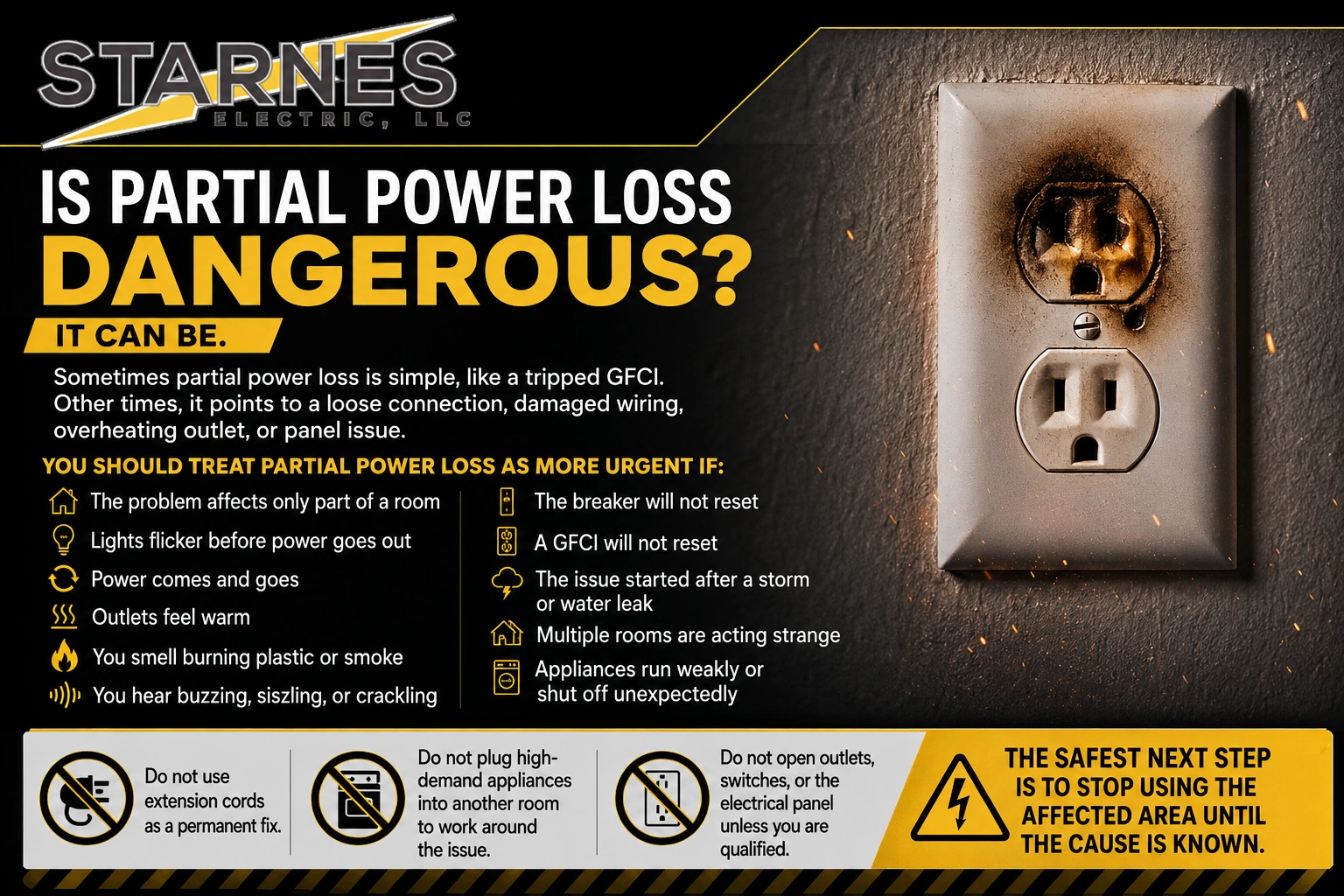
Is Partial Power Loss Dangerous?
It can be.
Sometimes partial power loss is simple, like a tripped GFCI. Other times, it points to a loose connection, damaged wiring, overheating outlet, or panel issue.
You should treat partial power loss as more urgent if:
- The problem affects only part of a room
- Lights flicker before power goes out
- Power comes and goes
- Outlets feel warm
- You smell burning plastic or smoke
- You hear buzzing, sizzling, or crackling
- The breaker will not reset
- A GFCI will not reset
- The issue started after a storm or water leak
- Multiple rooms are acting strange
- Appliances run weakly or shut off unexpectedly
Do not use extension cords as a permanent fix. Do not plug high-demand appliances into another room to work around the issue. Do not open outlets, switches, or the electrical panel unless you are qualified.
The safest next step is to stop using the affected area until the cause is known.
What Homeowners Can Safely Check First
There are a few things you can check without opening electrical boxes, removing devices, or taking off panel covers.
Check Whether the Whole Room Is Out or Only Part of It
Look at what is affected.
Is the ceiling light out, but the outlets work? Are only two outlets dead? Did one wall lose power?
This helps narrow down the issue.
Do not plug in high-demand appliances to test the circuit. Use simple observations only.
Unplug Recent Appliances or Devices
If the problem started after plugging in a space heater, vacuum, treadmill, freezer, printer, tool, or microwave, unplug it.
High-demand devices can reveal circuit problems quickly.
Once the device is unplugged, do not assume the issue is solved if the same circuit has been tripping, flickering, or losing power. There may still be an underlying electrical problem.
Check for GFCI Outlets
Look in the affected room and nearby areas.
Check bathrooms, kitchen counters, garage, laundry room, basement, crawlspace, exterior outlets, and utility areas.
Press reset once.
If the GFCI trips again, do not keep forcing it.
Fully Reset the Breaker One Time
A breaker can look like it is on when it is not fully reset.
If you know which breaker serves the affected room, turn that breaker fully off, then back on one time.
Only do this if there are no burning smells, sparks, buzzing, hot areas, moisture, or signs of damage.
If you are not sure which breaker controls the room, do not randomly cycle breakers connected to critical equipment unless you understand what they serve.
Look and Smell for Warning Signs
Do not touch anything that seems unsafe.
Watch for:
- Burn marks
- Melted outlet faces
- Smoke smell
- Buzzing
- Warm wall plates
- Sparking
- Wet outlets
- Flickering when a switch is touched
If you see, hear, smell, or feel any of these warning signs, stop checking and call an electrician.
When to Call an Electrician for Partial Power Loss
Call a licensed electrician if the power does not come back after basic checks or if the issue shows any sign of heat, damage, or repeated failure.
You should call if:
- One room has no power and the breaker is not tripped
- A GFCI will not reset
- Power comes and goes
- Lights flicker or dim in that room
- Outlets feel warm
- You hear buzzing or crackling
- You smell burning
- A breaker trips again after reset
- The room lost power after a storm
- The home has older wiring
- The issue affects a business, rental, or important equipment
- You are relying on extension cords to get power back
For commercial or industrial spaces, partial power loss can also interrupt equipment, lighting, security systems, registers, servers, HVAC, or production areas. That needs proper troubleshooting, not guesswork.
A good electrician should be able to show you where the circuit is failing and explain whether the fix is a device replacement, wiring repair, panel repair, GFCI replacement, or something larger.
How Starnes Electric Finds the Cause of Room-Specific Power Loss
Starnes Electric troubleshoots partial power loss by finding where power stops and why.
That may include:
- Checking the electrical panel
- Testing the breaker
- Identifying whether the circuit is shared
- Checking GFCI protection
- Testing affected outlets and switches
- Inspecting for loose or failed connections
- Looking for heat damage or arcing
- Checking fixtures and junction points
- Reviewing the load on the circuit
You may not need a major repair. Sometimes the issue is a failed GFCI, worn outlet, loose connection, bad switch, or damaged device.
The important part is finding the cause before the affected area is used normally again.
If one room in your home or business lost power and the breaker does not look tripped, Starnes Electric can inspect the circuit, explain what we find, and help you choose the safest repair for your property in Rock Hill, Fort Mill, York County, Lancaster County, Chester County, and nearby South Carolina communities.
FAQs About One Room Losing Power
Why did one room lose power but the breaker is not tripped?
The power loss may be caused by a tripped GFCI, loose connection, failed outlet, bad switch, damaged wiring, or a breaker that looks on but is not fully reset. The issue may be happening somewhere else in the circuit, not at the panel.
Can a GFCI outlet shut off power to another room?
Yes. A GFCI outlet can protect other outlets downstream. The reset button may be in a bathroom, garage, kitchen, laundry room, basement, or outdoor area, even if the dead outlet is somewhere else.
Should I reset the breaker if it does not look tripped?
You can try turning the suspected breaker fully off and then back on once, as long as there are no burning smells, sparks, buzzing, hot areas, moisture, or signs of damage. Do not keep resetting a breaker that will not hold.
Why do some outlets work in the room but others do not?
That can happen when part of the circuit has failed, a GFCI has tripped, an outlet connection has opened, or the room is served by more than one circuit. An electrician can test the circuit to find where power stops.
Can a bad outlet make other outlets stop working?
Yes. If an outlet is feeding power to other outlets downstream, a failed or loose connection at that outlet can shut off power beyond it.
What if the room lost power after a storm?
Stop using the affected circuit and call a licensed electrician, especially if there was water intrusion, lightning, wind damage, or outdoor electrical exposure. Wet or storm-damaged electrical components should not be handled without proper training.
Can loose wiring cause a fire?
Loose wiring can create heat and arcing, which can become dangerous. If you suspect loose wiring, stop using the affected area and have it inspected.
Who should I call if one room loses power in Rock Hill, SC?
Call a licensed electrician who can test the circuit safely. Starnes Electric serves Rock Hill, Fort Mill, Lake Wylie, Tega Cay, York, Clover, Indian Land, Lancaster, Chester, and nearby communities.
Get Help With Room-Specific Power Loss
If one room lost power and the breaker is not tripped, Starnes Electric can help find the cause safely.
Our team can inspect the circuit, test outlets and switches, check GFCI protection, evaluate the breaker, and identify loose or damaged wiring before the problem becomes more serious.
Call Starnes Electric at (803) 280-3510 or schedule service online for electrical troubleshooting in Rock Hill, Fort Mill, York County, Lancaster County, Chester County, and nearby South Carolina communities.
About the Author: Starnes Electric