
2026 NEC GFCI Requirements for Outdoor HVAC Units
Table of Contents
The 2026 NEC includes important GFCI requirements that affect how outdoor HVAC equipment is planned and protected on residential properties. However, the NEC is a model code, which means the requirements only become enforceable when adopted by the state or local jurisdiction.
For homeowners, builders, HVAC contractors, and property managers, the main issue is simple: outdoor HVAC units may require specific ground-fault protection depending on the adopted code, equipment type, circuit rating, listing, and local inspection requirements.
At Starnes Electric LLC, we know electrical code changes can sound technical fast. Terms like NEC 210.8(F), GFCI, SPGFCI, branch circuits, outdoor outlets, and listed equipment are not everyday language for most homeowners. But these details matter because they affect safety, inspections, equipment installation, and long-term service reliability.
In NEC language, an “outlet” does not only mean a plug-in receptacle. It can also mean the point in the wiring system where power is supplied to equipment, including certain hardwired outdoor HVAC units.
Outdoor HVAC units operate in conditions where moisture, grounded metal, wet soil, rain, service disconnects, and electrical equipment are all close together. GFCI protection is designed to reduce shock risk when current leaks where it should not go. The 2026 NEC continues the push toward better protection for outdoor dwelling-unit equipment, including HVAC systems.
Do not use this article to decide whether your specific HVAC circuit is compliant. The equipment nameplate, breaker, voltage, disconnect, wiring method, adopted code, and local inspection requirements all need to be reviewed together. This article explains what homeowners should know and why working with a qualified electrician matters.
Stay ahead of the 2026 NEC changes.
Whether you're replacing an HVAC unit or upgrading electrical circuits, Starnes Electric LLC is ready to help. Call today for expert service.
Does Outdoor HVAC Equipment Need GFCI Protection Under the 2026 NEC?
Under the 2026 NEC, outdoor HVAC equipment may need GFCI protection when it falls under the outdoor outlet requirements for dwelling units. The exact answer depends on the circuit, the equipment, the code edition adopted by your local jurisdiction, and the exceptions that apply.
This is important because the NEC is a model code. It does not automatically become enforceable everywhere on the same day. States, cities, counties, and local inspection departments adopt specific editions and may also use amendments. That means one area may still be enforcing an earlier NEC edition while another area prepares for 2026 requirements.
For homeowners, the practical answer is this: do not assume an outdoor HVAC installation is exempt from GFCI protection. New installations, replacements, equipment changes, panel upgrades, disconnect replacements, and major electrical work may trigger a closer code review.
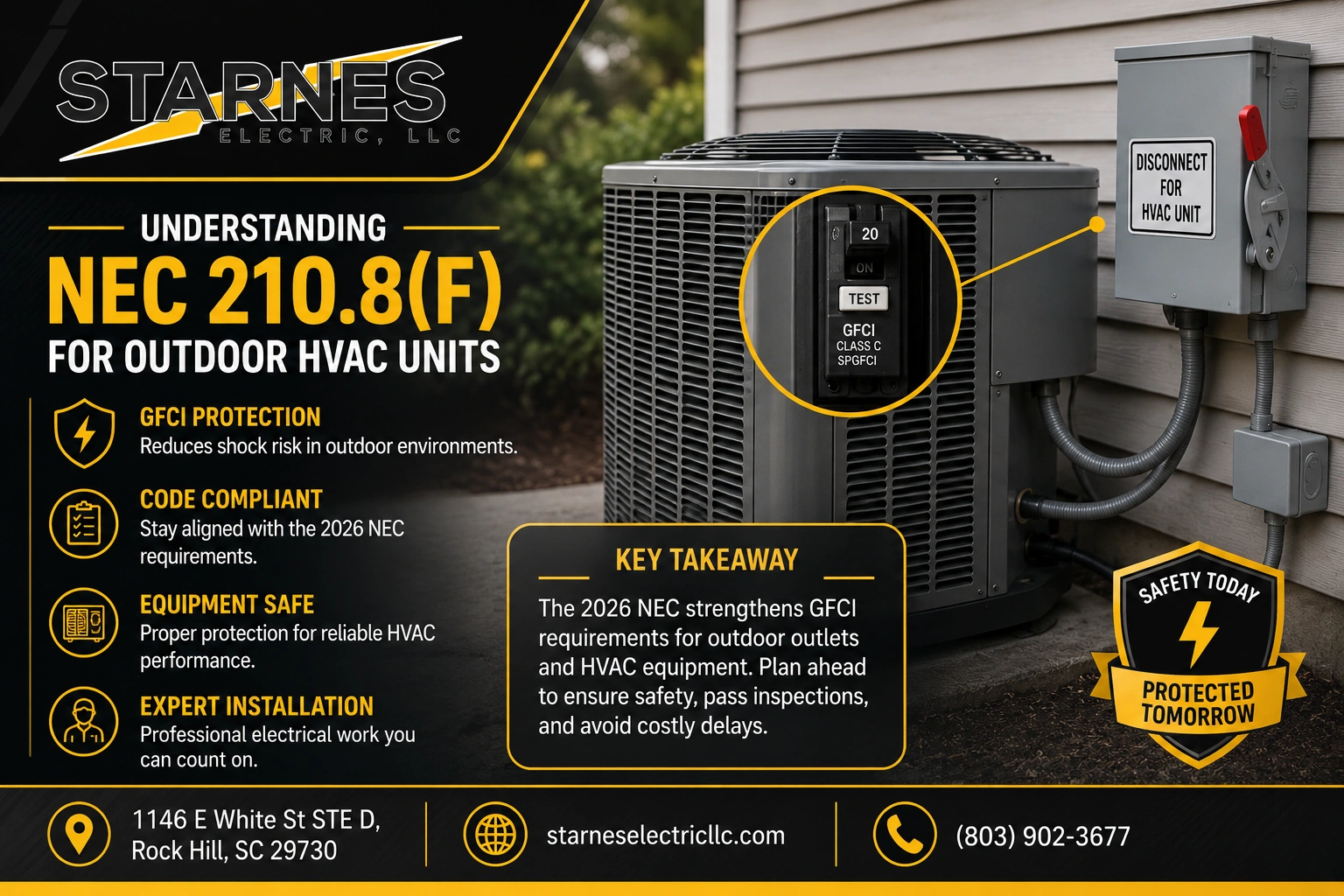
Outdoor HVAC equipment can include central air conditioning condensers, heat pumps, mini-split outdoor units, and similar exterior mechanical equipment. These units are typically hardwired and connected through outdoor disconnects. Because they are outside, they are exposed to moisture and service conditions that make ground-fault protection an important safety topic.
A licensed electrician can review the equipment nameplate, circuit rating, voltage to ground, disconnect setup, manufacturer requirements, and local code enforcement expectations. That is the safest way to determine what applies to a specific home.
What Does NEC 210.8(F) Mean for Outdoor HVAC Units?
NEC 210.8(F) addresses GFCI protection for outdoor outlets at dwelling units. In common terms, this section focuses on outdoor electrical outlets supplying equipment, not just standard plug-in receptacles.
This distinction matters. Many homeowners hear “outlet” and think only of the wall receptacle where they plug in a cord. In the NEC, an outlet can also mean a point on the wiring system where current is taken to supply equipment. That can include a hardwired outdoor HVAC unit.
For outdoor HVAC equipment, the 2026 NEC continues to refine how GFCI protection applies. One of the key discussions is how to protect HVAC equipment while also addressing nuisance tripping concerns that have affected some systems. Modern HVAC equipment can include variable-speed motors, inverter-driven components, and electronics that may create compatibility concerns with some protective devices.
The purpose of the requirement is not to make HVAC systems harder to install. The purpose is to improve electrical safety in outdoor environments while giving the industry clearer paths for compatible protection.
For homeowners, the main takeaway is that an outdoor HVAC circuit should be evaluated as part of the entire electrical system. The breaker, disconnect, wiring method, equipment listing, grounding, manufacturer instructions, and local code requirements all matter.
At Starnes Electric LLC, we help homeowners and contractors understand these requirements before work begins, not after an inspection issue appears.
When Does the HVAC GFCI Exception Expire?
A major date connected to NEC 210.8(F) is September 1, 2026. The listed HVAC equipment exception tied to outdoor outlet GFCI protection is scheduled to expire on that date.
Where the applicable NEC edition is adopted and enforced, listed outdoor HVAC equipment covered by NEC 210.8(F) may need an approved GFCI or SPGFCI protection path after that date.
That does not mean every homeowner must immediately replace electrical equipment on September 1, 2026. Code enforcement depends on local adoption, project type, permit requirements, existing installation rules, and whether new work is being performed.
However, the expiration date is still important for planning. If you are replacing an HVAC unit, upgrading a panel, installing a heat pump, adding a mini-split, or preparing new construction, the electrical design should consider current and upcoming requirements.
Waiting until inspection day to think about GFCI protection can lead to delays, extra costs, or equipment compatibility questions.
This is why Starnes Electric LLC recommends involving a qualified electrician early. When electrical planning happens before equipment is installed, it is much easier to choose the right breaker, disconnect, protection method, and installation approach.
What Outdoor HVAC Equipment May Be Affected?
NEC 210.8(F) can affect outdoor outlets at dwelling units that supply outdoor equipment. For HVAC, this may include outdoor air conditioning condensers, heat pumps, mini-split condensers, and other exterior equipment supplied by qualifying branch circuits.
The equipment most often discussed is residential outdoor HVAC equipment connected through an outdoor disconnect. These systems may be installed beside the home, behind the house, near a garage, on a pad, near landscaping, or close to other exterior utilities.
The exact requirements can depend on several factors, including:
- The branch circuit rating
- The voltage to ground
- Whether the equipment is listed
- The type of GFCI or SPGFCI protection used
- The disconnect labeling
- Manufacturer installation instructions
- Local code adoption
- Inspection department interpretation
One important 2026 NEC discussion involves special-purpose ground-fault circuit interrupter (SPGFCI) protection. For certain listed HVAC equipment, a Class C SPGFCI path may be permitted when the installation meets the applicable requirements. This is different from a standard Class A GFCI device commonly used for receptacles.
That distinction is not something homeowners need to solve on their own. It is something the electrical contractor, HVAC contractor, equipment manufacturer, and inspector may need to coordinate.
Using the wrong device can create problems. It may lead to nuisance tripping, failed inspections, unsafe assumptions, or equipment that does not perform as expected. The goal is to provide the correct protection for the equipment and installation.
What Other NEC Requirements Apply to HVAC Systems?
HVAC electrical installations are affected by several NEC requirements, not just GFCI rules. A safe and code-compliant installation must consider the full electrical setup.
First, the circuit must be properly sized. HVAC equipment has nameplate data showing minimum circuit ampacity, maximum overcurrent protection, voltage, phase, and other electrical requirements. These markings guide wire sizing, breaker sizing, and disconnect selection.
Second, the outdoor unit typically needs a proper disconnecting means. This allows technicians to safely shut off power while servicing the equipment. The disconnect must be correctly located, rated, installed, and connected.
Third, grounding and bonding must be correct. Outdoor metal equipment, electrical enclosures, raceways, and grounding conductors play an important role in fault protection.
Fourth, wiring methods must be suitable for the location. Outdoor wiring may be exposed to moisture, sunlight, temperature changes, and physical damage. The materials used must be approved for the environment.
Fifth, working clearances and access matter. HVAC equipment needs proper service space, and electrical equipment must remain accessible. A disconnect hidden behind shrubs or blocked by other equipment can create safety and service problems.
Finally, GFCI protection may apply under NEC 210.8(F) when the outdoor HVAC outlet falls within the section’s scope and no valid exception applies.
The code does not exist to complicate a project. It exists to reduce hazards. Outdoor HVAC systems combine electrical power, metal cabinets, wet locations, and service work. Proper electrical installation helps protect homeowners, technicians, and the equipment itself.
Security Lighting Installation: Best Places to Add Outdoor Lights Around Your Home
Outdoor security lighting works best when it is strategically placed [...]
Learn More
What Are the GFCI Rules for Outdoor Outlets?
NEC 210.8 includes requirements for GFCI protection in specific locations and conditions. Outdoor outlets at dwelling units are a major part of that conversation because exterior areas can increase shock risk.
For outdoor receptacles, GFCI protection has long been familiar to homeowners. If you plug in holiday lights, lawn equipment, tools, pressure washers, or outdoor appliances, GFCI protection helps reduce the risk of electric shock in wet conditions.
The 210.8(F) conversation goes further because it addresses outdoor outlets, not only standard receptacle outlets. That is why hardwired outdoor equipment, including certain HVAC units, can be part of the requirement.
In simple terms, if an outdoor outlet at a dwelling unit supplies qualifying equipment under the adopted NEC edition, GFCI protection may be required unless a specific exception applies. Under the 2026 NEC framework, the temporary HVAC exception has a September 1, 2026 expiration date, and certain listed HVAC equipment may have a Class C SPGFCI protection path.
Homeowners should also remember that outdoor receptacles have their own requirements. They may need weather-resistant devices, in-use covers, proper boxes, correct mounting, and GFCI protection. Garages, accessory buildings, crawl spaces, basements, kitchens, bathrooms, laundry areas, and other locations may also have separate GFCI rules.
Because the details vary by location and project, the best approach is to have the installation reviewed by a licensed electrician.
Why This Matters for Homeowners
The 2026 NEC GFCI requirements matter because electrical safety around outdoor HVAC equipment is not a minor issue. An outdoor unit sits in rain, humidity, wet grass, soil, and service environments. Technicians work around these systems. Homeowners walk near them. Children and pets may be nearby. A ground fault in the wrong conditions can create serious risk.
It also matters because code compliance affects inspections. If you are replacing an outdoor HVAC unit and the electrical side is not addressed properly, the project may run into delays. An HVAC contractor may install the equipment, but the electrical circuit, disconnect, breaker, and protection method still need to meet applicable requirements.
Reliability matters too. Some homeowners worry that GFCI protection will cause nuisance tripping. That concern is part of why the industry has worked through exceptions, device classes, and equipment compatibility. The answer is not to ignore the code. The answer is to install the correct protection for the specific equipment and code path.
A qualified electrician can help avoid mismatched components and poor planning.
How Starnes Electric LLC Helps With Outdoor HVAC Electrical Requirements
At Starnes Electric LLC, we help homeowners, HVAC contractors, builders, and property managers plan electrical work the right way. Outdoor HVAC installations need more than a quick breaker swap or disconnect replacement. They need careful review of the equipment, circuit, grounding, wiring, disconnect, and applicable code requirements.
Our team can inspect existing outdoor HVAC circuits, install or replace disconnects, evaluate panel capacity, upgrade circuits when needed, and help determine the correct GFCI or SPGFCI approach based on the adopted code and equipment requirements.
We also help homeowners understand what is happening in plain language. You should not have to decode NEC language by yourself. If your outdoor HVAC unit needs electrical work, we can explain what applies, why it matters, and how to move forward safely.
Plan Ahead for Safer Outdoor HVAC Power
The 2026 NEC changes are a reminder that outdoor HVAC equipment is part of the home’s electrical safety system. If you are replacing an air conditioner, installing a heat pump, adding a mini-split, upgrading your panel, or planning a home improvement project, the electrical side should be reviewed early.
Starnes Electric LLC can inspect the circuit, disconnect, grounding, wiring, and panel capacity connected to your outdoor HVAC equipment. We can also help you understand what protection method may apply based on the adopted code, equipment requirements, and inspection expectations.
Our goal is to help protect your home, support reliable equipment operation, and give you clear guidance before the project reaches inspection.
FAQs About 2026 NEC GFCI Requirements for Outdoor HVAC Units
Does every outdoor HVAC unit need GFCI protection?
Not always. Requirements depend on the adopted NEC edition, the equipment, the circuit, the installation details, and any applicable exceptions. A licensed electrician should review the specific system.
What is NEC 210.8(F)?
NEC 210.8(F) addresses GFCI protection for certain outdoor outlets at dwelling units. In NEC language, an outlet can include the point where power is supplied to hardwired equipment, not just a plug-in receptacle.
What is SPGFCI protection?
SPGFCI stands for special-purpose ground-fault circuit interrupter. In the 2026 NEC, listed Class C SPGFCI protection is one path that may be permitted for listed HVAC equipment.
Does the September 1, 2026 date mean I need to replace my HVAC wiring immediately?
Not necessarily. Code enforcement depends on local adoption, project scope, permitting requirements, and whether new electrical work is being performed. Existing installations should be reviewed by a licensed electrician before making assumptions.
Why can GFCI protection cause nuisance tripping on HVAC equipment?
Some modern HVAC systems use electronics, inverter-driven components, and variable-speed motors that may interact with certain protective devices. The correct protection method should be chosen based on the equipment, listing, code requirements, and manufacturer instructions.
Confused by the 2026 GFCI code updates?
Make sure your outdoor HVAC unit meets current electrical requirements. Call Starnes Electric LLC for trusted inspections and code-compliant solutions.
About the Author: Starnes Electric