
Generac Installation Costs: 2026 Pricing for Standby Power in South Carolina
Table of Contents
A professionally installed Generac standby generator in South Carolina will commonly cost between $9,000 and $18,000 in 2026, although smaller essential-circuit systems may cost less and complicated whole-home installations can exceed $20,000. The generator is only one part of that total. Homeowners must also account for the automatic transfer switch, electrical work, gas or propane connections, site preparation, permits, inspections, and possible upgrades to the home’s existing electrical or fuel system.
That is why online equipment prices can be misleading. Seeing a generator advertised for around $6,000 does not mean the entire project will cost $6,000. That would be like pricing a swimming pool by looking only at the cost of the water.
In our opinion at Starnes Electric, standby-generator pricing should always begin with a home evaluation rather than a product page. Two South Carolina homes with the same square footage can need completely different systems. One may have natural gas, a newer 200-amp panel, and a convenient installation area. The other may require a propane tank, a long underground fuel line, panel modifications, and several rounds of site planning.
The generator may be the star of the show, but the installation determines whether it performs safely when the lights go out.
Ready for Reliable Backup Power?
Our experts make Generac installation simple with upfront pricing and dependable service across South Carolina.
How Much Does It Cost To Install A Generac Standby Generator In South Carolina In 2026?
Most South Carolina homeowners should expect a complete Generac installation to fall between $9,000 and $18,000 in 2026. A smaller generator protecting only selected circuits might land near the lower end, while a 22 kW, 24 kW, or 26 kW whole-home system often moves toward the middle or upper end.
A typical installed price may include:
- The Generac standby generator
- An automatic transfer switch
- A concrete, composite, or prepared mounting pad
- Electrical wiring and conduit
- Generator and transfer-switch connections
- Natural-gas or propane piping
- Battery installation
- Startup and testing
- Permit and inspection fees
- Load management equipment when needed
- Contractor labor
- Site cleanup and owner orientation
Retail equipment pricing gives homeowners a useful starting point, but it is not the final project cost. For example, a 22 kW Generac package with a 200-amp transfer switch was listed at approximately $6,839 by a major retailer in July 2026. That price covers the equipment package, not the complete electrical, fuel, permitting, and site work required to make it operational.
A straightforward installation may involve placing the generator close to both the electrical service and an adequately sized natural-gas line. A more complicated project may require trenching across the property, relocating equipment, upgrading a gas meter, installing a propane tank, or modifying the service equipment.
This explains why asking, “How much is a Generac?” is a bit like asking, “How much is a kitchen?” The answer depends on what is already there and what needs to be changed.
Our general 2026 planning ranges are:
- Essential-circuit system: approximately $7,500 to $11,000
- Mid-sized partial or managed whole-home system: approximately $10,000 to $15,000
- Large whole-home system: approximately $13,000 to $20,000 or more
- Complex installation with major upgrades: potentially above $20,000
These figures are planning estimates, not fixed quotes. Generator availability, labor rates, fuel requirements, permit costs, and site conditions can change the final amount.
How Much Do Standby Generators Cost For South Carolina Homes?
The generator itself can cost roughly $4,000 to $8,000 or more, depending on output, enclosure, transfer-switch package, monitoring features, and product series. Installation and supporting work then add several thousand dollars.
Smaller standby generators may protect selected essentials such as:
- Refrigerators and freezers
- Lighting circuits
- Internet equipment
- Well pumps
- Medical devices
- Garage doors
- A limited number of receptacles
Larger models may be designed to operate central air conditioning, kitchen appliances, water heaters, pumps, and most or all household circuits.
Generac currently offers residential air-cooled models in several capacities, including 18 kW, 22 kW, 24 kW, and 26 kW options. An 18 kW model may support essential circuits or broader coverage when paired with load-management equipment, while larger units are commonly considered for whole-home applications.
The automatic transfer switch is another major part of the cost. It monitors utility power and transfers the home to generator power when an outage occurs. Once utility service returns, it transfers the home back and allows the generator to cool down and shut off.
Without an automatic transfer switch, the system would not provide the seamless standby operation most homeowners are purchasing.
There may also be ongoing costs after installation:
- Annual maintenance
- Oil and filter changes
- Battery replacement
- Remote-monitoring subscriptions
- Propane tank rental or ownership
- Fuel during outages
- Periodic professional inspections
- Repairs as the equipment ages
We believe homeowners should consider the full ownership cost rather than chasing the lowest installation price. A bargain installation is not much of a bargain if the gas line is undersized, the transfer switch is poorly located, or nobody explains how the system should be maintained.
How Much Is A Generac Generator For A 2,000 Sq Ft House Installed?
A Generac system for a 2,000-square-foot South Carolina house will often cost approximately $10,000 to $17,000 installed. Many homes of that size may use a generator in the 18 kW to 24 kW range, but square footage alone cannot determine the correct capacity.
A 2,000-square-foot home with gas heat, a gas water heater, and a gas range may have a much lower electrical demand than a similarly sized all-electric home. The all-electric property may need to support electric heat strips, an electric water heater, a clothes dryer, cooking equipment, and a large HVAC system.
The first house may operate comfortably on a smaller generator. The second may require a larger unit or a carefully designed load-management system.
Generac states that its 18 kW residential unit can support essential-circuit protection and may provide broader coverage when paired with load-shedding switches. The manufacturer also notes that the model is capable of backing up a five-ton air conditioner under an appropriately designed installation.
A 24 kW Generac Guardian model is rated for up to 24,000 watts on liquid propane and approximately 21,000 watts on natural gas. That difference matters because generators commonly produce less power on natural gas than they do on propane.
For a 2,000-square-foot home, the final installed cost may look something like this:
- Generator and transfer switch: $5,500 to $8,000
- Electrical installation: $2,000 to $5,000
- Fuel piping or propane work: $1,000 to $4,000
- Pad and site preparation: $500 to $2,000
- Permits, inspection, battery, and startup: $500 to $1,500
These categories overlap, and every contractor structures estimates differently. The point is not to create a perfect shopping receipt. It is to show why the generator’s sticker price represents only part of the investment.
What Size Generac Generator Do I Need For A South Carolina Home?
The correct generator size depends on the appliances and systems the homeowner wants to operate during an outage, not just the house’s square footage.
A proper load calculation should consider both running wattage and startup demand. Motors and compressors can draw much more electricity when starting than when operating normally. Central air conditioners, well pumps, refrigerators, and other motor-driven equipment must be evaluated carefully.
An electrician may review:
- Main electrical service size
- HVAC capacity and startup current
- Electric or gas heating
- Water-heater fuel type
- Well and septic equipment
- Refrigeration
- Kitchen appliances
- Laundry equipment
- Medical or accessibility equipment
- Home-office loads
- Electric vehicle charging
- Pool or spa equipment
- Which loads are essential during an outage
South Carolina’s summer climate makes air conditioning one of the biggest sizing concerns. A generator that keeps every lamp glowing but cannot start the central AC may not feel like whole-home protection during a humid August outage.
Still, automatically choosing the biggest available unit is not always wise. Oversizing can increase equipment and fuel costs without providing meaningful benefits. It may also require a larger gas line, higher-capacity meter, or bigger propane supply.
Load management can sometimes provide a better solution. A load-management module temporarily prevents selected high-demand equipment from running simultaneously. The generator may power the AC first, for example, while delaying the electric water heater or another nonessential load.
We generally see these broad categories:
- 10 kW to 14 kW: selected essential circuits
- 16 kW to 18 kW: essential loads plus some major equipment
- 20 kW to 24 kW: managed or complete coverage for many average homes
- 26 kW and above: larger homes or properties with substantial electrical demand
These ranges are not substitutes for a load calculation. They are simply useful conversation starters.
The Architectural Role of Generator Installation in Urban Resilience and Planning
When the power goes out, cities can grind to a [...]
Learn More
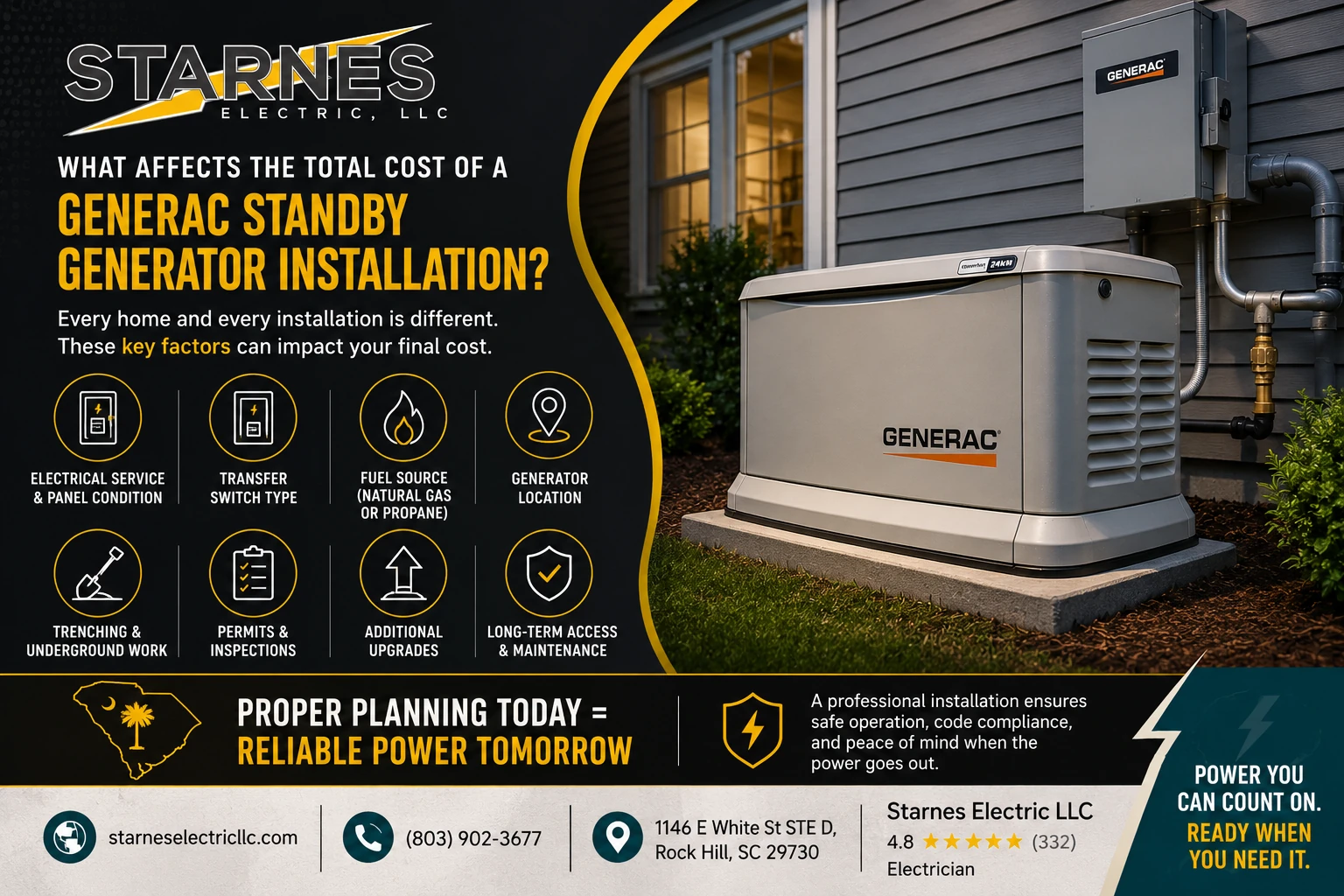
What Affects The Total Cost Of A Generac Standby Generator Installation?
The total cost is shaped by far more than generator capacity. Site conditions can add or subtract thousands of dollars.
Electrical Service and Panel Condition
An older electrical panel may need modifications or replacement before it can safely support an automatic transfer switch. Limited breaker space, outdated equipment, corrosion, or previous unapproved wiring can complicate the job.
Transfer-Switch Type
Some installations use a service-rated whole-home transfer switch. Others use a switch serving selected circuits. The appropriate choice depends on the home’s electrical design and backup goals.
Fuel Source
Natural gas can be convenient because it does not require an on-site storage tank. However, the gas meter and piping must provide enough volume for the generator and the home’s other gas appliances.
Propane is useful where natural gas is unavailable, but the project may require purchasing or leasing a tank, preparing a tank location, installing regulators, and running underground piping.
Generac specifically advises installers to confirm that the gas meter and fuel system can supply the generator while continuing to serve other household appliances.
Generator Location
The unit must meet manufacturer instructions and applicable clearance rules. It also needs safe access for service technicians.
A convenient location near the gas and electrical services usually costs less than a location 70 feet away behind a patio, retaining wall, and prize-winning rose garden.
Trenching and Underground Work
Long conduit or gas-line runs raise labor and material costs. Hard soil, roots, pavement, landscaping, and drainage features can make trenching more difficult.
Permits and Inspections
Standby installations commonly involve electrical permits, and local jurisdictions may also require mechanical, fuel-gas, zoning, or building approval. South Carolina permitting requirements vary by city and county, so the project must be reviewed under the rules of the local authority. Published South Carolina municipal guidance illustrates that generator projects may require separate approvals for electrical work, mounting structures, and fuel connections.
Additional Upgrades
Costs may increase when the project needs:
- Gas-meter upgrades
- A larger propane tank
- New service equipment
- Panel replacement
- Load-management modules
- Concrete work
- Landscaping restoration
- Bollards or impact protection
- Extended warranties
- Cold-weather or monitoring accessories
This is why a site visit matters. Accurate generator pricing cannot be produced by multiplying square footage by a mysterious internet number.
How Much Does It Cost To Run A Generac Generator For 24 Hours?
A Generac standby generator may cost approximately $70 to $200 or more to operate for 24 hours, depending on its size, load, fuel type, and local fuel price.
A 24 kW Generac Guardian consumes approximately 203 cubic feet of natural gas per hour at half load and approximately 306 cubic feet per hour at full load. On propane, it uses about 2.53 gallons per hour at half load and 3.9 gallons per hour at full load.
Over 24 hours, that equals roughly:
- Natural gas at half load: 4,872 cubic feet
- Natural gas at full load: 7,344 cubic feet
- Propane at half load: about 61 gallons
- Propane at full load: about 94 gallons
South Carolina’s reported residential natural-gas price reached $26.63 per thousand cubic feet in April 2026, although residential bills, utility rate structures, and seasonal charges vary. At that reported rate, a 24 kW generator running continuously could theoretically use approximately $130 of natural gas at half load or nearly $196 at full load over 24 hours.
Propane operating cost depends on the homeowner’s delivered price. At $2.75 per gallon, 61 gallons would cost about $168, while 94 gallons would cost approximately $259.
Real-world operation is rarely a perfect half-load or full-load scenario. Electrical demand rises and falls throughout the day. The AC cycles, refrigerators turn on and off, lights are switched off at bedtime, and appliances are used intermittently.
Homeowners can reduce fuel use by avoiding unnecessary loads during extended outages. There is usually no need to run the electric dryer, pool heater, oven, and every television at the same time just because the generator technically can.
Fuel cost also explains why generator sizing matters. A larger machine may provide more capacity, but it can require more fuel. The ideal system balances comfort, essential needs, startup demands, and reasonable operating expense.
Turn the Next Outage Into a Minor Inconvenience
A Generac standby generator is not a small purchase, but neither is replacing spoiled food, dealing with a flooded basement, losing well water, or spending several summer nights without air conditioning.
At Starnes Electric, we believe homeowners deserve a generator estimate based on their actual property rather than an attractive equipment price pulled from a website. We evaluate electrical demand, HVAC startup requirements, panel condition, transfer-switch options, fuel availability, generator placement, load management, permitting, and long-term service access.
Our goal is not to sell the largest generator that fits beside the house. It is to design a system that starts reliably, operates safely, and supports the equipment your household truly needs during a South Carolina outage.
Contact Starnes Electric to schedule a standby-power evaluation. We will explain the installation costs clearly, help determine the right Generac capacity, and build a backup-power plan that makes sense before the next storm decides to test your electrical service.
Wondering What a Generac Installation Really Costs?
Get honest pricing, expert recommendations, and a free estimate from South Carolina's trusted generator installation team.
About the Author: Starnes Electric