
Smart Home Wiring: What to Plan for During a Renovation
Table of Contents
A renovation is one of the best times to plan smart home wiring because walls are already open, electrical work is being changed, and adding infrastructure is much easier than cutting into freshly painted drywall later. The smartest approach is not filling the house with gadgets. It is creating a flexible electrical and low-voltage backbone that can support the technology you use today and whatever you decide to add five or ten years from now.
In my view, that is the difference between a genuinely smart home and a house full of devices that all need their own app, adapter, charger, and desperate search for an available outlet.
Planning a Smart Home Renovation?
Get professional smart home wiring designed for today’s needs and tomorrow’s upgrades. Call Starnes Electric LLC today.
What Structured Wiring Should I Plan For My New Home?
Structured wiring sounds like something reserved for server rooms and extremely enthusiastic technology hobbyists, but the idea is actually pretty simple.
Instead of installing internet, television, security, audio, and other low-voltage cables wherever they happen to fit, structured wiring gives them an organized central system.
During a renovation, that often means planning a central location where important communication cables terminate. From there, cables can run to individual rooms and devices throughout the house.
A good structured wiring plan may include:
- Cat6 or higher-category Ethernet cable for reliable wired internet connections
- Dedicated cable runs for wireless access points
- Wiring for security cameras
- Doorbell and entry-system wiring
- Connections for televisions and media equipment
- Speaker wiring for whole-home or outdoor audio
- Wiring for alarm sensors and security equipment
- Cabling for smart thermostats or environmental sensors where appropriate
- Spare conduit for future upgrades
- Clearly labeled wiring at both ends
Ethernet deserves special attention.
Wi-Fi has improved tremendously, and most homeowners understandably want wireless convenience. But that does not mean every device should rely exclusively on Wi-Fi.
Televisions, desktop computers, gaming systems, home offices, security cameras, and wireless access points often benefit from a wired connection. A good Ethernet backbone can also reduce congestion on the wireless network.
Personally, I would rather install an extra Ethernet cable while the wall is open than explain to myself three years later why the streaming television freezes every time someone starts a video call upstairs.
It is also worth thinking about where networking equipment will live.
Do not automatically hide the modem, router, network switch, and other equipment inside the hottest, smallest closet in the house. These devices need power, ventilation, accessibility, and enough physical space for future additions.
A structured wiring panel or dedicated low-voltage area can make future troubleshooting considerably easier.
And please label everything.
Nothing destroys confidence in a beautifully wired system faster than finding 24 identical cables with absolutely no indication of where any of them go.
What Wiring Is Required For A Smart Home?
There is no single wire that magically turns a conventional house into a smart home.
Different systems have different electrical and communication requirements. Some devices are completely wireless. Others need line-voltage power. Some use Ethernet. Some rely on low-voltage control wiring. Others communicate using technologies such as Wi-Fi, Bluetooth, Zigbee, Thread, or similar protocols.
That is why planning matters more than chasing one particular technology.
For most renovated homes, the electrical foundation should include properly placed receptacles, appropriate circuits, lighting wiring, and power where smart devices may eventually be installed.
Think about devices such as:
- Smart switches and dimmers
- Motorized shades
- Video doorbells
- Exterior security cameras
- Smart thermostats
- Smart locks
- Garage door controllers
- Smart appliances
- Wi-Fi access points
- Home theater equipment
- Whole-home audio
- Landscape lighting controls
- EV charging equipment
- Smart irrigation or outdoor controllers
Some smart switches, for example, may require a neutral conductor in the electrical box. Whether a particular device requires one depends on its design.
This is exactly the kind of detail worth discussing during renovation work.
It is much easier to make electrical boxes and wiring configurations flexible while electricians are already working in the walls than after the house is finished.
Another practical issue is box size.
Modern smart switches, dimmers, and controllers can be deeper and bulkier than simple traditional switches. Stuffing multiple devices, connectors, and conductors into an undersized electrical box can quickly turn an otherwise neat installation into a frustrating puzzle.
Larger or appropriately sized boxes can provide useful working room when the installation allows.
Power availability is another overlooked issue.
Where will the Wi-Fi access point get electricity?
What about a camera under the eaves?
Will the smart toilet need a receptacle?
Does a motorized window treatment need hardwired power near the window?
Where will a wall-mounted tablet or control screen be charged?
Nobody enjoys discovering that the “wireless smart home” requires a power cord dangling halfway down a newly renovated wall.
The technology may be wireless. Electricity usually is not.
What Are The Essential Things Needed For A Smart Home?
People tend to start smart-home planning by thinking about devices.
Smart thermostat. Smart lock. Smart lights. Smart refrigerator that apparently believes you desperately need to know what is happening inside the vegetable drawer.
I would start somewhere less exciting: infrastructure.
A reliable smart home needs several basics working together.
Strong electrical service and circuit planning
Smart technology cannot compensate for an electrical system that is already struggling with the home’s basic loads.
A major renovation is a good opportunity to review electrical capacity, panel condition, circuit distribution, and whether planned additions will substantially change the home’s demand.
This becomes particularly important when renovations include things such as:
- Electric ranges
- Heat pumps
- Additional HVAC equipment
- Home offices
- Workshops
- Hot tubs
- Electric water heating
- EV chargers
- Large entertainment systems
Smart-home planning should fit into the broader electrical design rather than being treated as a completely separate project.
Reliable networking
A smart home without reliable networking is basically a house full of devices asking you to restart the router.
Plan coverage carefully.
Depending on the size and layout of the home, one router tucked behind a television may not provide consistent service to bedrooms, garages, patios, cameras, or detached structures.
During renovation, consider running Ethernet to ceiling or wall locations that could support properly positioned wireless access points.
A central equipment location
Networking and automation equipment needs somewhere sensible to live.
The location should offer:
- Adequate electrical power
- Ventilation
- Accessibility
- Space for expansion
- Organized cable management
Putting every piece of technology into one tiny cabinet because “we’ll figure it out later” is a great way to create a cabinet you are afraid to open.
Surge protection
Modern homes contain a lot of sensitive electronics.
Televisions, computers, appliances, chargers, network equipment, controls, and automation hubs all add up quickly. Discussing appropriate surge protection as part of a renovation can therefore make sense, especially when the electrical panel is already being evaluated or upgraded.
A backup plan
Smart devices should make everyday life easier, not make basic functions impossible when the internet goes down.
Whenever possible, important systems should still have practical manual controls.
You should not need a functioning cloud server on another continent simply to turn on your kitchen lights.
Good smart-home design provides convenience without creating unnecessary dependency.
What Smart Home Wiring Should Be Installed During A Renovation?
If the drywall is coming down, this is the moment to think ahead.
Running a cable while framing is exposed can be relatively straightforward. Running the same cable after insulation, drywall, cabinets, tile, paint, and trim have been completed can be considerably more difficult.
One of the best future-proofing tools is not actually a cable at all.
It is conduit.
Installing strategically placed empty conduit can give future cables a pathway through finished walls or between floors. That can be especially valuable for television locations, network equipment, home offices, attic spaces, mechanical rooms, exterior camera locations, or areas where technology is likely to change.
Technology standards change faster than houses do.
The perfect cable installed today might not be the perfect cable fifteen years from now. An accessible pathway gives future homeowners options.
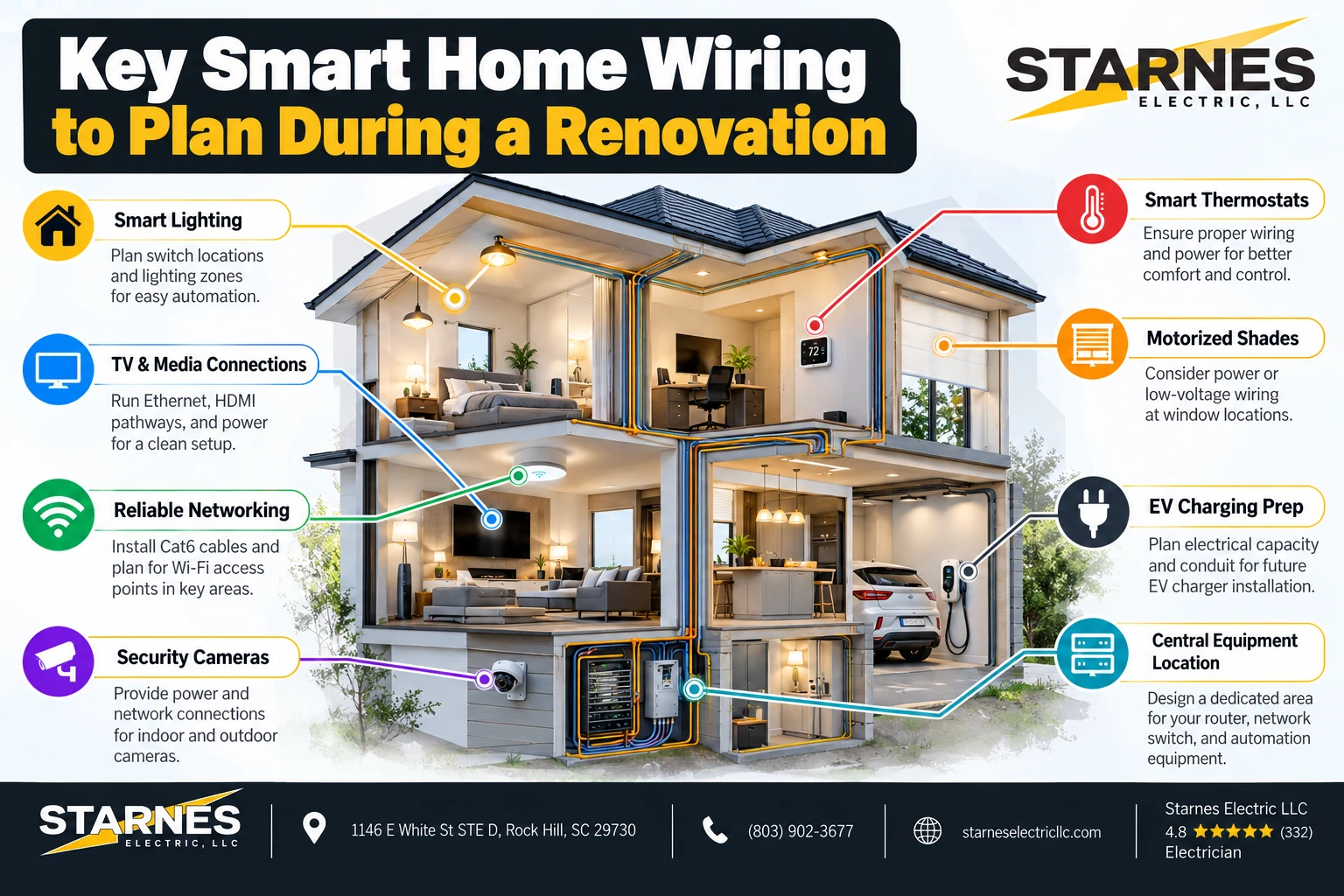
During a remodel, consider discussing provisions for:
Smart lighting
Lighting is one of the most useful places to add automation.
Smart switches and dimmers can provide schedules, scenes, occupancy control, remote operation, and integration with other systems.
But good smart lighting begins with sensible electrical design.
Plan switch locations carefully. Consider how multiple entrances to a room will operate the lights. Think about whether decorative, task, accent, and general lighting should be controlled separately.
Do not let smart technology become an excuse for awkward everyday controls.
Motorized shades
If motorized shades are even a possibility, renovation is a great time to consider power or low-voltage wiring at window locations.
Battery-powered shades are convenient, but permanently powered options can eliminate periodic battery replacement, particularly on large or difficult-to-reach windows.
Security cameras
Outdoor cameras need thoughtful locations with clear views and reliable power or network connections.
Wired camera systems can provide strong reliability and avoid depending entirely on batteries or distant Wi-Fi signals.
Camera planning should also consider where recording equipment or networking hardware will be located.
Video doorbells and entry controls
Modern doorbells can require more than the old two-wire setup provides, depending on the system being installed.
Renovation gives you the chance to plan the entrance properly rather than discovering compatibility issues after the new front door and trim are finished.
Home offices
Home offices deserve more electrical and networking attention than they used to.
Consider multiple receptacles, Ethernet connections, dedicated locations for monitors and equipment, USB charging if desired, and adequate lighting.
One lonely outlet behind the desk is rarely enough once you add a computer, monitors, printer, speakers, phone charger, lamp, and the mysterious power brick nobody remembers purchasing.
Entertainment spaces
Wall-mounted televisions look wonderful when the wires disappear.
Plan power, Ethernet, HDMI pathways, speaker wiring, and equipment locations before the wall is finished.
A television mounted beautifully above a fireplace with three cords dangling toward an extension strip is technically entertainment, just perhaps not in the intended way.
What Are Some Ideas For Smart Home Projects During A Remodel?
Once the infrastructure is planned correctly, this is where smart-home design becomes more enjoyable.
A remodel creates opportunities to automate systems in ways that feel genuinely useful rather than gimmicky.
Here are several projects worth considering.
Whole-home smart lighting
Instead of installing a handful of smart bulbs, consider an integrated switching strategy.
You could create scenes such as:
- Good Morning: Gradually turns on selected lights.
- Away: Switches off unnecessary lighting when everyone leaves.
- Movie Night: Dims living-room lighting to preset levels.
- Good Night: Turns off common-area lights from one control.
- Vacation: Automates selected lighting to make the home appear occupied.
That is the sort of technology I like because you benefit from it without thinking about it constantly.
Smart exterior lighting
Landscape and security lighting can operate automatically according to schedules, sensors, or other controls.
You can also divide exterior lighting into zones so the entire property does not need to light up like a football stadium every time someone walks past the driveway.
Smart HVAC controls
Smart thermostats and zoning controls can help homeowners manage comfort more precisely.
During a larger renovation, this may also be the time to think about room usage, temperature sensors, HVAC zoning, and whether future automation should coordinate heating and cooling with occupancy.
Leak detection and automatic water shutoff
This is one of the least glamorous smart-home projects and possibly one of the most useful.
Water sensors can monitor areas around water heaters, washing machines, sinks, dishwashers, or other potential leak locations. Some systems can work with automatic shutoff equipment.
Nobody brags to neighbors about their leak sensor.
They may, however, become extremely enthusiastic about it the day a washing-machine hose fails.
Smart garage and driveway systems
Garage doors, exterior lighting, cameras, vehicle charging, and access controls can all be planned together during a renovation.
If an EV charger may be added later, discussing electrical capacity and conduit during renovation can make the eventual installation considerably easier.
Automated shades and lighting together
Motorized shades can work with lighting controls to manage glare, privacy, and natural light.
In rooms with large windows, home theaters, or west-facing glass, this can be much more practical than it initially sounds.
Centralized control
Some homeowners prefer individual apps for each system. Others want major systems integrated into one interface.
Either approach can work.
The mistake is buying 14 unrelated devices first and deciding how they should communicate afterward.
Start with the functions you actually care about. Then choose equipment and infrastructure that can support those goals.
A smart home should solve small everyday annoyances. It should not become an additional hobby unless you want it to be one.
Hardwired Smoke Detectors vs Battery Smoke Alarms: What Homeowners Should Know
Hardwired smoke detectors are the stronger choice for long-term home [...]
Learn More
Build the Smart Home Behind the Walls With Starnes Electric LLC
The best smart-home upgrade may be the one nobody sees when your renovation is finished.
Extra wiring, well-placed electrical boxes, Ethernet runs, spare conduit, thoughtfully located power, and a properly planned electrical system are not particularly impressive in photographs. But they make nearly every future smart-home project easier.
At Starnes Electric LLC, we believe renovation planning should look beyond the devices homeowners want this year. A good electrical plan should also consider how the home may change, what technology may be added, and where additional power or connectivity could eventually be needed.
If you are remodeling a kitchen, finishing a basement, opening walls, building a home office, upgrading lighting, or renovating a large portion of your home, it is worth discussing smart-home infrastructure before the drywall goes back up.
Adding one more cable or conduit pathway during construction can be simple. Trying to create the same pathway after the cabinets, tile, paint, flooring, and furniture are in place is usually a very different experience.
Starnes Electric LLC can help you plan electrical upgrades with both today’s needs and tomorrow’s technology in mind.
Because the smartest part of a smart home is not the voice assistant sitting on the counter.
It is the planning that happened before anyone could see it.
Renovating? Plan the Wiring Now
Avoid costly electrical changes later. Call Starnes Electric LLC for professional smart home wiring during your renovation.
About the Author: Dalton Starnes