
What Is the Difference Between a Standard Electrical Box and a Fan-Rated Box?
Table of Contents
A standard electrical box and a fan-rated box may look similar from below the ceiling, but they are designed for different purposes. A standard ceiling box is generally intended to support a stationary light fixture. A fan-rated box is specifically designed to handle the weight, movement, and vibration produced by a ceiling fan.
That distinction matters because a ceiling fan does more than hang in place. Its rotating blades create ongoing movement that can loosen an unsuitable box or mounting system over time. Even when a standard box initially feels secure, it may not provide the long-term support a fan requires.
Using the wrong box can lead to wobbling, damaged wiring, cracked drywall, or, in severe cases, the fan pulling away from the ceiling. Before installing a ceiling fan, the existing electrical box should be inspected to confirm that it is listed and securely installed for fan support.
Is your ceiling box safe for a fan?
Don't risk a loose or falling ceiling fan. Call Starnes Electric LLC for a professional electrical box inspection and upgrade.
What Is a Standard Electrical Box?
A standard electrical box is an enclosure that contains wire connections and provides a mounting point for electrical devices or fixtures.
Depending on its location and design, a standard box may be used for:
-
Ceiling lights
-
Wall sconces
-
Outlets
-
Light switches
-
Smoke detectors
-
Junction points
-
Lightweight decorative fixtures
The box protects electrical connections from physical damage and helps contain sparks or heat if a connection fails. It also keeps wires organized and provides a secure mounting surface for device or fixture hardware.
Standard electrical boxes are available in several materials, shapes, and sizes, including metal and plastic models. Some attach directly to framing, while others are made for installation in finished walls or ceilings.
The important point is that not every ceiling box is designed to support moving equipment. A box may be suitable for a lightweight light fixture but unsafe for a ceiling fan.
What Is a Fan-Rated Electrical Box?
A fan-rated electrical box is specifically designed and tested to support a ceiling fan.
These boxes are built to withstand both the fan’s weight and the repeated movement produced while the blades rotate. They are typically made from durable metal or reinforced materials and installed with stronger mounting hardware than a typical light-fixture box.
A fan-rated box may be:
-
Attached directly to a ceiling joist
-
Mounted to structural blocking
-
Connected to an adjustable brace between joists
-
Designed as a retrofit box for an existing ceiling
The box should be clearly marked or listed for ceiling-fan support. This information may appear inside the box, on its packaging, or in the manufacturer’s installation instructions.
The rating applies only when the box is installed correctly. Even a fan-rated box can be unsafe if it is attached with improper screws, loose hardware, or inadequate structural support.
Why Does a Ceiling Fan Need a Special Box?
A ceiling fan creates forces that a stationary light fixture does not.
As the fan operates, its motor and blades generate movement. Even a properly balanced fan produces some vibration. If the blades become dusty, loose, bent, or unbalanced, that movement can increase.
A fan-rated box is designed to resist:
-
Continuous vibration
-
Rotational movement
-
Downward weight
-
Side-to-side stress
-
Startup and stopping forces
-
Minor fan imbalance
The support system must hold the fan securely during operation, not only while it is turned off.
A standard box may seem strong enough when the fan is first installed. The greater concern is how the mounting system will perform after months or years of regular use.
How Can You Tell Whether an Electrical Box Is Fan-Rated?
The most reliable way to identify a fan-rated box is to look for a marking inside it.
The box may include wording that indicates it is suitable for ceiling-fan support. Some models also display a listed weight capacity or refer to the type of fixture they are designed to hold.
However, the marking may be difficult to see if it is covered by wiring, paint, insulation, or mounting hardware.
Other possible signs include:
-
Heavy-duty construction
-
Large mounting screws
-
A visible support brace
-
Direct attachment to a ceiling joist
-
Reinforced threaded holes
-
Specialized fan-mounting hardware
These features may suggest that the box is fan-rated, but they do not confirm it.
A metal box is not automatically suitable for a ceiling fan. Many standard metal boxes are intended only for lighting fixtures. Likewise, a box that feels solid may still be installed incorrectly or attached primarily to drywall.
When the rating is unclear, an electrician can remove the existing fixture and inspect the box, mounting method, and surrounding framing.
Can You Install a Ceiling Fan on a Standard Electrical Box?
A ceiling fan should not be installed on a standard electrical box unless that box is specifically listed for fan support.
Even if the box previously held a heavy light fixture, it may not be designed to withstand the movement produced by a fan.
Installing a ceiling fan on an unsuitable box can cause:
-
Fan wobbling
-
Loose mounting screws
-
Cracked ceiling drywall
-
Strained electrical wires
-
Buzzing or rattling
-
Damage to the mounting bracket
-
Separation of the fan from the ceiling
The fan may operate normally at first, making the installation appear successful. Problems often develop gradually as repeated vibration loosens the support system.
If the existing box is not fan-rated, it should generally be replaced before the fan is installed.
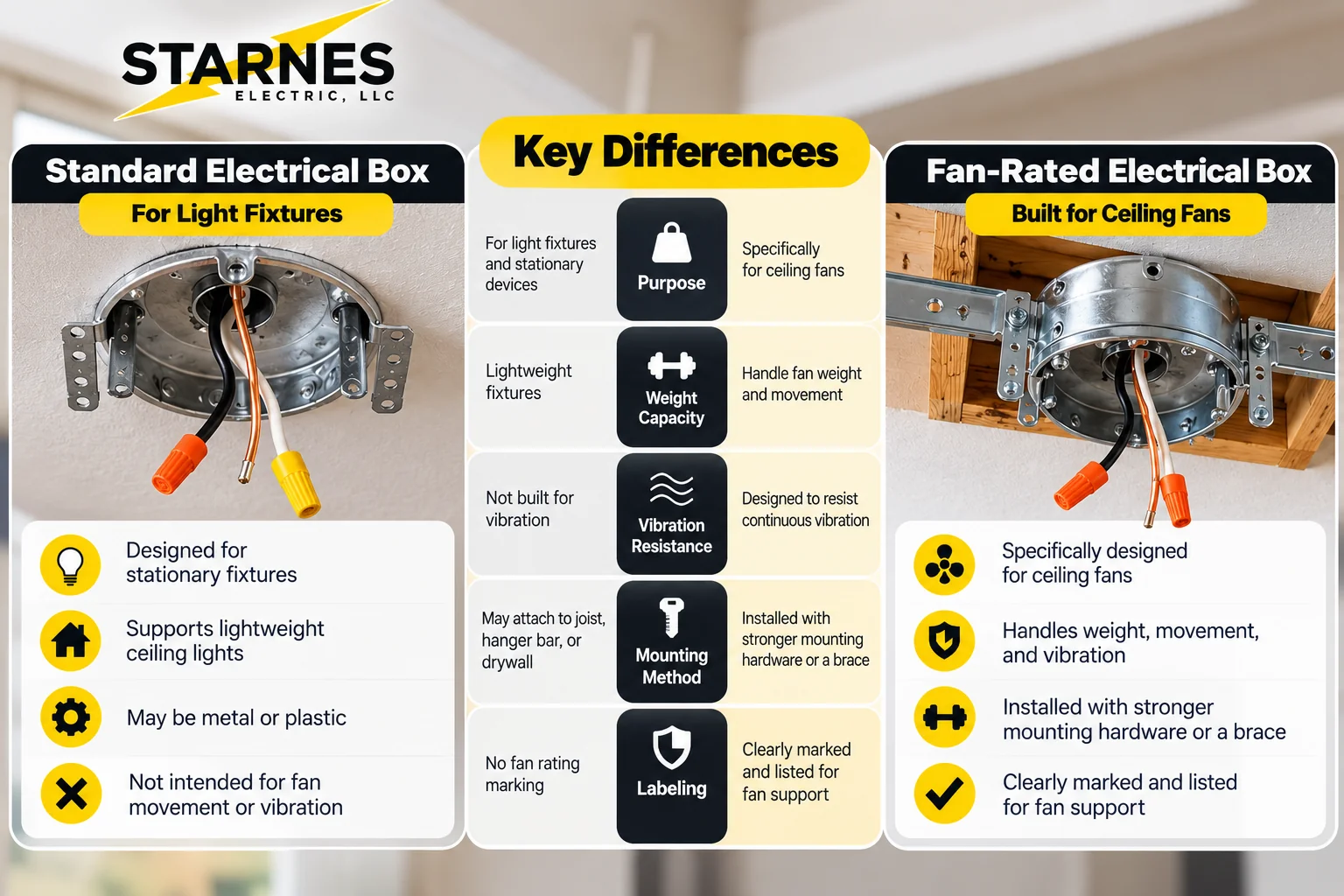
How Are Standard and Fan-Rated Boxes Mounted Differently?
The mounting method is one of the most important differences between a standard box and a fan-rated box.
Standard Box Mounting
A standard ceiling box may be:
-
Nailed to the side of a joist
-
Screwed to framing
-
Attached to a lightweight hanger bar
-
Clamped to drywall in a finished ceiling
-
Supported by a bracket intended for light fixtures
These methods may be appropriate for stationary fixtures, depending on the box, fixture weight, and installation.
However, a drywall-mounted box or lightweight support bar is generally not suitable for a ceiling fan unless the complete assembly is specifically listed for that purpose.
Fan-Rated Box Mounting
A fan-rated box is usually attached to structural framing or a heavy-duty brace.
Its support system may include:
-
Strong screws driven into a ceiling joist
-
A metal brace spanning two joists
-
Structural wood blocking
-
A retrofit expansion brace
-
A manufacturer-approved fan-support assembly
The goal is to transfer the fan’s weight and movement into the building structure rather than the drywall.
Drywall may conceal the box, but it should not serve as the fan’s primary support.
Lighting Installation in Modern Homes: How Design Meets Functionality
In modern homes, lighting does more than just brighten a [...]
Learn More
Are Fan-Rated Boxes Stronger Than Standard Boxes?
In general, yes. Fan-rated boxes are built with stronger mounting points and support hardware.
The box may include thicker material, reinforced screw holes, or fittings that attach securely to a brace. The mounting screws used with a fan are also typically more substantial than those used for a lightweight ceiling light.
However, strength depends on more than the box itself. The entire support system matters.
A fan-rated box can still fail if:
-
It is installed with the wrong screws
-
The brace is not properly tightened
-
The ceiling joist or framing is damaged
-
The fan exceeds the listed capacity
-
The mounting bracket is installed incorrectly
-
The box is loose in the ceiling
The box, brace, screws, framing, and fan bracket should be treated as one complete support system.
Can a Fan-Rated Box Be Used for a Light Fixture?
Yes. A fan-rated box can usually support a standard light fixture, provided the fixture is compatible with the box and mounting hardware.
Installing a fan-rated box may be a practical choice when a ceiling fan could be added later. For example, a homeowner may initially install a simple bedroom light but want the option of replacing it with a fan in the future.
A fan-rated box may also work for some heavier light fixtures. However, unusually heavy chandeliers may require a separate support system.
Always confirm that the fixture bracket fits correctly and that the box and support assembly are suitable for the fixture’s weight.
Can a Standard Box Support a Heavy Chandelier?
Possibly, but not automatically.
A standard box may support certain light fixtures, but a heavy chandelier often requires reinforced structural support. The chandelier’s weight must be within the box’s listed capacity, and the box must be securely attached to framing.
A fan and a chandelier also place different types of stress on the mounting system. A fan creates vibration and rotational movement, while a chandelier primarily creates a stationary downward load.
A heavy chandelier may require:
-
Structural blocking
-
A heavy-duty fixture box
-
A threaded support rod
-
A custom mounting plate
-
Additional framing
-
Manufacturer-specific hardware
Do not assume that every fan-rated box is appropriate for every chandelier. Review the fixture’s weight and installation instructions before choosing a support system.
What Does a Fan Support Brace Do?
A fan support brace spans the space between two ceiling joists and provides a secure mounting point for the electrical box.
This is especially useful when the desired fan location does not align directly with a joist.
Some braces are installed before the ceiling drywall is added. Others are designed for retrofit installation through an existing electrical-box opening.
A retrofit brace can often be inserted into the ceiling cavity and expanded until both ends grip the joists. The fan-rated box is then attached near the center of the brace.
This method may reduce the amount of ceiling damage required during installation. However, the brace must be positioned and tightened correctly. A loose brace can allow the fan to move, wobble, or make noise.
Can You Upgrade a Standard Box Without Opening the Entire Ceiling?
Often, yes.
An electrician may be able to replace a standard ceiling box with a fan-rated retrofit box and brace through the existing fixture opening.
The process may include:
-
Turning off the circuit
-
Removing the existing fixture
-
Disconnecting the wiring
-
Removing the old electrical box
-
Installing a fan-support brace
-
Attaching the fan-rated box
-
Reconnecting the wiring
-
Installing the fan bracket
-
Mounting and testing the fan
The exact method depends on ceiling access, joist spacing, insulation, ductwork, plumbing, and the size and condition of the existing opening.
Some installations are easier to complete from an attic. Others can be performed entirely from below. Minor drywall repair may be needed if the old opening is oversized, damaged, or poorly positioned.
Can You Use a Plastic Electrical Box for a Ceiling Fan?
Some plastic or composite boxes are specifically manufactured and listed for ceiling-fan support. However, an ordinary plastic ceiling box should not be assumed to be fan-rated.
The material alone does not determine whether the box is suitable. The manufacturer’s listing, weight capacity, mounting system, and installation instructions are what matter.
A fan-rated composite box may include:
-
Reinforced mounting points
-
Heavy-duty screws
-
Built-in structural support
-
A brace or joist-attachment system
-
Clear fan-support labeling
A basic plastic box intended for a light fixture may flex, crack, or pull away under repeated fan movement.
Do not rely on appearance alone. Check the box markings and manufacturer’s instructions.
Does the Size of the Ceiling Fan Affect the Box Requirement?
Yes. Larger or heavier fans may require stronger support.
The fan’s total installed weight can include the motor, blades, light kit, downrod, canopy, and accessories.
A long downrod can also increase movement because the fan hangs farther from the ceiling, placing additional leverage on the mounting system.
Installation requirements may differ for:
-
Small bedroom fans
-
Large living-room fans
-
Outdoor fans
-
High-velocity fans
-
Fans with long downrods
-
Commercial-style fans
-
Fans with heavy light kits
The fan manufacturer’s instructions should identify the required box and mounting method. Unusually large or heavy fans may need additional structural reinforcement.
What Happens If a Fan Is Installed on an Underrated Box?
An underrated or improperly installed box may begin to loosen while the fan operates.
At first, the problem may appear as slight wobbling or an occasional clicking sound. The movement may become more noticeable over time.
Warning signs can include:
-
The canopy pulling away from the ceiling
-
A box that moves when the fan is touched
-
Cracks forming around the ceiling opening
-
Repeated rattling or clicking
-
Loose mounting screws
-
Wires rubbing against metal edges
-
The fan tilting to one side
-
Increasing vibration
These signs should not be ignored.
Turn off the fan and have the support system inspected. Continuing to operate a fan mounted to a loose or unsuitable box can damage the wiring and increase the risk of the fan separating from the ceiling.
Is Fan Wobble Always Caused by the Electrical Box?
No. A ceiling fan can wobble for several reasons.
Common causes include:
-
Uneven or unbalanced blades
-
Loose blade screws
-
A bent blade arm
-
Incorrect blade installation
-
A loose downrod
-
An unbalanced light kit
-
A problem with a sloped-ceiling adapter
-
A loose mounting bracket
-
An unsuitable or loose electrical box
A fan-rated box does not guarantee that a fan will never wobble. It provides the structural support needed for normal operation.
When a fan wobbles, both the fan components and the ceiling support should be inspected. Persistent movement can eventually loosen even a properly installed system.
Do Outdoor Ceiling Fans Need Fan-Rated Boxes?
Yes. Outdoor ceiling fans also require electrical boxes listed for fan support.
The fan, box, wiring method, and related components must also be suitable for the installation location. A covered porch may be classified differently from an area directly exposed to rain or other weather.
Depending on the location and applicable electrical requirements, an outdoor installation may need:
-
Weather-resistant electrical components
-
Corrosion-resistant hardware
-
Proper sealing
-
A damp- or wet-location-rated fan
-
Outdoor-appropriate wiring methods
-
Additional circuit protection where required
Humidity, moisture, and temperature changes can affect both the fan and its mounting hardware.
Indoor-rated equipment should not be installed in an exposed outdoor location. An electrician can help determine which products and installation methods are appropriate for the space.
Can You Install a Fan-Rated Box Yourself?
A homeowner with appropriate electrical and carpentry experience may be able to install a fan-rated box, but the project can be more involved than it first appears.
The installer must confirm that:
-
The circuit is safely de-energized
-
The wiring is in good condition
-
The brace is correctly positioned
-
The box is listed for fan support
-
The box is securely fastened
-
The fan is within the support system’s listed capacity
-
The correct mounting screws are used
-
The equipment is properly grounded
-
The fan is assembled and installed correctly
Working overhead adds difficulty. Attic heat, insulation, limited access, and hidden ductwork or plumbing can complicate the project.
If the existing wiring is damaged, the box needs to be relocated, or the framing cannot be clearly identified, hiring a qualified electrician is generally the safer option.
How Much Does It Cost to Replace a Standard Box With a Fan-Rated Box?
The cost depends on the ceiling type, access, wiring condition, fan height, and overall installation complexity.
A straightforward replacement may cost less when the electrician has attic access or can install a retrofit brace through the existing opening.
The price may increase when:
-
The ceiling is vaulted
-
The fixture is located over a stairwell
-
The wiring needs repair
-
The opening requires drywall work
-
Structural framing must be added
-
The fan is unusually large or heavy
-
Scaffolding or a lift is required
-
The existing box is difficult to remove
The fan installation itself may be priced separately from the box upgrade.
Providing photos of the existing fixture, ceiling height, attic access, and new fan may help the electrician assess the project and prepare a more accurate estimate.
What Should You Ask Before Installing a Ceiling Fan?
Before installation, ask the electrician or installer:
-
Is the existing electrical box listed for fan support?
-
How is the box attached to the ceiling structure?
-
Is there a brace between the joists?
-
Can the support system hold the new fan’s weight?
-
Does the fan require a special mounting system?
-
Is the wiring properly grounded?
-
Will the existing wall switch control the fan correctly?
-
Is a separate speed control needed?
-
Will drywall repair be necessary?
-
Is the fan suitable for the room or outdoor location?
These questions can help prevent surprises after the old fixture is removed.
Keep the fan’s instruction manual, mounting bracket, and included hardware together before the installation appointment.
Give Your Ceiling Fan a Stronger Foundation
The main difference between a standard electrical box and a fan-rated box is the type of load each is designed to support. A standard box may safely hold a stationary light fixture, while a fan-rated box is built to handle the added weight, vibration, and movement of a ceiling fan.
At Starnes Electric, we inspect existing ceiling boxes, determine whether they are listed for fan support, and replace unsuitable or undersized boxes when necessary. Our team can install an appropriate fan brace, inspect the wiring, mount the fan securely, and test the completed installation.
Whether you are replacing a ceiling light with a fan, addressing a wobbling fixture, or preparing a room for a new installation, Starnes Electric can help ensure the support above the ceiling is as dependable as the fan below it.
Contact Starnes Electric to schedule professional ceiling-fan installation and confirm that your new fan is attached to a box designed for the job.
Need a fan-rated electrical box?
Get your ceiling fan installed safely with the right support. Call Starnes Electric LLC for expert installation today.
About the Author: Dalton Starnes